


Second piece on Madison Air Solutions (MAIR)… first is here. This one is about Larry Gies, founder and Chairman. He still effectively controls the company and created the the operating model. A third piece covers the products, the pricing and the ebm-papst acquisition.
TLDR… storied history of building businesses over decades with key mentors who helped shape his now empire that expands well beyond MAIR to his own private equity firm. Now a buy-and-hold style investor, it’s no wonder he agreed to inject hundreds of millions to help close MAIR’s recent transformative transaction of ebm-papst. His quiet $9bn stake in MAIR has gone largely undiscovered, it seems, though it stacks up against some of the greatest tech founders of our time…
Ownership
As of 30 June 2026, Larry Gies controlled ~337MM shares of MAIR. They sit across three vehicles. Madison Industries Holdings LLC, Madison Air Co-Investors LLC, and a private placement made at the IPO price. That’s 67% of the economic interest and 95% of the voting rights, worth ~$9BN. For scale, Marc Benioff’s stake in CRM runs ~$6.5BN, Tobi Lutke’s in SHOP $12BN, Brian Chesky’s in ABNB $12BN.
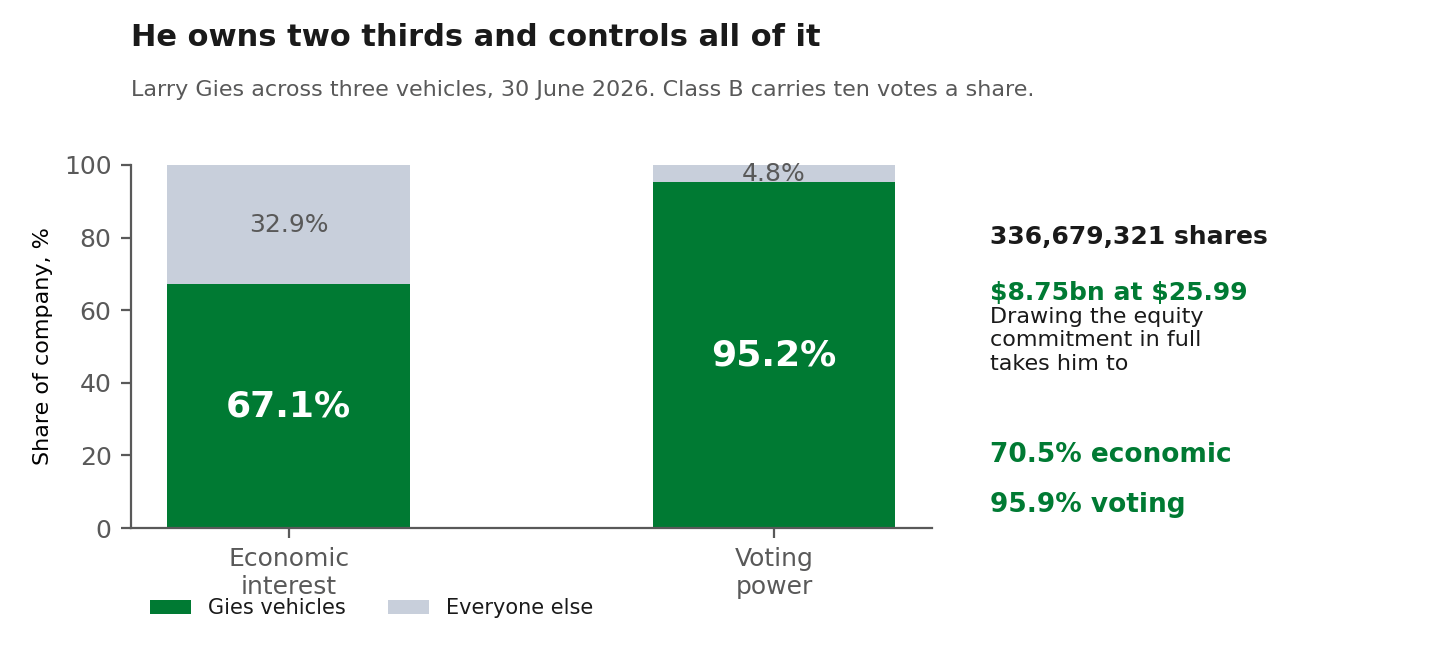
The gap between the two percentages is built on 10 votes per Class B share. The Schedule 13G filed August 10th states the chain plainly, “Larry Gies is the sole manager of Holdings. Holdings is the sole manager of Co-Investors.”
Small town Illinois
Gies grew up in Mendota, Illinois. Population ~7K, 90 miles west of Chicago. His father worked at Conco, a local manufacturer.
Conco was owned by Michael Heisley, a Chicago industrialist who founded Heico Companies, a decentralized holding company assembled from broken manufacturers. Heisley later bought the Vancouver Grizzlies and moved them to Memphis. He’s the single most important figure in this story, and he’s almost entirely absent from coverage of MAIR.
Gies’s first job was at Touche Ross. It ended at 24, after he wrote a memo criticizing how the firm handled its largest client. The story is usually told as a firing over a memo sent to a client’s CEO. His own account is narrower. His words are that “my days in my first job were numbered,” and the memo was internal.
He then went to work for Heisley. By his own description he ran one of Heisley’s manufacturing companies “quite poorly.” The instruction he received, and repeats, was “Go do it, kid.”
That apprenticeship is where the operating model comes from. A decentralized holding company that keeps what it buys. He founded what became Madison Industries in 1994, at 27, on 10 maxed-out credit cards and a $50,000 loan from a high school friend. His wife Beth, a former teacher, worked three jobs.
The eulogy, and when it actually happened
The story Gies tells most often is the eulogy exercise, from his University of Illinois commencement address of 11 May 2019.
“So that day I got our entire management team together and asked them to do something a bit unorthodox. I had them write their eulogy. Not their obituary, but their eulogy... My teammates spoke of family, making a positive impact on the world and doing good. But when they spoke specifically about how they wanted to be remembered for their professional lives, nobody mentioned making a lot of money for our investors.”
“That day we formed Madison Industries. Which meant that our highly successful business of buying and selling companies was headed for the trash heap.”
In a 2018 speech he put a date on it. “I was forty-five before I found my why.” That would place the turn around 2011, not 1994.
Madison Industries was founded in 1994 as Madison Capital Partners, a fundless sponsor. And a 2006 profile in The Deal describes a firm advertising a 90% net internal rate of return across 12 exits and five partial realizations.
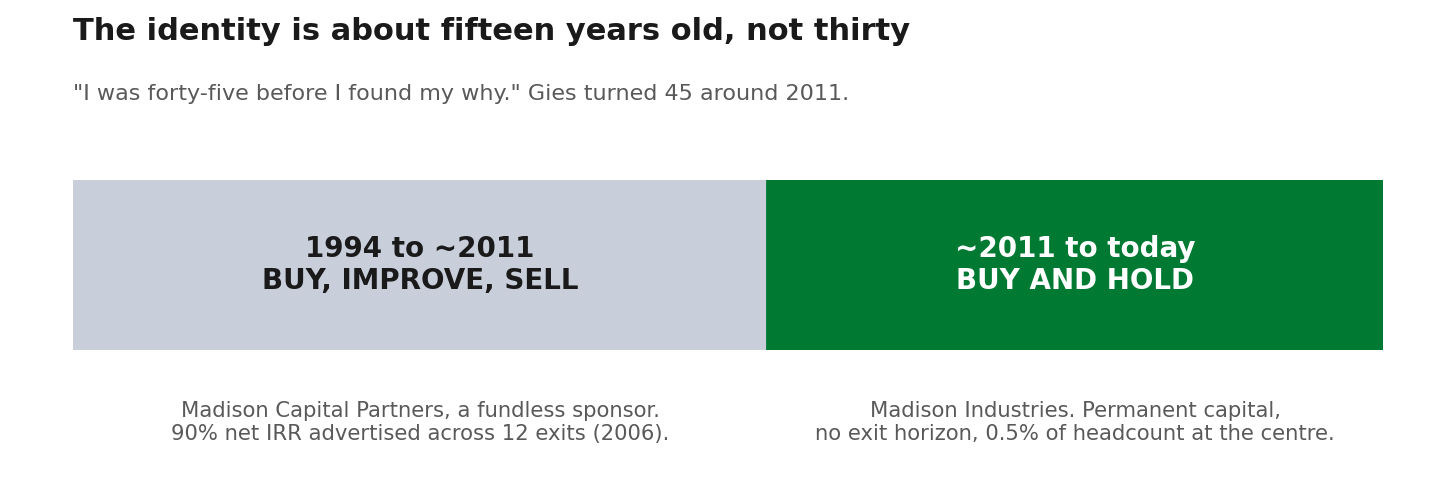
So the hold-forever philosophy dates to 2011, not to the founding. Todd Bluedorn, former Vice Chairman of Madison Industries, described the earlier version in May 2026. “Man, the guy can sniff markets. He buys on the cheap, he sells at the peak, and when he buys, it’s from corporations who are running and he sells them to corporations who have more money than they know what to do with.”
Professionalizing the business
Frank Ptak spent ~30 years at Illinois Tool Works (ITW), rising to Vice Chairman, and Madison’s own materials credit him with helping pioneer ITW’s 80/20 model. He then ran Marmon Holdings for 13 years. More than 100 autonomous businesses and $8BN of revenue, sold to Berkshire Hathaway. He reported to Warren Buffett. He also ran Marmon’s acquisition of Duracell in 2014, then joined Madison Industries as Senior Managing Director in January 2019.
He wasn’t the only one. Gies has assembled an unusually senior bench at the private parent.
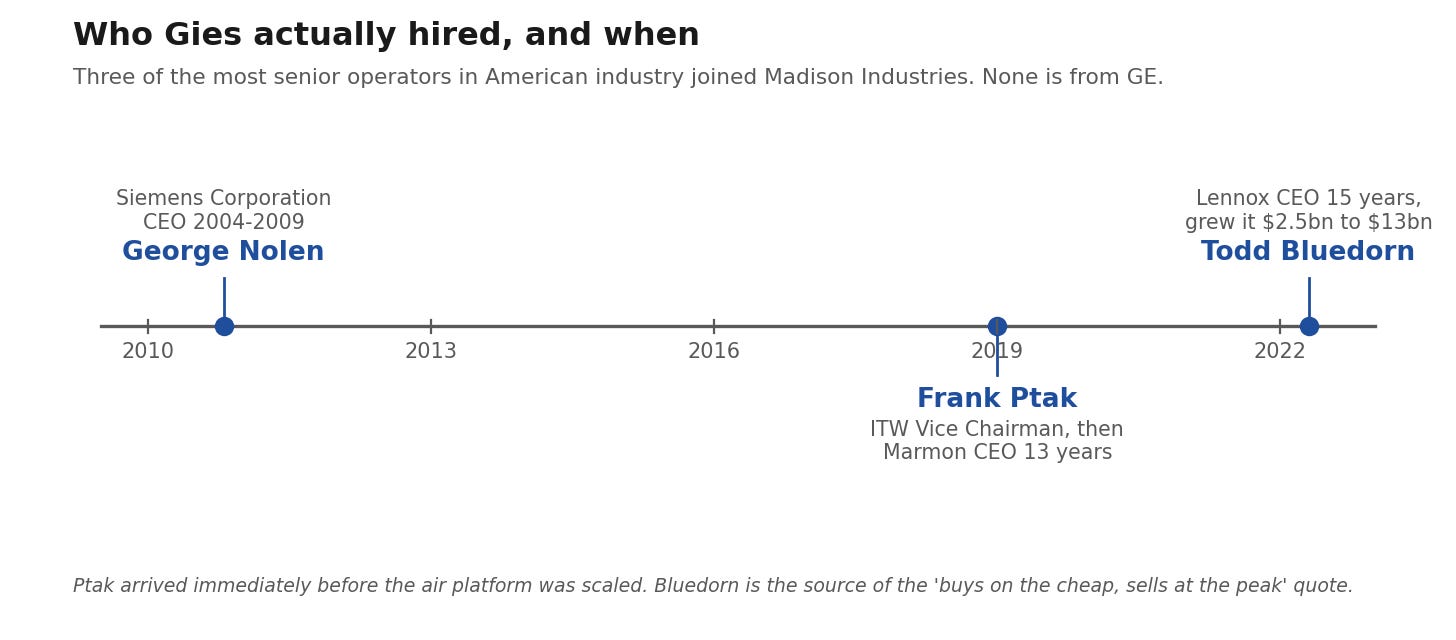
George Nolen arrived first, in October 2010, as Vice Chair. 27 years at Siemens, the last five as President and CEO of Siemens Corporation. He also chairs Filtration Group, another Madison company, and now sits on MAIR’s board.
Todd Bluedorn joined in April 2022, also as Vice Chair. 15 years at Lennox International, CEO from 2007 and Chairman from 2012, over which market capitalization went from $2.5BN to more than $13BN. Before Lennox he was President of Otis Elevator Americas and President of Carrier North American HVAC at United Technologies, and McKinsey before that, from 1992. West Point, and a US Army Combat Engineer Officer from 1985 to 1990. He’s the man quoted above.
Gies on hiring him. “Todd attracts world-class talent, builds high-performing teams and brings a successful track record of building best in class global businesses.” Bluedorn on why he came, and note what he names first. “The exceptional Madison team and its mission of making the world safer, healthier and more productive attracted me to this opportunity.”
There’s a recruiting channel visible in the dates but stated nowhere. Quan Nguyen, now MAIR’s Group President for Air Quality & Home, was VP and GM of Lennox Industries Residential from 2017 to 2024, under Bluedorn for most of it.
The lineage we can now see… Heisley supplies the shape in the early 1990s. Gies runs it for 15 years as a buy-and-sell operation. The identity changes around 2011 to holding. Ptak arrives in 2019 to professionalize the machine, immediately before the air platform is scaled through the $3.6BN Nortek acquisition.
The acquisition record
Madison Industries has done 80+ acquisitions since 2004, across 20-plus countries. MAIR specifically claims ~$8BN invested and ~$28BN of TAM unlocked since 2021. The air platform itself was assembled in nine years.
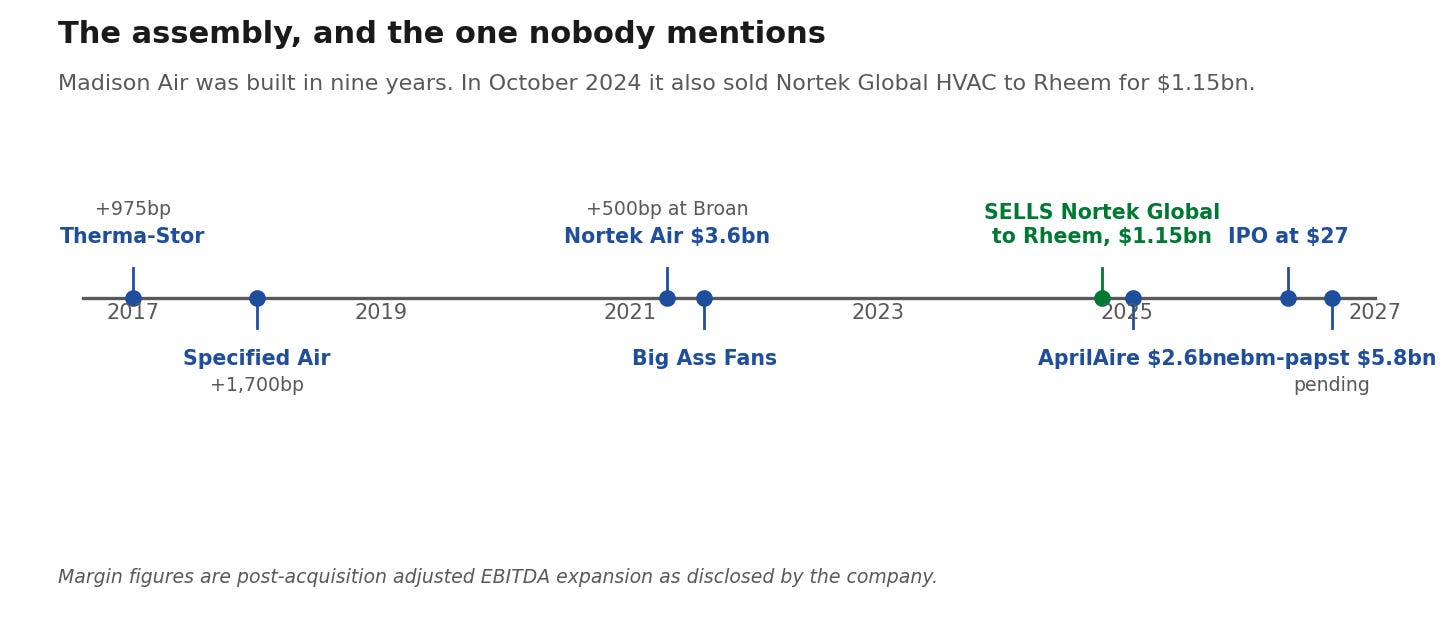
Madison publishes margin expansion figures for three deals. That’s the closest thing to a track record on the operating model. +975bps at Therma-Stor in Nov 2017. +1,700bps at Specified Air Solutions in Oct 2018. And +500bps at Broan-NuTone after the Nortek acquisition in Apr 2021. The company states the majority of those gains landed inside the first three years, and more than half above the gross margin line.
The anchor deal was Nortek Air, announced 19 April 2021 and bought from Melrose Industries plc at a reported $3.6BN. It brought ~6,000 employees and the Broan, NuTone, Reznor, StatePoint, Zephyr and Huntair brands. Gies at the time. “The global pandemic has put a spotlight on the importance of indoor air quality.”
Two things about how they buy are worth more attention than they get… they don’t call it integration. Wyant, on the 1Q26 call. “we don’t really call them integrations. We call them transitions... we buy businesses to allow them to continue to do what they do.” For a serial acquirer that’s a real statement of intent. It’s also consistent with a 45-person center that couldn’t run integrations even if it wanted to.
And speed is a stated value. Madison Industries publicly claims it has never changed an acquisition price after agreeing it, and that acquisitions close within 30 days, with one counterparty testimonial citing 15 business days. This is very attractive to sellers.
The green line on that timeline matters too. In October 2024, mid-assembly, Madison sold Nortek Global HVAC to Rheem for $1.15BN and said very little publicly about why. A company that holds forever is still a seller when the asset doesn’t fit. That’s defensible. But it isn’t the story on the slide, and it’s the fact that gives Bluedorn’s quote its edge.
The parent you are not buying
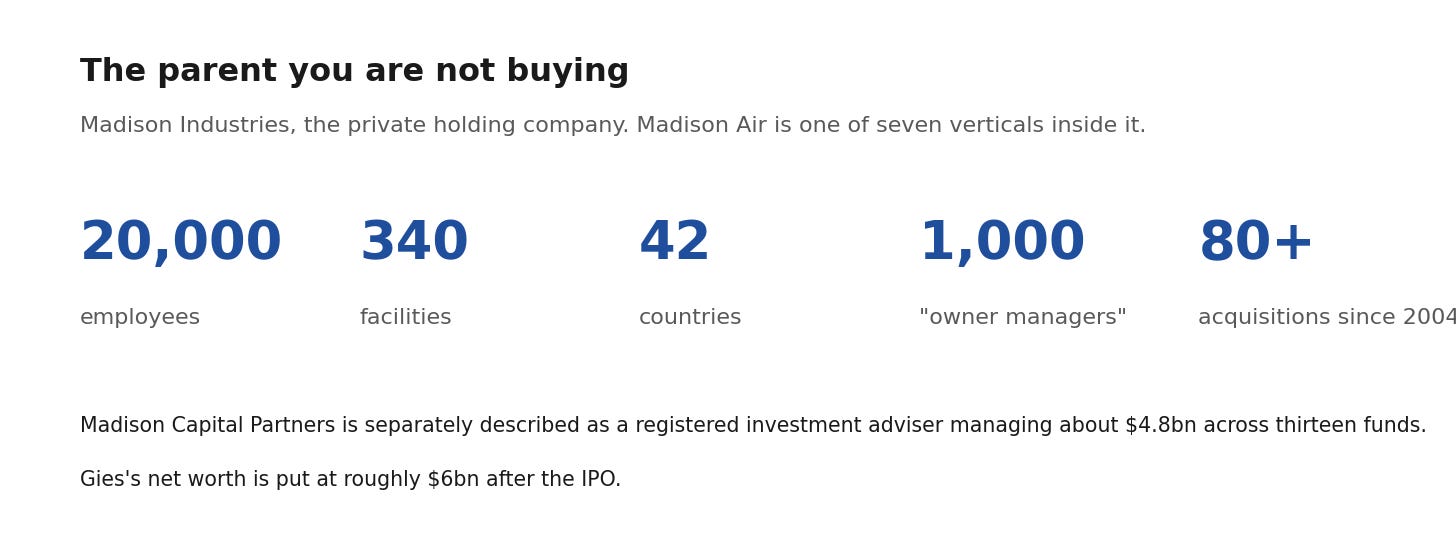
MAIR is one of seven verticals inside Madison Industries. Filtration, medical, safety, energy, industrial solutions, air, and Seakeeper. The parent reported ~$5BN of revenue in 2019 with 10,000 employees and 178 facilities. It has since ~doubled on both counts. Madison Capital Partners, the capital vehicle, is separately described as a registered investment adviser managing ~$4.8BN across 13 funds.
Two things follow for a public-market investor. The governance of the listed company is set by a private organization with considerably more at stake than the listed entity. And a Transition Services Agreement with Madison Industries International keeps supplying services post-IPO. Pre-listing, allocated corporate costs ran $10.0MM and $5.8MM in the periods shown in the 2Q reconciliation.
Decentralization
The prospectus contains the sentence that makes the model concrete.
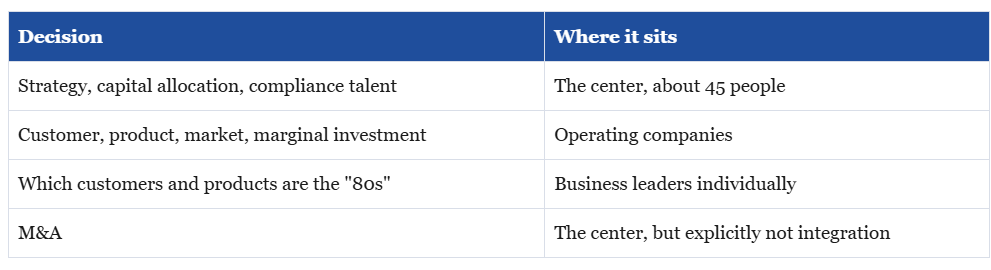
“We remain lean at the center with approximately 0.5% of total headcount.”
Against ~8,800 employees, that’s ~45 people running a $3.9BN revenue company. Forty-five. A typical industrial of this scale carries several hundred at corporate.
The CFO described the mechanism at the William Blair Growth Stock Conference on 4 June 2026, and it’s the clearest account anyone at the company has given.
“I think about the Nortek Air Solutions business, where it was kind of run as one blob when we first bought the business. Now we’ve broken that out into the air handling and the direct expansion in the clean room, clean room breaks out into life sciences, into semicon. Now we’ve got, instead of a centralized commercial team, we have dedicated teams coming to work every single day thinking about how they serve those customers in that end market.”
That’s 80/20 applied to org design rather than to product lines. Gies described the same instinct in the 2006 profile, long before any of the current messaging existed.
“I think that is why we have a hard time keeping people in the office. They all want to be on the plant floor.”
Where the decisions actually sit, from the filings and calls.
One caution on the branding. The decks name the operating system MAXX, Madison Air Execution Excellence. It appears once in the public record once… a strategy-pillar bullet reading “Madison Air Execution Excellence (MAXX) powered by 80/20.” That’s the entirety of the disclosure.
The nearest thing to observable machinery comes from Wyant’s 1Q remarks. More than 60 leaders put through 80/20 and sales training courses in a few weeks. Immersive AI-enablement sessions. And an enterprise-wide innovation summit she hosts at least twice a year.
The published values are short enough to quote in full, and two of them are testable. Trust, “doing what you say and saying what you do.” Bias for Action, “an organizational reflex to own problems and resolve them quickly.” Entrepreneurial, “operating with an owner’s mindset, emphasizing accountability, humility, and continuous improvement.”
Compensation
The compensation design is what makes a 45-person team possible. Executives are paid in long-dated Equity Appreciation Rights with single-cliff vesting. Jill Wyant held 3.7MM shares at IPO, of which 2.6MM were EAR units. She’s now at 3.5MM after two tax-withholding events. JJ Foley holds 1.7MM including 0.6MM EAR units.
The instrument is defined in Wyant’s Form 3 as “the right to receive one share of the Issuer’s Class A common stock upon vesting.” The cliffs are long. The clearest published example is the new chief accounting officer, hired June 2026. Base salary $355,000, target bonus 50%, and ~$700,000 of EAR units vesting in a single cliff on 15 July 2031. Five years, all or nothing.
It’s also broad. At the IPO, 10,339,435 Class A shares went to company executives and employees, and 146,556 EAR units went to former employees and consultants. They carried alumni. At the private parent, Madison Industries describes ~1,000 “owner managers” and maintains a named corporate function called Vice President, Owner Relations.
This is where an accounting item from the first piece stops being a technicality. The $125.9MM equity-appreciation charge Madison adds back to adjusted EBITDA is the price of running a company with 45 people at the center. It’s a real compensation cost. Excluding it is what takes the reported 2025 margin from an honest 23.0% to the 26.6% that anchors the premium-platform framing.
Board of Directors
One structural fact follows directly from all of the above, and we haven’t seen it written anywhere.
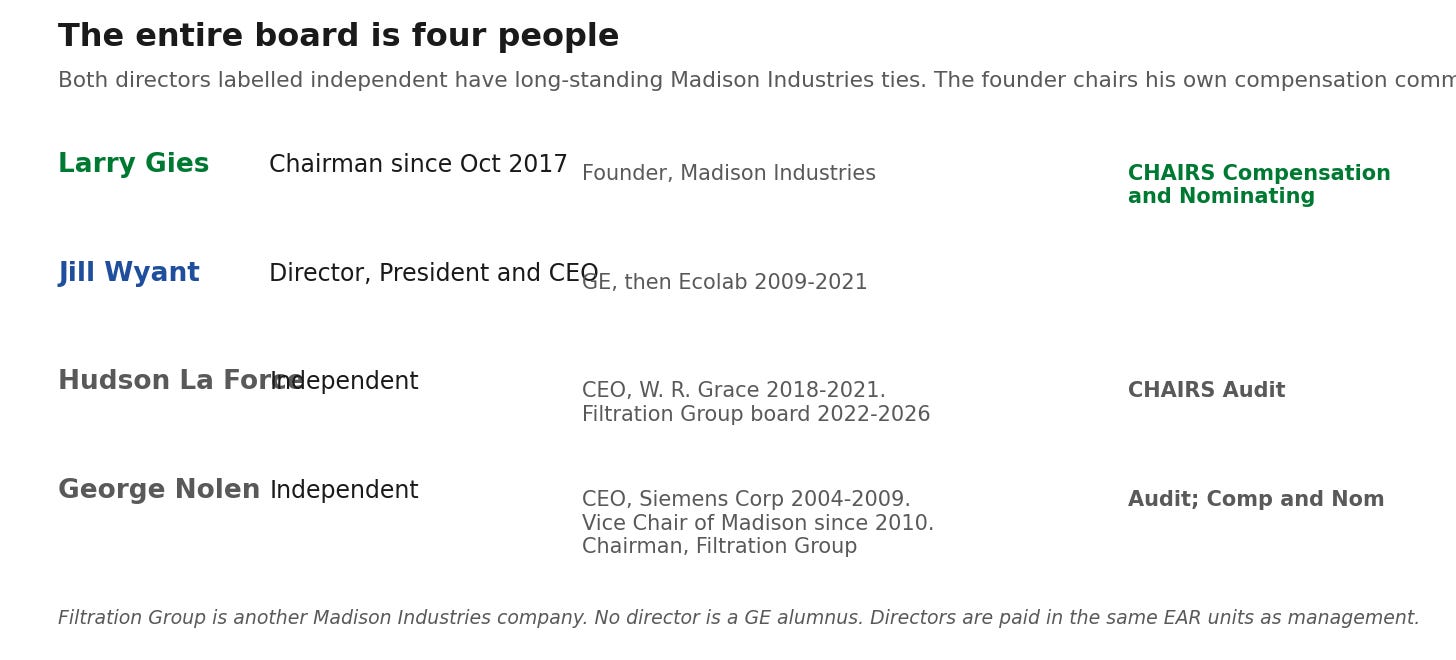
The entire board is four people. Four. Hudson La Force and George Nolen joined on 15 April 2026, the day before the IPO. Gies has chaired since October 2017.
Both directors labeled independent have long-standing Madison relationships. Nolen has been Vice Chair of Madison Industries since October 2010 and chairs Filtration Group, another Madison company. La Force sat on Filtration Group’s board from 2022 to 2026. Independence here is a NYSE definition.
And Gies personally chairs the Compensation and Nominating Committee. The founder holding 95% of the votes also chairs the committee that sets executive pay and nominates directors. La Force chairs Audit, which is the one committee where the rules leave no discretion. Directors are paid in the same instrument as management. Form 4s dated 29 June 2026 show La Force granted 5,711 EAR units and Nolen 5,077.
For a certain kind of investor this is the attraction, not the objection. Owner-operators with real capital at risk and no quarterly-earnings reflex have compounded capital better than committees for a century. Gies has ~$9BN of his own money in the same security, plus $620MM more bought in last week’s placement at the market price. But be clear about what you own. A private holding company that has sold a third of its economics and none of its control.
Ownership figures are from the Schedule 13G filed 10 August 2026 and Form 3 and 4 filings. Quotations are as delivered and dated in the text. The third piece will cover the products, the pricing and the ebm-papst acquisition. Not investment advice.
DISCLOSURE
Position: At the time of publication, the author holds a position in MAIR.
Trading Policy: The author will not materially alter this position within 48 hours of publication. After this period, the author may buy, sell, or otherwise adjust the position without further notice. Changes to the author’s view or position will be reflected in subsequent publications when material.
Conflicts: The author has received no compensation from the issuer or any party with a financial interest in this security.
Forward-Looking Statements: This report contains the author’s opinions, estimates, and projections, including price targets derived from financial models. These are forward-looking statements subject to substantial uncertainty. If these assumptions prove incorrect, the actual value may differ materially, including scenarios of significant loss or total impairment. The price target represents the author’s estimate of fair value under the stated assumptions, not a prediction of where the stock will trade.
This report is provided for informational purposes only and does not constitute investment advice. See the full Terms & Disclosures for additional important information.