


I am a generalist who reads widely and pieces together a mosaic. The test of that method is whether its frameworks hold up when the data arrives.
In February I posted a simple one... Split AI users into tiers. A small group of super users consume most tokens. Ask how much more each tier consumes once it runs agents, and how many adopt and multiply.
It said total token demand would reach 1.9x to 2.9x within 12 months. Every disclosed series I can find passed the top of that range in 3-7 months:
Anthropic run-rate revenue: $14B in February to a reported $65B by end of July. That is 4.6x in 5.5 months.
OpenRouter weekly tokens: about 7 trillion to 56 trillion from January to July. That is 8x in 7 months.
Google tokens, all surfaces: 480 trillion to 3.2 quadrillion a month. That is 6.7x in 12 months.
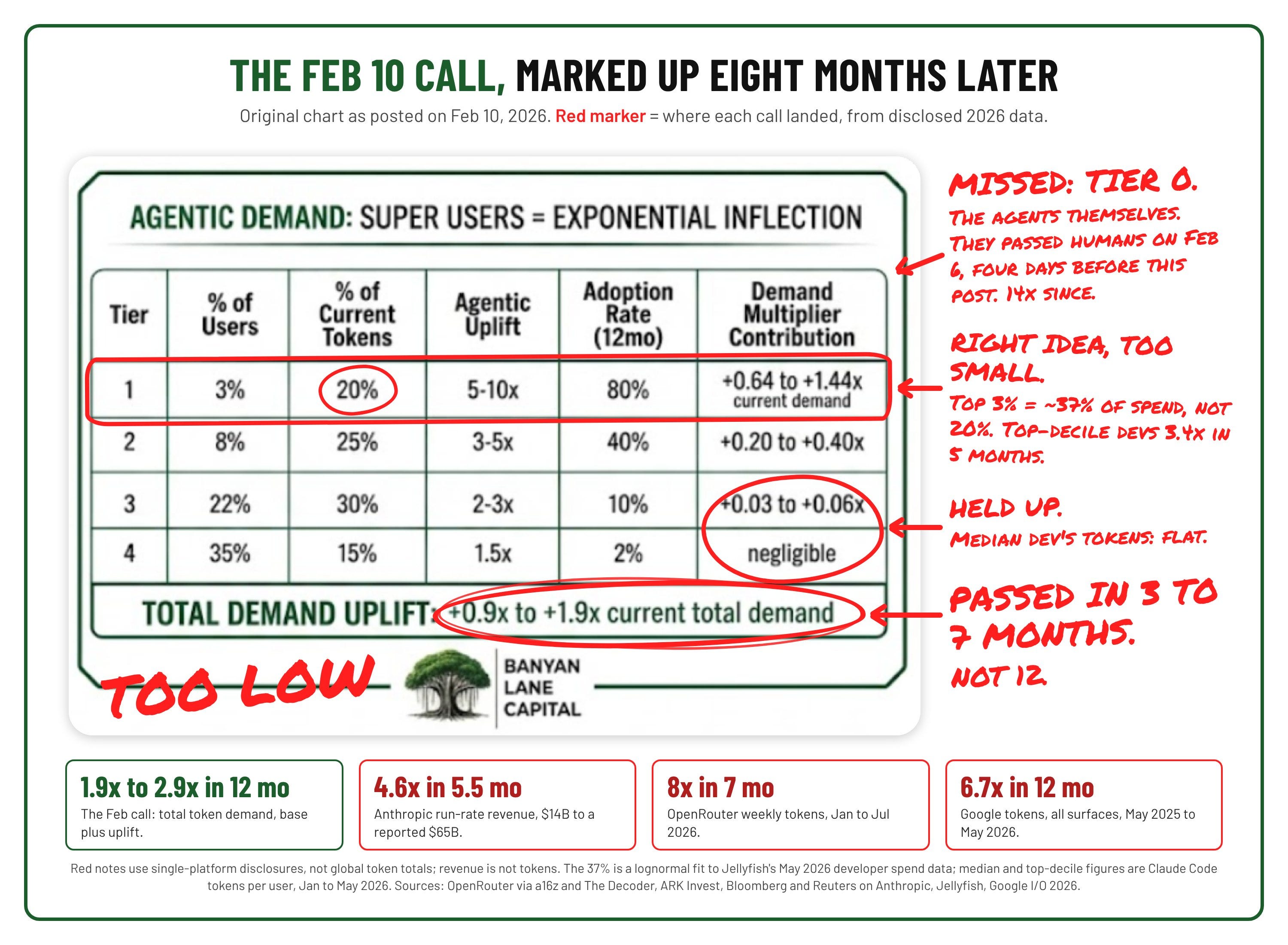
So structure was right and the numbers too low. The super users’ share was bigger than I assumed, and I left out a tier entirely.
Two lessons... framework is worth using again, and when I have been wrong on the inputs, I have been wrong by being too cautious. There are some who are bearish AI because they see it as worthless, while others are concerned about timing of demand/ROI. If you see it as worthless, then you should stop reading here. If you fall in the latter camp, then what you really should care about is the timing of agentic adoption. If you have better inputs or anecdotes etc, please share!
Same framework
The tier I left out was the agent itself. On OpenRouter, agents passed humans in token use on Feb 6, four days before my post. Agent tokens then rose 14x in 6 months and human tokens rose 2.8x.
Every AI demand forecast so far has carried a hidden cap: human attention. A person types, reads, thinks and types again. Jellyfish’s developer data shows 84% of users top out at one or two agents at a time.
Agents remove that cap. Google’s AI infrastructure chief, Amin Vahdat, said this month that with agents the gap between model calls goes from seconds toward milliseconds. Meta’s Muse and OpenAI’s Dots, both launched in September, give each agent its own cloud computer.
So I rebuilt the February table with a Tier 0 on top - the always-on agent.
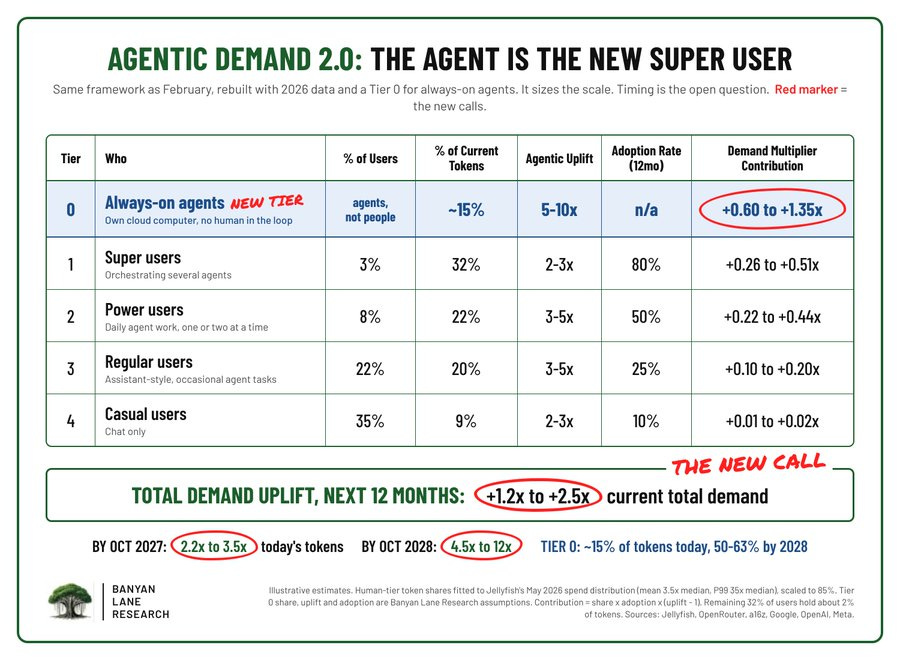
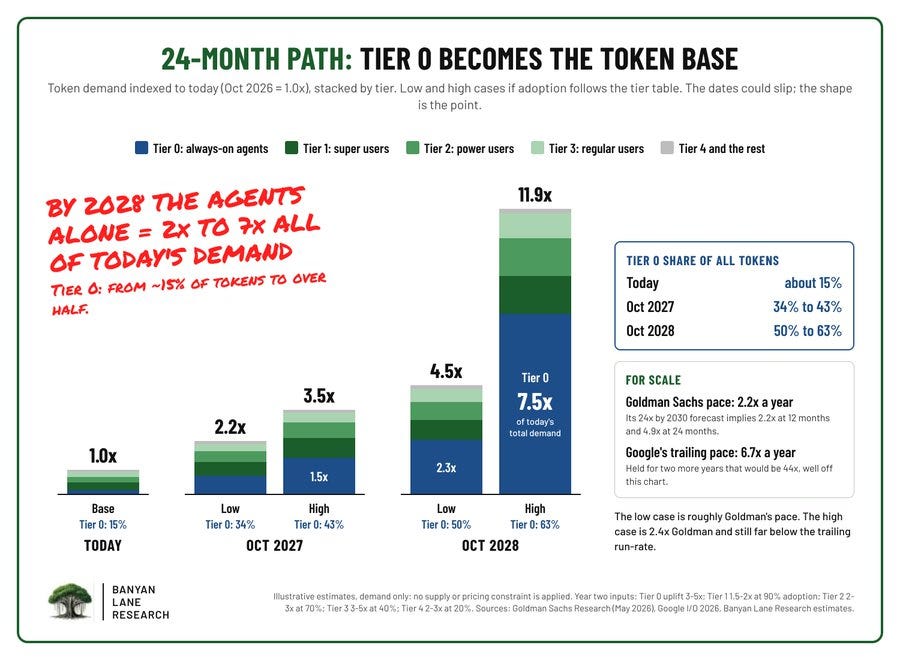
Here is what the framework says if adoption follows the table:
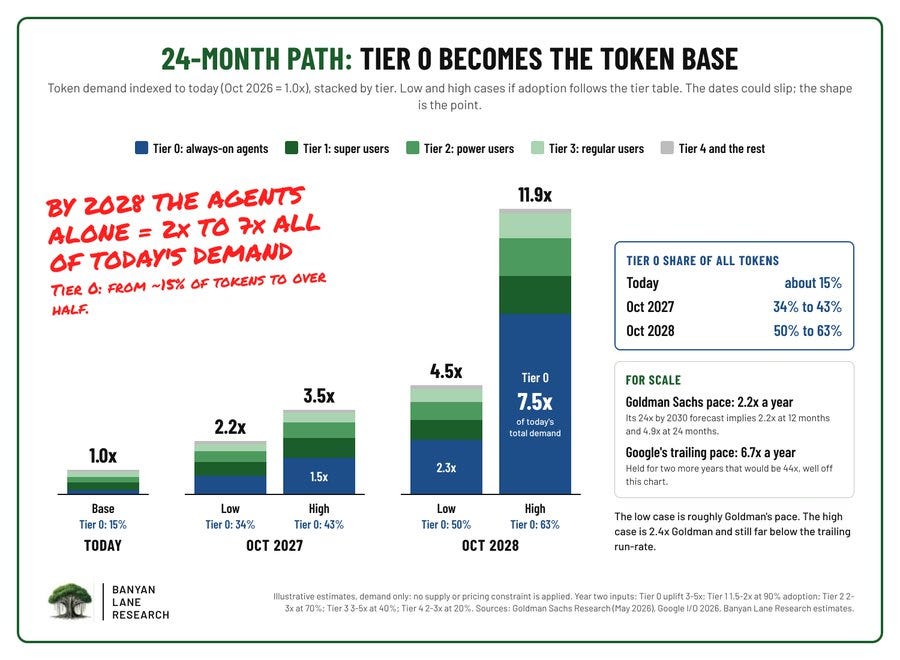
At the 12-month adoption rates: token demand of 2.2x-3.5x today.
At the 24-month rates: 4.5x to 12x.
Tier 0 share of all tokens: from roughly 15% today to more than half.
I hold the scale with far more confidence than the dates. The table has a clock on it because a model needs one. The clock is the least reliable part. The 15% starting share is also my assumption, not a disclosed number.
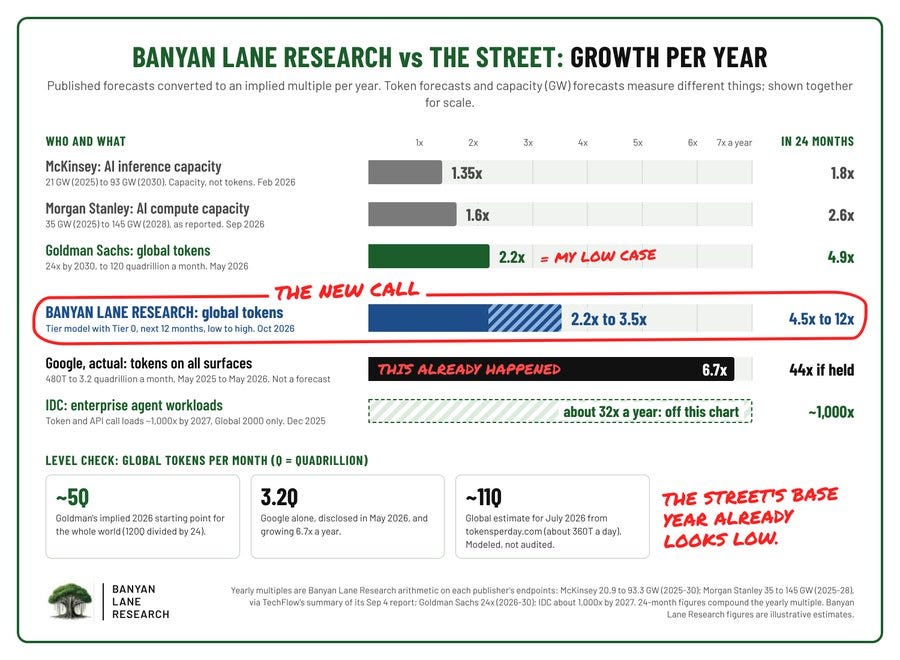
For reference, Goldman Sachs forecasts 24x by 2030, which is 2.2x a year. That is my low case. Google’s actual trailing pace is 6.7x.
What has to happen
This is not a claim about what is happening today. It is the list of things that have to happen for the high end of that table to show up.
Agents need their own computers at scale... Muse passed 5 million US downloads in 22 days, ChatGPT took 56, Similarweb put it at about 2.2 million daily users on Oct 5, and it is still only in the US and Canada.
They have to run longer... Today’s sizing assumes an agent is active about two hours a day. METR tracks how long a task a frontier model can finish alone, and the latest reading is about 17 hours, doubling roughly every four months. But, METR also warns its readings above 16 hours are unreliable, so treat that as direction.
They have to run side by side... Most users still stop at one or two. Three agents for eight hours, instead of one for two, is twelve times the tokens.
Access has to widen... Andrej Karpathy’s napkin math this week showed ~6 billion people have barely used these tools, 1-2 billion use free tiers casually, and about 20 million use frontier models professionally. Today’s demand curve is being drawn by a sliver of the population.
Someone has to pay... Jefferies’ case of a billion Muse users produces about $10.8 billion of annualized revenue. The infrastructure to serve them runs to hundreds of billions. Ads, commissions or paid tiers have to close that gap, or usage gets rationed.
If these happen, the scale is not subtle. Analyst Freda Duan estimates always-on agents need 1 to 2 gigawatts per 100 million daily users, and 3 to 4 if agents make more model calls. Half a billion daily users across Meta, Google, OpenAI and xAI would be 5 to 20 gigawatts. TrendForce’s figures imply roughly 30 gigawatts of AI capacity added in all of 2027.
Big question is... when
I do not know when this inflects. Anyone who names the quarter is guessing. The reasons timing is hard are real:
Rollouts are gated by supply... Meta’s AI chief said early Muse users consumed about 10x what internal test groups did. Muse has usage caps, and available compute is setting the pace, not demand.
Retention is unproven... Sensor Tower has 73% of new Muse users returning the next day, almost twice ChatGPT’s rate. But, it then loses users quickly, and ChatGPT pulls ahead by day eight or nine. Close to half of Muse’s early impressions came from Meta’s own ads.
Enterprises cannot yet measure the return... In Morgan Stanley’s latest CIO survey, 42% said they cannot assess the return on their token spend. About 13% see returns above their AI spend, but 28% see returns below.
The product still breaks... Some Muse tasks fall back to human assistants, and Amazon has blocked Muse from shopping on its site. Roadblocks like this need to be resolved, and likely will.
Hardware slips too... One unconfirmed report this week had expectations for Nvidia’s next-generation Rubin shipments cut roughly in half on yield and capacity limits.
Adoption curves look flat until they do not. February to August showed this can move faster than a sober model says. It can also stall for two quarters.
That is why I think every AI observer should be maniacally focused on two things... the timing and the scale of agentic adoption. It is the swing variable in every demand model, bull or bear.
The hiccups that will come
A multi-quarter view has to survive bad headlines. Expect them, especially on lab revenue and margins. The last two weeks already had two.
OpenAI... On Oct 8 the FT reported that OpenAI told investors its annualized revenue is approaching $50 billion, not the $70 billion that had circulated. The gap was a definition as Anthropic counts sales made through cloud partners and OpenAI does not, but it still read as a miss.
Anthropic... Its leaked draft prospectus showed a $42 billion net loss for 2025 on $4.6 billion of revenue, and $518 billion of planned spending on cloud services and data centers. The same document showed $11.5 billion of revenue in Q2 2026 alone and a second straight quarter of operating profit.
Pricing... Frontier-class models keep getting cheaper. Meta’s new model is priced at $4 per million input tokens, against $10 for OpenAI’s flagship. Cheaper tokens squeeze lab margins and expand units at the same time.
A lab can miss on margin while it serves more tokens than ever. Margin decides who captures the value, and units decide how much hardware gets used.
I expect lab margin misses which will move stocks, but this is not the full picture and likely underplays the volume piece.
Why that still gives me comfort on infrastructure
I am not claiming precision on any one quarter. I am claiming that over several quarters the direction of unit demand is clear enough that a lab stumble does not break the infrastructure case over time.
The supply chain is still strained... TSMC’s Q3 revenue was up ~50% YoY and above the top of its guidance.
Buyers are raising plans... JPMorgan now models capex at the four largest US clouds up 85% in 2026 and 70% in 2027. The 2027 figure was 50% before.
Existing capacity is full... Vahdat said Google’s seven and eight year old chips still run at 100% utilization, and that serving capacity has to double about every six months.
Agents change what is inside each gigawatt... Estimates of CPU cores per gigawatt under agent workloads run from a doubling (Dolphin Research) to four times (Arm). Morgan Stanley puts agent-driven DRAM demand at 15 to 45 exabytes by 2030, equal to 26% to 77% of 2027 supply.
The load lands on the rest of the internet too... Dolphin notes one agent price comparison task can trigger up to 146 page loads. Each one hits someone else’s servers.
One thing to keep straight. The agent’s own sandbox is small. Duan’s estimate for 100m daily users is about 65,000 CPUs and a tenth of a gigawatt. Most of the power is still inference. The hardware story is the shifting mix inside each gigawatt, not the sandboxes.
The risk on this side is financing, not demand. JPMorgan has cloud capex at 111% of operating cash flow in 2027. The buildout now leans on debt markets, and the cost of that debt is rising.
Pushback
“These are junk tokens”... More than 85% of agent tokens on OpenRouter are cached and billed at about a tenth of a fresh one. But cached context has to sit in memory for as long as the agent runs, and a bargain model still occupies a chip. Lower grade models running more agents is not a hole in the thesis, it is the thesis.
“This is bad for the labs”... On margins, yes. See the hiccups above. But whoever serves the tokens buys the compute still. The infrastructure case does not need the labs to capture the value.
“The ROI is not there...” Jellyfish found the first million tokens per developer buy about 11 merged pull requests and later millions buy almost none. Uber used its 2026 AI coding budget in four months. I read a blown budget as demand outrunning the plan. A world of hard caps looks like my low case, not zero.
“Supply and efficiency will catch up”... This is the strongest one. Reported capacity growth of about 1.6x a year, times cost per token falling 60% to 70%, can absorb 4x to 5x more tokens a year. My range is 2.2x to 3.5x. So at my low case accelerators could loosen. Against that, Google’s actual growth was 6.7x.
“People will not show up”... They might be too slow, yes. That is the timing risk above. But the table needs little: 10% of casual users changing behavior. Goldman’s entire 24x rests on 12% of knowledge workers using agents by 2030.
What I am watching
If timing and scale of agent adoption are the variables, these are the gauges:
Muse... whether usage caps loosen or tighten, when it opens International through WhatsApp, and daily users once the ad push fades.
Dots... what OpenAI charges after the free first month, and when it sells a second agent per plan.
Agent share of tokens... OpenRouter’s agent versus human split.
Google’s next token disclosure... Alphabet reports on Oct 28.
METR’s next task-length reading.
Lab gross margins... starting with Anthropic.
Server CPU and memory. AMD and Intel on 2027 allocation and pricing, and memory contract prices.
Meta’s capex guide in January.
The charts are illustrative and built with Claude’s help, as they were in February. I am a generalist connecting dots, not an engineer. Better inputs are welcome!
NFA. DYODD. Nothing here is investment advice.
Sources
DISCLOSURE
Position: At the time of publication, the author holds a positions in GOOGL.
Trading Policy: The author will not materially alter this position within 48 hours of publication. After this period, the author may buy, sell, or otherwise adjust the position without further notice. Changes to the author’s view or position will be reflected in subsequent publications when material.
Conflicts: The author has received no compensation from the issuer or any party with a financial interest in this security.
Forward-Looking Statements: This report contains the author’s opinions, estimates, and projections, including price targets derived from financial models. These are forward-looking statements subject to substantial uncertainty. If these assumptions prove incorrect, the actual value may differ materially, including scenarios of significant loss or total impairment. The price target represents the author’s estimate of fair value under the stated assumptions, not a prediction of where the stock will trade.
This report is provided for informational purposes only and does not constitute investment advice. See the full Terms & Disclosures for additional important information.