


Failed Telecom Sprawl Now Restructured, Inflecting Estimates, Technological Disruption Within Sight
30%+ TSR Through ‘30 at 6.0x EBITDA

Executive Summary
Trading at 6.0x EBITDA with a ~4% dividend yield and nearly 8% free cash flow yield, Vodafone is priced as just better than a melting ice cube. The consensus view is Vodafone is a structurally challenged utility in mature markets, steadily losing relevance as fiber replaces cable and competition erodes margins – a classic value trap that income investors bought in 2015 and have regretted ever since.
However, Vodafone just completed one of the most aggressive corporate restructurings in European history, monetizing ~€20 billion of broken assets (Hungary, Vantage Towers, then Italy and Spain), slashing the cost base, and stabilizing the balance sheet. Then, after surviving dividend cuts and intentional retrenchment to core profitable markets, Vodafone conducted several defensive maneuvers in response to the Nebenkostenprivileg crisis and fiber attack in Germany (35-40% of Group EBITDA). Finally, the merger with Three in the UK closed in 2025 transformed the market from four players to three with material synergies to come amidst stability.
What the market is not paying attention to, nor pricing in, is that a nearly decade-old investment in AST SpaceMobile and subsequent JV may transform Vodafone’s competitive positioning, operating model, and multiple over the coming years. Enter SatCo: a 50/50 joint venture with AST to deliver direct-to-device (D2D) satellite broadband connectivity to unmodified phones via a new constellation. Six satellites are now in orbit and are the largest commercial communications arrays ever launched into LEO. AT&T (another AST partner) has announced beta testing in 1H’26, and Vodafone Ireland filed for spectrum testing authority. SatCo has positioned itself as the potential gatekeeper of Europe’s sovereign connectivity layer, structured explicitly for EU regulatory compliance with a German Command Centre controlling encryption keys. An additional nine identified call options beyond D2D service present substantial potential upside. Vodafone committed ~€300 million total to the venture over time versus AST’s €3-5 billion constellation investment and separately owns 14.5 million AST shares currently valued at ~$1.4 billion, none of which is reflected in the stock price.
The thesis is a stabilizing utility at 6.0x EBITDA with next generation satellite communications infrastructure optionality for free. The base case delivers high-single-digit total shareholder return from yield and modest organic growth. The bull case is D2D service via SatCo proves disruptive and transforms the P&L for 30%+ TSR through the end of the decade. SatCo call options provide substantial upside with limited incremental risk given the capital-light structure. With a beta under 0.4 and FTSE 100 weight falling from ~3% a decade ago to just 0.8% today, execution on any of these opportunities would attract both passive index reweighting and active capital flows. Vodafone is on the verge of playing offense again.
Share price: 100 GBp / US ADR $13.5
Market cap / EV: ~$33 billion / ~$68 billion
Yield: 3.6%
EV / Consensus NTM EBITDA: 6.0x
P / Consensus NTM EPS: 12x
1yr Downside: $12.75 (6%) before yield 5x NTM EBITDA 5% miss
3yr Upside: $36 165% before yield 7x FY’30 EBITDA + SatCo (YE 3/31/29)
Why now?
Multiple converging catalysts create urgency. Vodafone’s core in Germany now shows clear signs of stabilization, with the business lapping easy comparables and demonstrating a more defensible go-forward strategy through the OXG fiber joint venture and 1&1 wholesale agreements. The UK market structure has fundamentally improved following the Three merger, with £700 million in expected annual synergies over five years progressing ahead of schedule. These improvements in Vodafone’s two largest markets are just now flowing through to consolidated financials.
JV partner AST has entered a critical execution phase – six satellites are now in orbit with guidance for 45-60 by year end, enough to deliver continuous service in major markets including Europe. Other AST partners have announced beta testing by mid-year 2026 and / or consumer pricing. Vodafone Ireland has filed for a 60-day Special Temporary Authority for spectrum testing, followed by a December 31, 2025 letter providing consent for AST to use their spectrum in Ireland. The technology has been validated with video calls to unmodified phones on multiple occasions via existing prior gen satellites, and AST’s vertically integrated manufacturing in Texas and beyond is scaling to meet constellation deployment timelines.
EBITDA multiple sits at the low end of both historical trading ranges and peer group averages, with no credit ascribed to the SatCo joint venture or Vodafone’s direct ownership of 14.5 million AST shares (currently valued at ~$1 billion). As the satellites enter orbit and technology is verified, the market will quickly be forced to monitor adoption rates and incoming cash flow which seems appears completely off current investors’ radar.
Business Overview
Vodafone Group Plc operates as one of Europe’s largest telecommunications providers while serving over 300 million customers globally. Post-restructuring, Vodafone’s operations concentrate on markets where it holds #1 or #2 positions. Germany represents 35-40% of Group EBITDA and remains the strategic core, with ~30 million mobile customers and ~10 million cable broadband subscribers. The United Kingdom, following approval of the merger with Three, will create the nation’s largest mobile operator with 29 million combined customers and perhaps the deepest spectrum portfolio across critical bands. The portfolio extends across Portugal, Ireland, Greece, Romania, Turkey, and several African markets via their Safaricom entity.
The business operates across three primary revenue streams. Mobile services generate approximately 60% of revenues with ARPU ranging €10-15 monthly across European markets. Fixed services contribute ~25% of revenues, concentrated in Germany where Vodafone’s cable infrastructure passes 24 million homes via hybrid fiber-coax (HFC) networks upgraded to DOCSIS 3.1 and migrating toward DOCSIS 4.0. Enterprise and wholesale services represent the balance, providing connectivity, IoT, and carrier services to business customers and other operators.
Vodafone increasingly emphasizes “convergence,” or bundling mobile and fixed services into single household packages. Converged customers exhibit significantly lower churn (8-10% annually versus 15-20% for mobile-only), higher ARPU (€40-50 versus €12-15), and greater lifetime value. Germany and UK represent the primary convergence opportunities given Vodafone’s ownership of both mobile and fixed infrastructure, while mobile-only operations in other markets partner with third-party fixed providers.
Business Model Simplified
Telecom economics follow a distinctive pattern: massive upfront infrastructure investment (spectrum, fiber, towers, base stations) creates a platform where revenue growth flows through at high incremental margins with expanding cash flows.
Revenue scales efficiently across this fixed cost base. Adding one more subscriber to an existing network incurs minimal incremental expense against existing infrastructure. Meanwhile, pricing power, bundling opportunities, and cross-sell initiatives compound returns without proportional cost increases. Fixed operating costs (network maintenance, spectrum fees, IT systems, customer service) remain largely constant regardless of subscriber count, generating substantial operating leverage as the customer base grows.
This operating leverage translates into cash flow generation, though the path isn’t linear. Regulatory requirements mandate network buildout and maintenance, creating baseline capital intensity. Technology transitions (e.g. 4G to 5G) require substantial upfront investment before delivering returns. However, subsequent upgrades (software improvements, spectrum layer additions, targeted densification) expand capacity at a fraction of the original cost. As each technology generation matures, capital intensity declines and free cash flow expands.
Underlying all of this is customer unit economics. Telcos typically spend €150–400 per gross addition (handset subsidies, sales commissions, credit checks, activation), with individual customers often not reaching profitability until several quarters later. This extended payback period makes churn devastating to returns and service quality essential to long-term value creation. In mature developed markets, competition for incremental share can be fierce, with operators deploying aggressive marketing tactics to capture or defend subscribers.
History in Short
The old Vodafone believed sprawling scale was destiny. This belief led to the 2019 acquisition of Liberty Global’s German and Central European assets for €18.4 billion – mobile, fixed, and TV to create a connectivity empire. Instead, it leveraged an already-stretched balance sheet just as 5G spectrum auctions began draining capital. By mid-2019, the dividend was cut 40%, and the share price collapsed. Scale, as it turned out, was not the same as returns.
CEO Nick Read then spent three years searching for a middle ground between expansion and outright retreat. Towers were spun into Vantage. A “Tech Comms” rebrand attempted to reframe the company as a technology platform. None of it worked. Activist investor Cevian Capital arrived in early 2022 with the stock 60% from 2015 peak, arguing the portfolio was too complex and management too slow. Margherita Della Valle took over as CEO in April 2023.
Vodafone’s struggles unfolded against Europe’s structurally challenged telecom landscape. To put it simply, the regulatory frameworks positioned consumers over carriers and returns lagged cost of capital leading to lagging investment. This problem compounded for years. Many markets were highly fragmented leading to weak pricing power, and consolidation was largely non-existent. EU mobile ARPU of ~€15 compares to ~$42.50 in the US, and when Germany’s CPI rose 19% from 2020-2024, wireless prices declined 6%.
Germany faced an exogenous shock when July 2024’s Nebenkostenprivileg abolition vaporized €800 million in high-margin TV revenue overnight - landlords’ right to automatically charge tenants for cable TV fees through their utility bills were eliminated. Vodafone retained half of 8.5 million affected households through aggressive re-contracting. Strategic hedges followed: OXG with Altice for fiber optionality, the 1&1 national roaming deal for wholesale revenue regardless of competitive outcome, and commercial discipline prioritizing value over volume. Management played defense to stabilize its most important market while the dust settled.
The UK four-player market had delivered returns below the cost of capital for years. The merger with Three, closed May 2025, created a 29-million subscriber entity with the deepest spectrum portfolio in the country. CMA approval marked a watershed where for the first time in a decade, a major European regulator acknowledged that sub-scale operators cannot fund 5G infrastructure. Expected synergies of £700 million annually are running ahead of plan. The sprawl strategy is dead. What remains is a focused operator in two markets that matter.
See Appendix for more detailed history.
Restructuring: Della Valle’s “Radical Change”
Margherita Della Valle’s promotion in 2023 marked the definitive break. Her first public statement was direct and without nuance: “Our performance has not been good enough. Vodafone must change.” The new doctrine was reductive - Customers, Simplicity, Growth - but its implications were radical. Markets were bifurcated into those with a “path to value” (scale + structure) and those without. The latter would be exited, regardless of revenue impact. Moreover, her long-term incentive compensation is 60% tied to Free Cash Flow, and 30% relative TSR versus peers. In short, her newfound discipline was painful near-term, yet aligned with long-term value creation for all shareholders. This was welcomed following the “imperial” era.
· Promise: Simplify the portfolio. Delivery: ~€20 billion monetized via exits in Spain and Italy and the Vantage Towers deconsolidation.
· Promise: Fix the UK scale deficit. Delivery: Merger with Three UK approved by the CMA with behavioral remedies rather than structural divestitures.
· Promise: Return capital. Delivery: €4 billion in buybacks executed at depressed valuations.
The boldest moves were also the simplest - exit markets where you can’t win. Spain and Italy were black holes with five mobile operators in each market, vicious price wars, returns consistently below the cost of capital. Previous management held onto them for “scale” and “flags on the map.” Della Valle sold them both.
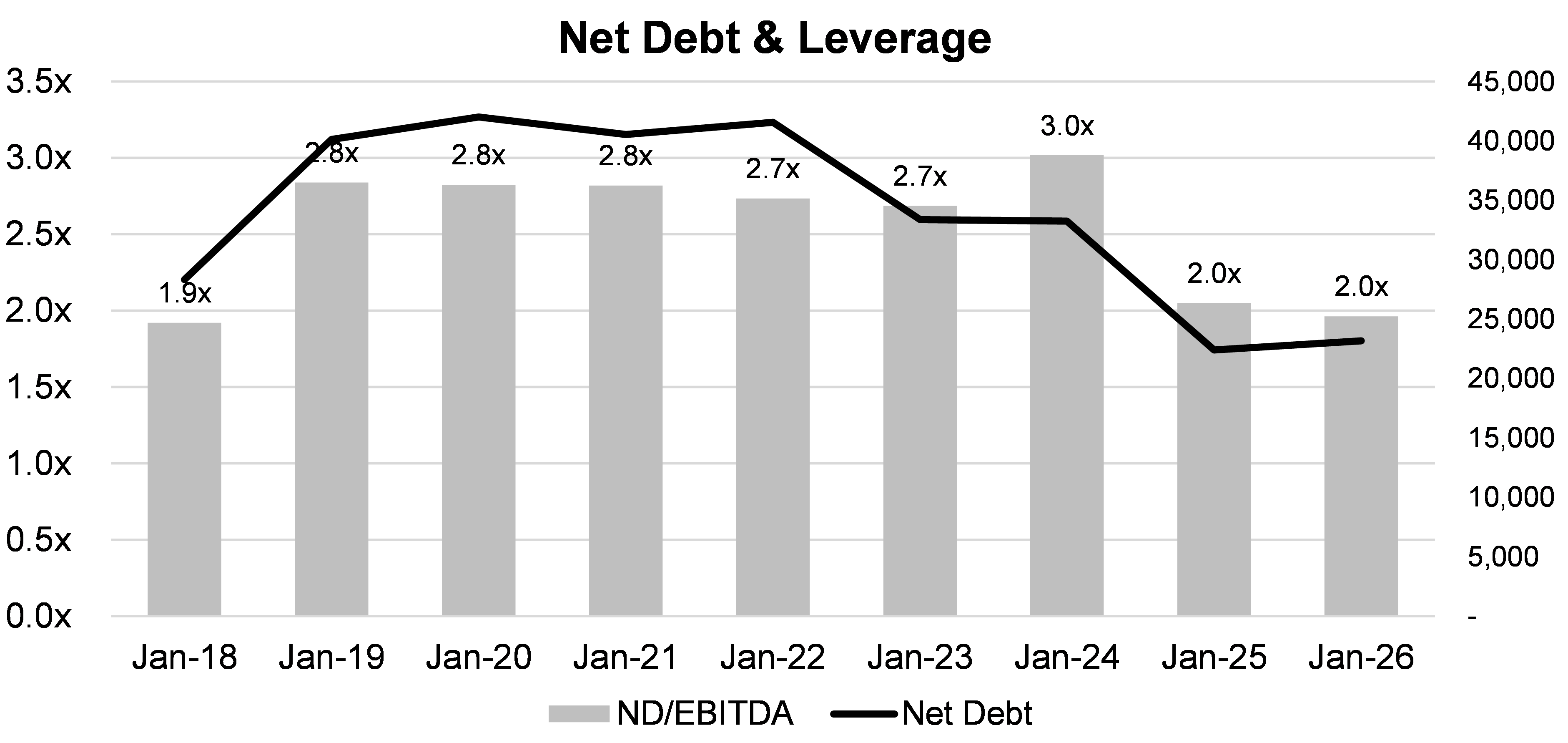
Spain was sold to Zegona for €5 billion (~5.5x EBITDA), and Italy followed for €8 billion to Swisscom (~7.6x EBITDA). The €13 billion in combined proceeds funded €4 billion in buybacks at share prices mostly below $9 (ADR). This stands as a clear signal that capital would be returned rather than redeployed into marginal markets. The remaining cash reduced net leverage from a peak of 4.3x to 3.0x today.
The psychological impact can’t be overstated. For years, investors watched Vodafone pour money into hopeless competitive battles. Now they’re watching management actively shrink the company to focus only on markets where they can achieve sustainable returns.
Vantage Towers: Unlocking Hidden Infrastructure Value
Vodafone’s Vantage Towers monetization exemplifies textbook financial engineering, exploiting the persistent valuation gap between integrated telcos (trading at 5-6x EBITDA) and pure-play infrastructure assets (trading at 15-30x EBITDA).
· 82,000-site European tower portfolio carved into a standalone entity in May 2020.
· Two-stage monetization via a March 2021 Frankfurt IPO at €24 per share that raised €2.3 billion while retaining 81.7% ownership, followed by a November 2022 co-control partnership with KKR and GIP at €32 per share (33% premium to IPO price).
· Acquiring consortium valued Vantage at €16.2 billion equity value or 26x FY’22 EBITDA, a multiple consistent with peers and significantly higher than Vodafone’s.
· Adding a July 2024 stake sale, Vodafone crystallized €6.6+ billion in cash proceeds for deleveraging while retaining 50% ownership and strategic co-control.
The transaction achieved three simultaneous objectives. First, it arbitraged the valuation discount by converting tower assets worth €8-10 billion on an embedded basis into €16.2 billion of standalone value. Second, the €6.6 billion proceeds reduced Vodafone’s Net Debt/EBITDA by approximately 0.5-0.6x, bringing leverage toward the 2.25-2.75x target corridor and freeing capital for core 5G and fiber investments. Third, it moved future tower CapEx off Vodafone’s consolidated balance sheet. Vantage’s build-to-suit program commits to 7,100 new sites through FY2026 (contributing €130M EBITDA by 2027) now funded through the JV rather than Group resources. Vodafone retained guaranteed network access via 32-year master service agreements, maintained co-control governance rights for potential future tower consolidation opportunities, and preserved 50% of the upside in an asset class characterized by inflation-linked contracts, minimal maintenance capex, and secular 5G densification tailwinds. This structure epitomizes Della Valle’s capital allocation philosophy: extract maximum value from non-core infrastructure, strengthen the balance sheet, and retain strategic optionality without sacrificing operational continuity.
Dividend Cuts and Other Transactions
The dividend history tells the story of capital constraints. By mid-2019, the board capitulated, cutting the dividend 40% to “rebuild headroom.” This was an admission that the empire was consuming more capital than it generated following years of misallocation. The second dividend cut came in FY’25 as the exit of tower assets mechanically reduced cash flows.
The less obvious but equally important move was commercializing VOIS (Vodafone Intelligent Solutions). For years, this was just an internal cost center (IT, HR, procurement bundled up in Romania and India). Now it’s a joint venture with Accenture that charges local Vodafone markets via Master Service Agreements and sells to third parties. Local markets can’t treat it as a free lunch anymore as they pay for services, which forces efficiency. Meanwhile, VOIS must compete with external providers, driving continuous improvement. A billion-euro cost bucket is transforming into a potential revenue stream.
Go-Forward Strategy
By Q1 FY’26, Vodafone had fundamentally transformed its strategic position, operational structure, and capital allocation framework. The company that entered 2018 as a sprawling empire seeking scale through convergence had emerged as a disciplined, return-focused operator willing to shrink revenue to improve profitability and grow again in the future. Management philosophy evolved from “Connecting the World” to “disciplined Value Creation” - a more modest but operationally credible narrative. Years of transformation have resulted in modest yet steady growth with key markets, Germany and UK, now both turning the corner. EBITDA margins appear to have just troughed in recent quarters, and the realization of UK synergies with modest growth should bring margin expansion over time.
Enter SatCo: Near-Decade Old Venture Investment Finally to Bear Fruit
What is SatCo?
SatCo is a 50/50 JV with AST established in March 2025 to deliver direct-to-device satellite service to unmodified smartphones across 21 EU member states – something no operator has yet achieved at full commercial scale. This is not a capacity agreement. It is the first-mover architecture for an entirely new connectivity tier which will transform Vodafone’s competitive position through technological leap rather than incremental improvement.
Who is AST and Why the Technology Matters
AST SpaceMobile is attempting what no company has achieved: broadband voice, data, and video from satellites directly to unmodified smartphones. This is not emergency texting but full terrestrial-quality connectivity from low earth orbit. As AST President Scott Wisniewski describes it, AST is building a “purpose-built direct-to-device constellation” with a “broadband first” strategy and a goal of bringing near “terrestrial connectivity” via a “big satellite in orbit to connect to small device very far away.” Founded in 2017 by Abel Avellan (who previously built and sold Emerging Markets Communications for $550 million), AST went public via SPAC in 2021 and commands a ~$35 billion market cap despite just $15 million in quarterly revenue (Q3 2025). This valuation reflects investor conviction that AST has solved the fundamental physics problem determining winners in direct-to-device. The strategic investor roster validates the bet: AT&T, Verizon, Google, Rakuten, American Tower, and Bell Canada have all taken positions. These operators and infrastructure players have conducted technical due diligence and aligned with AST’s approach.
Antenna Physics Determine Everything
Smartphones transmit at milliwatt power levels, an extraordinarily weak signal when measured from 720km orbital altitude. Only massive orbital receivers can reliably detect these transmissions. This is why antenna aperture size is the core technical differentiator, and why AST has taken the opposite approach from Starlink: fewer satellites with massive phased-array antennas rather than thousands of smaller units. AST is vertically integrated and builds satellites in the United States. As of today, Starlink appears to be the only likely competitor. AST’s antennas are the largest commercial arrays ever launched into LEO, carrying larger power generation capability than all peers via their massive solar arrays. BlueBirds 1-5 (currently in orbit) feature ~700 sq ft antennas. BlueBird 6 (launched December 2025) represents a categorical leap to 2,400 sq ft or 3.4x larger than earlier BlueBirds and 6.5x larger than Starlink’s current arrays. This translates to 15+ dB of link budget improvement: the difference between reliable indoor connectivity and outdoor-only service.
Larger aperture means the satellite can “hear” weak smartphone signals, penetrate buildings and foliage, deliver higher data rates through massive processing capacity, and operate within mobile operators’ existing licensed spectrum (600 MHz to 2 GHz) avoiding interference issues. Block 2 BlueBirds are expected to deliver 120 Mbps peak speeds to unmodified phones, with 45-60 satellites operational by end-2026.
The structure is engineered for European sovereignty via Luxembourg corporate domicile unlocks European Investment Bank financing, EU space program funding, and favorable tax treatment. A German Satellite Operations Centre near Munich or Hannover houses the “Command Switch” – the encryption key control and ground station gateway that is the critical differentiator. European operators maintain exclusive control over key functions allowing the JV to align interests with legislators and regulators. In a crisis, European traffic can be isolated from AST’s global network. Critical communications cannot be monitored or disabled by foreign entities.
This cuts to the heart of the Ukraine lesson: connectivity should not hinge on whether Elon Musk keeps Starlink switched on. Starlink operates from the U.S. with centralized control that could theoretically be switched off or monitored by other interests. Vodafone is not just building service capacity – it is positioning as the EU’s partner for the next generation of communications with digital sovereignty. The moat created against alternatives becomes regulatory as much as technological. And successful execution on SatCo opens doors to larger projects: IRIS² participation, defense contracts, critical infrastructure mandates. The EU has committed €10.6 billion to IRIS². Germany has allocated €35 billion for space defense through 2030. Sovereign satellite infrastructure is strategic priority, not commercial option. SatCo’s “Sovereignty-as-a-Service” architecture offers what governments will pay premium prices to secure.
Vodafone’s Strategic Positioning: Seven Years in the Making
Vodafone’s involvement is a seven-year commitment, not a speculative bet. The company has been a lead investor since 2018, contributing capital, technical engineering resources through its Malaga R&D hub, and spectrum assets. In January 2024, Vodafone invested $110 million via convertible note. In late 2024, Vodafone extended its commercial agreement through 2034, a 10-year horizon signaling space-based connectivity as a permanent strategic pillar. Board-level integration confirms strategic priority: Luke Ibbetson (Head of R&D, 12+ years at Vodafone) joined AST’s board in April 2021, and Johan Wibergh (former Group CTO) chairs AST’s Network Planning Committee. Placing executives of this caliber on a partner’s board indicates core strategy, not experimentation. Vodafone executives discuss SatCo openly in interviews and feature it prominently on their website. They view this as transformational for their business.
Business Model: Wholesale B2B2C
AST sells to mobile operators, not consumers. This wholesale B2B2C model is the strategic inverse of Starlink’s vertically integrated approach. AST’s partners collectively serve 2.8 billion subscribers: AT&T, Verizon, Rakuten Mobile, stc Group, Bell Canada, and Vodafone (via SatCo). These partnerships have generated over $1 billion in contracted revenue commitments – substantial validation that MNOs will pay for technology they cannot build independently. Execution is accelerating: AST will likely close 2025 with north of $3 billion in cash, manufacturing has expanded to 500,000 sq ft with 1,800 employees (100% growth in six months), and the company demonstrated the world’s first space-based video call on an unmodified phone with Vodafone in January 2025, with download speeds exceeding 20 Mbps demonstrated across multiple partner tests. AST has also received FCC Special Temporary Authority for FirstNet evaluation.
The D2D Market: Service Coming in 2026
The direct-to-device consumer service isn’t a “call option.” It is the baseline business case with validated demand addressing measured service quality failures that 14-26% of European customers experience regularly.
European Infrastructure Deficit Creates Structural Demand
Europe’s terrestrial mobile infrastructure significantly lags its global peers. While North America achieves 91% Standalone 5G coverage, Europe reaches only 40%. Even non-standalone 5G coverage hit just 87% in 2023, trailing South Korea (99%), the U.S. (98%), Japan (97%), and China (90%). Consequently, the European Commission estimates that by 2030, over 45.4 million people or more than 8% of the EU population will still lack gigabit connectivity.
The Commission acknowledges that “market forces will not guarantee achievement of connectivity targets,” citing a €42 billion annual investment shortfall through 2025. This combination of declining private investment, persistent coverage gaps, and regulatory fragmentation across 27 member states creates the structural foundation for D2D adoption. Satellite does not compete with robust terrestrial networks; rather, it fills the gaps that terrestrial economics cannot close.
High consumer mobility further amplifies this value. With 72% of Europeans traveling to other EU countries annually (and 28% more frequently), the “Roam Like at Home” regime drives expectations for seamless connectivity. Yet, infrastructure gaps persist at borders, in rural transit corridors, and in less-developed regions. D2D resolves this, transforming fragmented coverage into truly seamless European connectivity.
Validated Consumer Willingness to Pay
The September 2025 Viasat/GSMA Intelligence survey of 12,390 mobile users across 12 markets including France, Germany, Italy, and the UK provides comprehensive validation.
Willingness to Pay
60% of consumers globally express willingness to pay more for D2D satellite services, with average willingness-to-pay measuring 5-7% ARPU increase. Even in the U.S. 56% of surveyed consumers affirmed willingness and 48% in France. Coverage quality now ranks as the #1 purchase criterion, surpassing price, data allowances, and device subsidies.
Coverage Failures Drive Demand
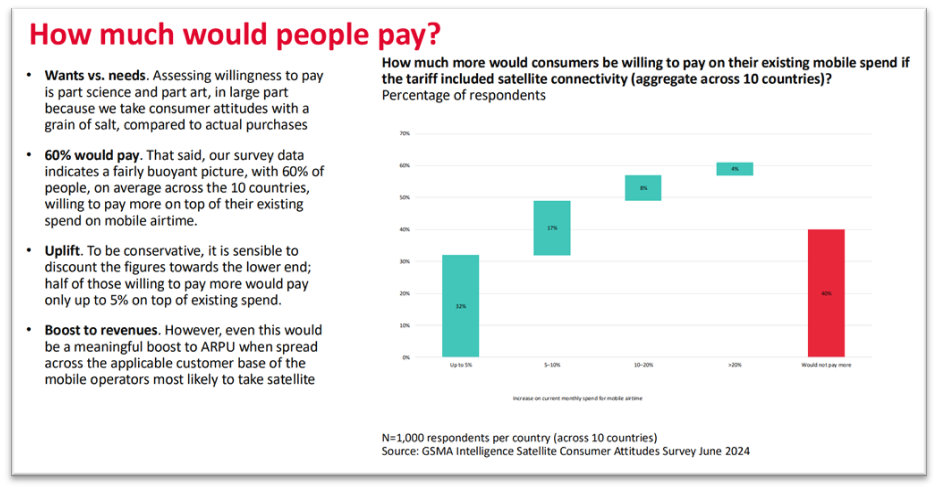
Over 33% of consumers report losing access to basic cellular services at least twice monthly. 14% struggle with inconsistent or no coverage at home. This is not just rural areas, but basement apartments in cities, thick-walled buildings, terrain-shadowed zones, and the like. 21% report getting good coverage only “some of the time” domestically. France and the U.S. lead in SMS failures with 26% and 23%, respectively, losing text messaging 5+ times per month.
GSMA Intelligence describes this as an “inflection point” where “MNOs need to move fast to harness excitement over satellite services to secure loyalty and generate revenue.” The language is unambiguous: operators offering “coverage certainty guarantee” gain significant competitive advantage, while those without satellite partnerships face market share erosion. This is positioned as “an essential tool for digital inclusion, safety, and economic growth.”
Churn Risk is Existential
47% of consumers surveyed globally would switch mobile operators to obtain satellite coverage in areas outside terrestrial coverage. This has increased year-over-year, indicating that as awareness grows, competitive pressure on operators without satellite may significantly intensify. For Vodafone, this is both a defensive imperative and offensive opportunity via SatCo.
Subscription Analogs and Market Validation
To validate adoption potential, we must analyze the broader subscription economy. The average European household already maintains two to four digital subscriptions, spending €40–80 monthly on services they could theoretically live without.
Current market comps include:
Netflix: €13–20/month (~80 million households; ~35% penetration).
Spotify: €11–13/month (~100 million subscribers; ~20% population penetration).
PlayStation Plus: €8–20/month for gaming enhancements.
Microsoft 365: €8–17/month (26–27 million users).
Pricing
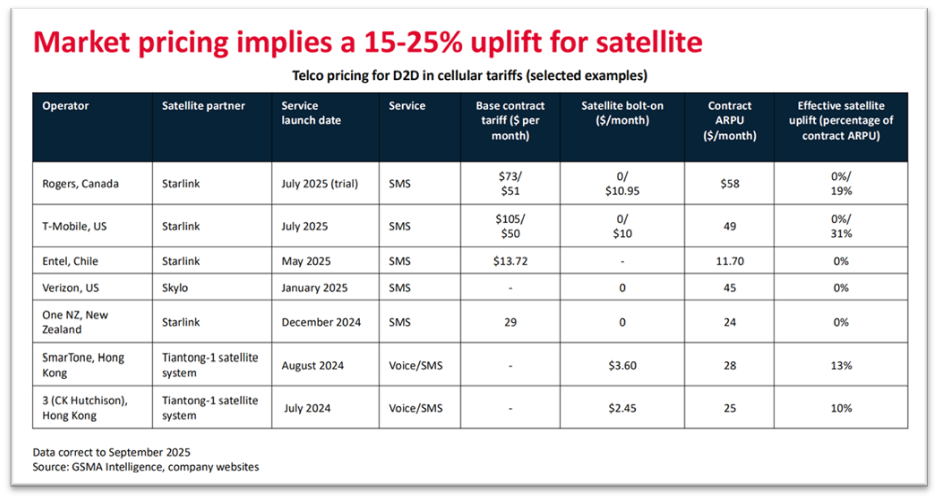
Under typical wholesale agreements, MNOs retain control over consumer pricing. For SatCo as well as AST’s other partners, this appears to be the path forward with a 50/50 split of revenue. The current public benchmark for AST’s service comes from Bell Canada, which anticipates charging CAD 10–15 (~$7–11) per month, representing a low-teens percentage increase on top-tier plans. While specific pricing and revenue splits will vary by region, this analysis assumes a gross monthly ARPU of €7 (so €3.50 net to SatCo). T-Mobile’s service, not yet full broadband D2D, with Starlink is $10/month lending support to the €7 price point.
Value Proposition
The €7 price point may spark internal debate among European MNOs, where base ARPU remains below €20. While a €7 add-on represents a substantial step up in price, requiring stakeholders to carefully weigh the benefits of enhanced connectivity against the risk of consumer resistance. The decision-making process will center on whether the added value of satellite services can justify this increase in markets accustomed to lower monthly charges. However, because European service levels significantly lag those of other major markets, this creates a unique opportunity for operators to price for true differentiation rather than commoditized data. With the context of securing dead zone coverage, claimed “full coverage” areas that do not meet consumer needs, mountainous terrain, business continuity, and travel, the price point seems justified. Even accounting for conservative European spending habits, this equates to roughly €0.25 per day, or just two to three coffees a month. This price point undercuts most entertainment subscriptions while offering superior utility. Furthermore, global consumers consistently demonstrate a willingness to pay for tangible mobile technology upgrades. As this service represents the first true direct-to-device coverage, MNOs will likely accelerate adoption through creative bundling, price locks, and cash-back incentives to overcome initial friction.
Extraordinary Capital Efficiency
Vodafone funds 3-5% of total infrastructure costs but receives 50% JV ownership. Total Vodafone commitment: ~€300 million ($110 million convertible note, €25 million service prepayments, ~€100-200 million for ground infrastructure including the German command center, gateway stations, and network integration). AST commits €3-5 billion for the satellite constellation itself. This structure only makes sense if Vodafone’s non-capital contributions are extraordinarily valuable: customer access across 20 home markets plus 40 partner markets, spectrum rights, and regulatory expertise across fragmented European jurisdictions to which AST cannot replicate access. Meanwhile, Vodafone’s equity stake in AST (14.5 million common shares) has appreciated to ~$1.4 billion.
Competitive Landscape: The Starlink Structural Disadvantage
While Starlink remains the only credible competitor in the D2D space, it faces structural disadvantages in Europe driven by path-to-market ambiguity, technical limitations, and regulatory exposure.
The primary concerns center on Starlink’s go-to-market strategy and risk as a potential Trojan Horse. Starlink creates existential uncertainty for potential MNO partners. Although the T-Mobile partnership provides partial service today, Elon Musk has repeatedly discussed launching a standalone carrier. If Starlink pivots to a direct-to-consumer model, it alienates every MNO that currently “owns” the customer relationship. Any responsible Board of Directors must weigh whether partnering with Starlink invites a Trojan Horse that will eventually compete directly against them. This dynamic creates a broad opening for AST, positioning them favorably as MNOs seek alternatives, let alone what could be a better quality service. AST’s success is ultimately SatCo’s success – it positions the constellation to scale volumes faster, accelerating rollout and reinvestment while growing the value of Vodafone’s equity stake.
Starlink currently lacks the technical capability for full Direct-to-Device (D2D) service today. Musk has publicly stated that achieving this requires two or more years, a new ASIC, and a new constellation, with spectrum integration targeted for the 2028 iPhone. Starlink has also undergone significant acquisitions using valuable equity currency to secure EchoStar’s spectrum licenses (AWS-4, H-block, AWS-3) for over $20 billion in cash and SpaceX stock. While this deal equips Starlink with 50 MHz for D2D expansion, it reveals a reliance on capital-intensive acquisitions rather than organic technical advantage.
Conversely, AST’s organic lead is the result of nearly a decade spent developing its core solution as purpose-built for the D2D market (and other defense applications for which they provide little detail but are not unknown in the market). AST’s hardware features a proprietary AST5000 ASIC chip developed with TSMC, with integration beginning mid-2026. This technology delivers 10x processing capacity, 120 Mbps speeds, and AI-driven dyanmic spectrum sharing for 2x–3x efficiency gains. Furthermore, AST utilizes “bent-pipe” architecture routing data through MNO-controlled ground stations. This ensures data sovereignty and compatibility with unmodified 3GPP devices for broadband voice, data, and video (even indoors via low-band spectrum).
European spectrum rules create a regulatory moat that is reinforced by the laws of physics. EU regulations demand stringent protection of terrestrial mobile networks, creating a geometry problem for Starlink regarding antenna size & interference. Starlink’s smaller 35-square-meter antennas struggle with precise beam control, resulting in wider sidelobe radiation that risks interfering with established cellular services. To mitigate this, regulators may enforce a Buffer Zone requirement of 100 kilometers. In Europe’s patchwork geography, this could exclude 70–80% of the 450 million European population, effectively sidelining major metros like Berlin, Munich, and Paris, as well as entire countries like the Netherlands and Belgium. AST’s solution relies on significantly larger 223-square-meter arrays, which enable tighter signal focus and superior sidelobe suppression. This shrinks the required buffer to under 20 kilometers, opening a total addressable market three to four times larger than Starlink’s.
SatCo’s model is strengthened by Vodafone’s backend expertise, managing solutions for 30 MNOs across 45 countries and fostering partnerships in 21 EU states with harmonized spectrum. This operational strength is backed by over 3,700 patent claims (1,700 granted across 36 families). Key innovations include beamforming for earth-fixed cells, mutual coupling calibration for precise phase estimation in dynamic LEO environments, throughput-boosting MIMO, and dual-polarization.
Lastly, Starlink will face an uphill battle winning the political favor to reach true scale in Europe. Musk’s escalating clashes with the EU, including 2025 calls to “abolish” the bloc following a €120 million fine on X and labeling it a “bureaucratic monster,” add significant political risk. There are numerous of these such incidents. It may also make the EU think twice when EchoStar’s 2 GHz MSS spectrum expires in 2027, as EchoStar is now effectively “in the hands” of Musk. SatCo’s compliant, partnership-driven strategy avoids these challenges.
Financials & Valuation Framework
Core Business Base Case
Despite significant challenges in the last five to seven years, there is ample reason to believe that Vodafone’s core business will return to a normalized growth cadence. This can reasonably be described as 1-2% revenue growth in Germany, 2-3% in the UK, 1-2% in Other Europe, and low to mid-single digits in lesser developed markets such as Turkey and Africa. This grants some credit for a blend of volume and price and should be attainable with execution focus and yields upside to consensus estimates over the next several years of 2-3%. More interesting is the progression, or lack thereof, of consensus EBITDA margins. Prior to issues in the German market, consolidated EBITDA margins sat at just over 33% in FY’22-’23. The most recent 24 months have seen margins of ~29%, and consensus assumes this level going forward. This seems hard to believe given the inherent operating leverage in the model and incoming UK synergies. The model assumes German margins growing modestly from 36% toward 38% over three years, following a rapid decline from 40% margins previously. Additionally, faster growing Vodacom/Safaricom is 20% of group revenue with mid 30s% margins. Thus, it does not require anything heroic to see consolidated margins trending gently to 30% in ~12 months and toward 31% in CY’29 (FY’28). This yields 5% upside to estimates going forward several years, for 4-5% EBITDA growth. Put another way, consensus expects ~2% revenue growth to drive ~2% EBITDA growth in perpetuity, and the base FY’26e they are forecasting from is likely to prove too low to begin with.
Altogether, one can think of the total shareholder return (TSR) algorithm as 4-5% earnings growth and ~4% dividend yield for a total of 8-9%. Management will then have the option to continue repurchasing shares which could support TSR of 9-10%. This should be considered the base case for the business before SatCo. Downside to this case would most likely come in the form of growth challenges in Germany which could slow consolidated growth by a few points (barring another exogenous shock).
Business Model Reimagined
Early commentary above loosely followed the flow of a dollar through telecom income and cash flow statements. The reality is most of these businesses, including Vodafone, are rather mature (read normalized low to mid-single digit growth) as a result of the markets they operate in and the nature of the service. However, the potential SatCo standalone impact is material. D2D service has the potential to drive volume growth via organic share gains and lower churn, pricing uplift, lower CAC (the CAC is the split of consumer-facing ARPU with AST), lower capital intensity (AST bears the majority of spend for the constellation). This flips the legacy model on its head.
Furthermore, if service is successful there are likely material impacts to the legacy business. Capital intensity may fall materially as Vodafone may choose to slow tower buildout or maintenance, instead leveraging the constellation. The presence of material technological advantage vs. peers may drive incredible opportunities for bundling or other sales tactics.
Altogether, success at SatCo leads to higher ROIC and free cash flow. Importantly, it has been years since Vodafone possessed the balance sheet capacity to make offensive maneuvers in the market versus peers or materially reward shareholders on an ongoing basis. The stabilization of the core plus accretive and accelerating returns from SatCo have the potential to drive net leverage to 1.0x in just a few years. Best-in-class global peers carry 2.0-3.0x of net leverage. This would imply balance sheet firepower of €10-20 billion or more versus the current market cap of just over €25 billion.
Best of all, this is without the impact of numerous call options, many of which could individually add 2-3% to forward consensus EBITDA estimates.
D2D Impact – from EBITDA Uplift to Capital Efficiency Inflection
While the constellation to serve SatCo should see its first dedicated satellite launch in the coming months and beta testing by mid-year (per AT&T), the timing of commercial revenue is uncertain. In such instances for large, multi-year inflections, it is important to focus more on conviction in the thesis of where the market or company is going than on exact timing. Should the constellation be in place in late ’26, it stands to reason that SatCo should be able to revenue from D2D service soon thereafter with material ramp over several years.
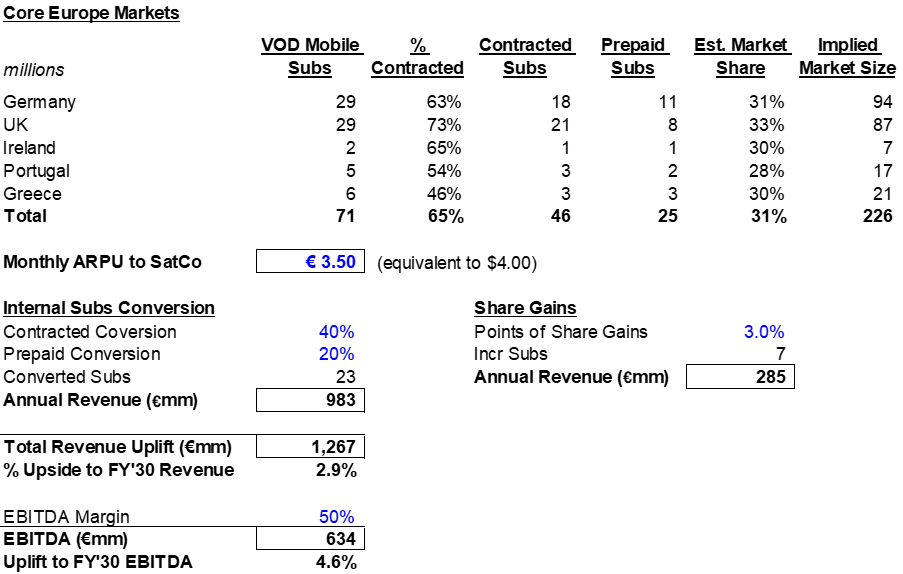
SatCo has yet to disclose any details of go-to-market strategy, but the building blocks of modeling EBITDA outcomes over multiple years do exist. Starting with addressing just the opportunity in larger and wealthier European markets, Vodafone has 71 million subs to sell service to. Vodafone discloses contracted vs. prepaid subs figures, and it would stand to reason that prepaid subs may be less likely to upgrade to D2D. Contracted subs should act more like the subscribers polled by GSMA above, as well as those Europeans paying for entertainment subscriptions. Netflix has achieved ~80 million subs for 35% penetration of households over many years, but this penetration figure is very different than assuming a conversion rate of existing subs for Vodafone. Similar difficulty exists in comparing Spotify’s 100 million subs for 20% population penetration.
Using absolute subs as guidance on the high end and GSMA’s polling results on both willingness to upgrade and magnitude of ARPU uplift, this analysis assumes Vodafone might achieve 40%/20% penetration of their contracted/prepaid base in these five major markets. This yields 23 million total subs over a timeframe of ~3 years to FY’30, ending 3/31/29. Several other MNOs or related services have guided to early expectations of ARPU, and a total upsell figure of €7.00 to the consumer is in the range of what might be expected (SatCo should receive half of that ARPU). This is a larger percentage increase in fully baked ARPU for consumers, but still a small absolute incremental spend for an individual consumer to access truly “full coverage.” Such a competitive advantage would likely result in share gains of a few points of the rest of the market. The result is an incremental ~€1.0 billion of revenue. AST has guided to 80-90% EBITDA margins over time, but SatCo should experience something lower. Given SatCo will, as understood today, spend some incremental capital on physical infrastructure for the service and more than likely leverage their existing software, billing, IT and other capabilities, their margins should lag yet still be quite impressive. The net result is another 5% upside to FY’30 EBITDA.
Similarly, Vodafone’s other markets could achieve some level of penetration over time but at lower ARPU and lower conversion rates.

While adding an incremental five points of growth to current EBITDA expectations several years forward does not sound like much, it certainly is in the context of expected the normalized algorithm of 4-5% annually. However, perhaps more important for any endpoint valuation of the equity is the capital efficiency with which this profit will be generated. Vodafone’s consolidated CapEx intensity is typically 18-20% of revenue. These profits will be generated leveraging infrastructure paid for by SatCo’s partner, AST, with only modest physical infrastructure spend for SatCo. Furthermore and perhaps more importantly, the success of the constellation is likely to yield material capital intensity benefits for the legacy business as Vodafone leverages its newfound “full coverage” from SatCo to both slow tower buildout across many markets, as well as slow maintenance spend. These benefits are hard to quantify today, and management is unlikely to speak on them until after they have proven the results due to the nature of service requirements. Using the historical capital intensity of the legacy business 17-18% of revenue in normal years, we can trend this to 15% several years, while layering in €100 million of CapEx to support SatCo operations over the next 24 months, followed by €20 million per year thereafter. In this case, it seems CapEx likely plateaus at FY’26 for several years before trending toward €6.7 billion (and there may be more downside versus this level over time). This improvement compounds meaningfully in a business with a large capital base and provides management material optionality to allocate capital. The model assumes no incremental buybacks, modest dividend growth, and simple net debt reduction over time. The compounding free cash flow accrues to equity holders.
Financials
For the sake of simplicity, this research will display a single modeled scenario as alternatives are relatively simple to walk through and understanding the order of magnitude of upside over several years with execution is the most important takeaway of this research. As mentioned above, Vodafone appears set to deliver high-single digits TSR going forward, with financial deviation to downside likely limited to a few points of growth barring other shocks. At current valuation of ~6.0x EBITDA, this presents a compelling entry point both on a standalone basis, as well as for the explicit lack of value ascribed to SatCo’s D2D launch or the numerous call options present.
Using the framework for D2D subscriber conversion above, this analysis estimates the new opportunity via SatCo may add an incremental ~€750 million of earnings over several years to FY’30, year ending 3/31/30. This roughly maps to CY’29 – the set of financials the market would be expected to focus on rolling three years forward. This approach of anticipating results the market will be looking onto as NTM in three years is both central to framing risk to reward, as well as how the market typically prices securities with exponential growth and/or unprofitable current position.
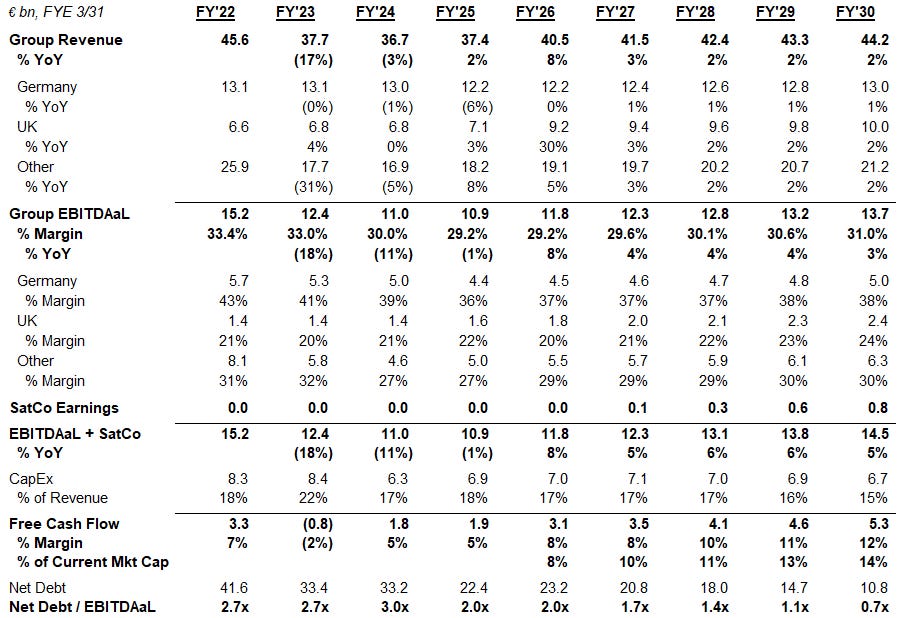
Rolling forward to FY’27, ending 3/31/27, Vodafone will have its first clean set of annual results in years. The business will be lapping German challenges making for easier comps, UK synergies will be crystallizing, CapEx growth should normalize relative to growing earnings, large M&A should not be present, free cash flow will grow significantly, and the full impact of ~€3.3 billion in share repurchases should shine through with 10% lower shares outstanding. Given consensus price targets lack the ability to look beyond NTM and often act as more of a “spot” indicator, there is meaningful upside as the above forces compound to outsize equity appreciation on a flattish multiple. Additionally, recent strong 1H results do not seem to have been fully pushed through to annual results, leading to apparent upside to 2H consensus – forward years compound off this higher base. Moreover, the dramatic swing of negative YoY growth to less negative or positive in some segments presents difficulty in forecasting that should be handled by observing two-year stacked comps – this approach further cements the rapid improvement and potential upside rolling forward into FY’27.
These impacts are even larger rolling forward to FY’30 at which time the real value of SatCo’s earnings and capital intensity will have taken hold while yielding significant debt to equity value transfer when valuing the business based on EBITDA.

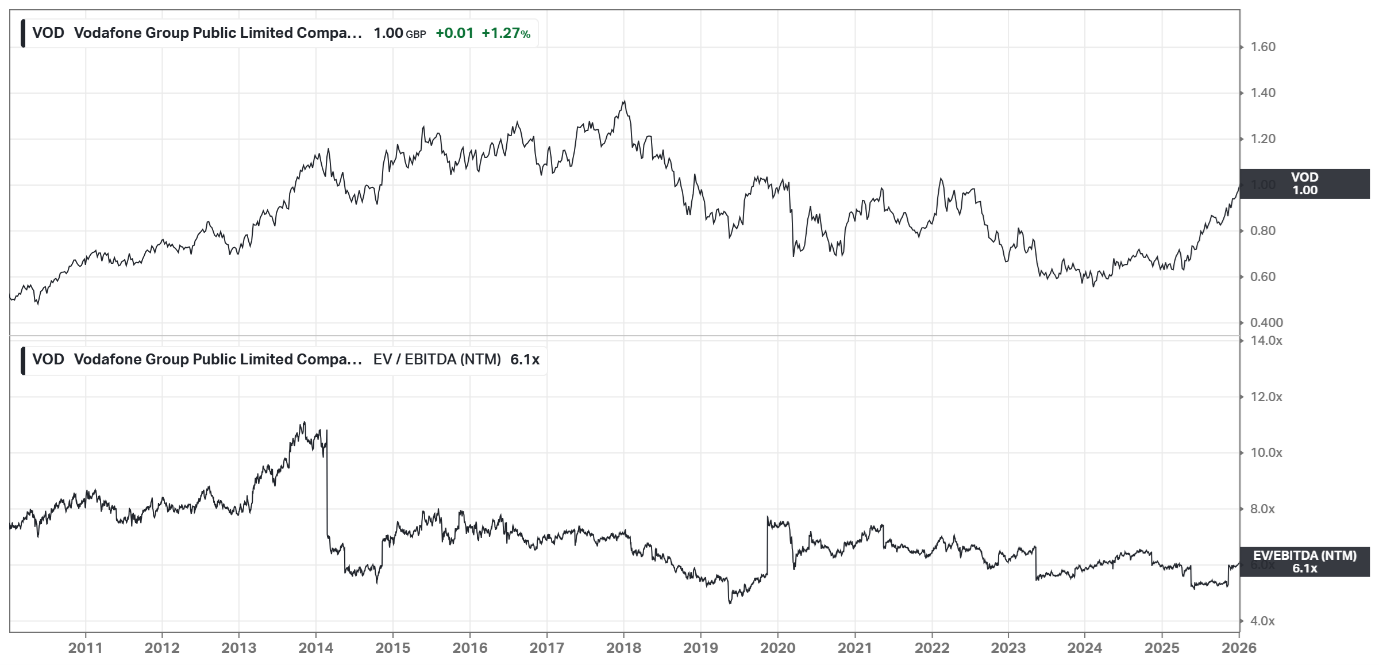
Continued execution in legacy core and successful launch of SatCo should bring multiple expansion overtime. Vodafone, for a time, traded at 7-8x EBITDA and large global peers trade at 6-7x with faster growing TMUS at 9x. Fortunately, the free cash flow inflection from SatCo is so large that this compounding that large equity appreciation does not require multiple expansion beyond peers, despite there being a case to make that this is possible over time. In the event that one or more of the aforementioned call options hit, the story will increasingly evolve away from a sleepy European telecom turnaround to one of innovation – this is where the market may choose to apply a multiple in the range of 7-9x for the earnings growth and capital efficiency.
ROIIC over ROCE
Vodafone and peers are often measured and compared by their return on capital employed, or ROCE. This is a very standard metric which aims to measure the tax-effected operating income against the capital the business has raised or consumed – most simply debt plus equity. However, this is not a good metric for measuring businesses that are undergoing significant change as it holds onto the sins of the past in the denominator. These sins, such as in Vodafone’s case, may take the form of prior acquisitions or misallocation, namely too much debt (though others do exist). Instead of this approach, the market should begin to assess Vodafone on an “incremental” basis, hence return on incremental invested capital, or ROIIC.
This analysis yields very telling results – Vodafone’s newfound and accretive growth driver would yield very large ROIIC.

Qualitative
The “Stock” Story
Vodafone’s rocky path of the last five or so years has significantly impaired their standing in public markets. Repeated endogenous and exogenous shocks hurt financial results, trimmed dividend margin of safety, and led many investors to question their path forward. These effects compound both on each other and with time, compressing the multiple investors are willing to pay for expected future earnings. What should be a defensive large cap with pricing power and stable margins was anything but. Herein lies the opportunity to capitalize on, first, the normalization of results under a new steady-hand, and second, impending technological disruption which SatCo stands to lead in Europe. This is the “value to growth” transition with real market cap that investors dream of finding. Better yet, while historical data is tough to precisely pinpoint, it appears Vodafone has fallen from 3% weight in the FTSE 50 Index ten years ago to just ~0.80% today. Should they execute on the opportunity ahead, they’ll naturally win more passive flows. But they’ll also win meaningful active flows and mindshare as this magnitude of outperformance a key building block of both long-only and long/short portfolios. Best of all, it comes from a stock with a beta of under 0.4 making it very attractive to portfolio managers who operate within risk budgets.
The “Anti-Elon” Positioning
An additional consideration is the likely structure of the D2D industry going forward. History suggests distribution and access to users is one of the top challenges in satellite-to-device communications (for context, “Eccentric Orbits: The Iridium Story” by John Bloom is instructive). Two approaches are emerging. AST has chosen an explicit wholesale model, positioning itself as a neutral partner to carriers–even managing to get “mortal” enemies AT&T and Verizon to invest together. AST’s service will flow through MNO billing and software packages, with consumers largely unaware when their device switches to satellite connectivity. This path to market has secured partnerships covering ~2.8 billion global subscribers, with definitive agreements signed by Vodafone, AT&T, Verizon, Bell Canada, Rakuten, and stc KSA. The continued conversion of this subscriber pool speaks to the comfort that the world’s largest MNOs have in AST’s technology and execution.
Starlink will inevitably share the table in this emerging duopoly. Their terminal business has been highly disruptive to legacy satellite communications, approaching 10 million subscribers globally at $80-120 per month. Their D2D service with T-Mobile currently offers only basic text and voice with mixed reviews; full capabilities are expected in perhaps two years as their spectrum is integrated into iPhones and they launch a new constellation. However, the terminal business’s role in recent global conflicts–coupled with Elon Musk’s personal and political statements–has led many sovereigns and corporates to turn away from Starlink as a partner. To date, Starlink has struck MNO partnerships worth just over 200 million subscribers versus AST’s 2.8 billion.
In an increasingly polarized world where Europe is moving to secure sovereign access to next-generation technology, “anti-Elon” positioning may become an investment theme benefiting Vodafone both directly through SatCo and indirectly via ownership of 14.5 million AST shares. AST management has remained firmly disengaged from any political rhetoric, refocusing conversations on serving their partners–another reason to admire the team. (Disclaimer: This is not intended to denote any specific political leaning of this publication.)
Call Options Beyond Base Case
Beyond the consumer D2D base case of subscriber growth and improved capital efficiency, SatCo creates multiple strategic options that could materially impact Vodafone’s valuation over the coming years.
1. Churn Reduction
A Viasat/GSMA survey indicates 47% of consumers would switch operators to secure satellite coverage. With Vodafone’s ~100 million European customers generating ~€15 billion in annual service revenue, preventing just 3pts of the 15-25pts of annual churn in those markets. Impact could be €450 million in revenue before considering lowered CAC and other offsets. At 35% margins, this retention secures €350 million in EBITDA, roughly 2.5% of FY’26 Group EBITDA.
2. FirstNet of Europe
In the US, FirstNet and AT&T are finalizing an agreement with AST for ~7.8 million connected devices. At a projected $10 monthly ARPU, this yields $750 million in annual EBITDA. Europe offers a comparable €500 million+ EBITDA opportunity. Specifically, the UK Space Agency is actively integrating D2D into its Emergency Services Network, with the Home Office finalizing a £1.11 billion framework for devices by summer 2026. Given Vodafone’s in-country infrastructure and the UK government’s friction with Starlink, SatCo holds the pole position to secure these contracts on existing devices. The European landscape for first responder services is fragmented, presenting challenges in scaling quickly. However, winning in one market may very quickly lead to winning in many.
3. Wholesale Revenue from Competing MNOs
SatCo can monetize competitors who lack D2D access. A “single turnkey arrangement” across 21 EU member states allows Vodafone to sell capacity at high margins. Every 10 million wholesale subscribers signed at €3.50 per month generates over €375 million in incremental EBITDA, assuming 90% margins due to zero acquisition costs and existing system leverage. For some peers, it may turn into a “if you can’t beat them, join them” situation.
4. Additional Spectrum Allocation
European regulators are harmonizing 2 GHz bands for space-to-Earth communications. As the sovereign alternative to American-controlled entities like Starlink, SatCo may gain preferential access to these scarce allocations. This secures a regulatory moat and capacity expansion without competitive auctions, transforming the service from rural enhancement to a genuine traffic-offloading capacity layer. This could occur as soon as 2027 with Echostar’s spectrum expiring.
5. Enterprise IoT Revenue
Vodafone operates the world’s largest IoT platform with 215 million devices. Converting just 3% of this base (6.5 million devices) to satellite at a conservative €7 monthly ARPU generates ~€550 million in annual recurring revenue. Because SatCo’s architecture requires no specialized hardware, this upselling strategy incurs near-zero CAC. These multi-year, 80%+ margin contracts could yield over €400 million in incremental EBITDA.
No other satellite IoT provider has 215M pre-existing customer relationships, integrated billing systems, and global enterprise sales teams embedded in exact verticals satellite IoT serves. Furthermore, SatCo’s direct-to-device architecture enables this without specialized hardware. SatCo could win material market share here.
6. Government & Defense Procurement
The EU has committed €10.6 billion to IRIS² for sovereign space communications. While the current consortium faces development risks, SatCo offers immediate, leading technology with sovereign data control. By 2030, the EU intends to operate 290 satellites providing secure government/military communications independent of foreign control. European policymakers are likely to face a significant challenge in achieving this goal for one simple reason – the technological leap to achieving next generation space-based communications has only recently come into the spotlight and requires years of capital and R&D development. Whether complementing IRIS² or launching a new constellation, this role could generate €200 million+ in EBITDA.
7. Equity Participation from Other European MNOs
Following the TowerCo precedent (American Tower, Crown Castle), other European MNOs may eventually seek equity in SatCo rather than just purchasing capacity. While dependent on JV contract terms, this would monetize Vodafone’s position at a premium and provide capital to accelerate buildout.
8. Appreciation of AST Equity Stake
Vodafone’s 14.5 million share stake in AST is a hidden asset, appreciating to ~$1.4 billion (~€1.2 billion) by early 2026. If AST executes its US commercial launch, FirstNet integration, and government contracts, its valuation could reach $100–300 billion by 2030. This implies an incremental value to Vodafone of $3 billion to over $9 billion.
9. European Digital Sovereignty Infrastructure Status
Digital Sovereignty & Financing SatCo helps fulfill the EU’s Digital Decade Universal Connectivity goals, unlocking European Investment Bank financing and Recovery Fund allocations. The 2025 Airbus partnership further embeds SatCo into the aerospace-defense base. With €47 billion already allocated across German, French, and EU space initiatives, governments have proven they will pay a premium for sovereign infrastructure. There remains a strong opportunity for SatCo to play a complementary role, if not more, as the project progresses. This could take the form of leveraging the existing assets or launching a new constellation altogether. Most importantly, the design enables sovereign control of the movement of data which is not the case in the current design of Starlink’s constellation. This could be worth €200 million EBITDA or much more depending on level of involvement.
Summary: Asymmetric Risk-Reward at Strategic Inflection Point
SatCo represents extraordinary asymmetry at a moment when the technology is actually deployed with AST’s BlueBirds entering commercial service in the coming quarters, and perhaps as important, the EU setting a regulatory path for consumer uses, defense applications, and broader sovereign access and control of space-based telecommunications. Vodafone is quietly positioning itself as the favored satellite connective tissue across Europe precisely when technology maturity, regulatory preference, and geopolitical necessity converge. While markets focus on terrestrial network struggles and simplification strategy, the company engineered first-mover advantage in satellite infrastructure that competitors cannot easily replicate. Wholesale aggregation transforms satellite deployment from competitive threat into infrastructure generating rents from entire European market. Sovereign architecture transforms commercial service into the strategic asset and/or partner European governments need.
This isn’t defensive positioning or speculative bet on emerging technology – it is a strategic repositioning to control essential infrastructure at an inflection point where satellite connectivity transitions from niche emergency feature to mainstream telecommunications capability.
Risks
Technology Risk: AST Could Fail
Satellites are hard. Building the largest commercial phased-array antennas ever deployed in LEO is extraordinarily complex. AST has experienced many delays, and the BlueBird constellation could face technical failures, launch issues, or performance problems that render the service commercially unviable. These are not standardized, mass-produced satellites like Starlink’s current constellation. Each BlueBird represents custom engineering with limited flight heritage. Failure rate could be higher than smaller, simpler satellites. If multiple satellites fail after launch or underperform specifications, the economics of the constellation deteriorate rapidly.
Mitigation: The market is not including any upside for SatCo today. In other words, the D2D upside and optionality are free. Vodafone’s exposure is limited to investments made in AST over a number of years and prepayments, which eliminates balance sheet risk to Vodafone. Cash flow would not decline in the scenario. AST also has holds upwards of $4 billion of cash on their balance sheet after multiple financings in 2025, providing meaningful support in the event something goes wrong.
Competitive Risk: Fiber Could Kill Cable Faster Than Expected
Deutsche Telekom is spending €5-6 billion annually on fiber rollout in Germany. If consumer preference shifts dramatically toward fiber (whether for performance reasons or simple marketing perception) Vodafone’s cable network could become stranded faster than management anticipates.
The existential fear is that cable becomes perceived as “old technology” regardless of actual performance parity. Even if DOCSIS 4.0 delivers 10Gbps speeds (sufficient for a decade), consumer psychology could favor “fiber” as the premium option, forcing Vodafone into a price-over-quality competitive position that erodes margins.
Mitigation: DOCSIS 4.0 delivers 10Gbps, sufficient for the vast majority of consumers for the next decade. The OXG fiber joint venture provides coverage where needed without destroying Vodafone’s balance sheet. And empirically, 80% of consumers don’t actually need or pay for fiber speeds as cable remains “good enough” at lower cost. The German operation also benefits from wholesale revenue diversification through the 1&1 roaming agreement, reducing dependence on retail broadband growth. While fiber is superior in the long run, the Consumer Indifference Threshold is ~500Mbps. Vodafone’s cable hits 1Gbps. For the next 5 years, the CAPEX required to overbuild cable destroys competitor ROIC before it hurts Vodafone’s churn.
Execution Risk: Management Could Stumble
Della Valle’s restructuring has been impressive, but integration is hard. The UK merger involves combining two organizations with different cultures, systems, and customer bases. Post-merger integration failures are common in telecom (overlapping coverage areas create complex site decommissioning decisions, customer migrations can trigger churn spikes, and cost synergies often take longer to realize than projected).
In Germany, the commercial reset could reverse if competitive intensity increases. The deliberate shedding of low-value customers makes financial sense only if branded contract customers remain stable. If Deutsche Telekom or O2 launch aggressive promotional campaigns, Vodafone’s higher-priced positioning could trigger accelerated churn. Management’s response to such a dynamic would be crucial to protecting the large cash flow core in Germany.
Mitigation: Track record matters. This management team successfully sold Spain and Italy at premium multiples, executed the Vantage Towers separation, and stabilized Germany after the MDU television crisis. They’ve earned credibility. The UK merger also has structural advantages) overlapping coverage means immediate spectrum synergies rather than requiring full network integration before benefits materialize. Their approach has proven measured and long-term in nature, while not stretching operations or the balance sheet.
Changes in competitive dynamics are always hard to predict, but the launch of D2D should provide a stabilizing force on Vodafone’s side of the scale in a true competitive service advantage.
Macro Risk: European Recession
A severe European recession would hurt consumer spending on mobile services and delay enterprise IT spending, crimping B2B growth. While telecom is traditionally defensive, a prolonged downturn could force price cuts to retain customers, compressing ARPU growth and delaying the revenue inflection thesis.
The debt burden, while manageable at 2.3x net debt to EBITDA, could become constraining if EBITDA declines. Covenant concerns would limit financial flexibility just when the company needs optionality to navigate the downturn.
Mitigation: Telecom is relatively defensive. People cut streaming subscriptions before mobile connectivity. Government defense contracts are counter-cyclical, security spending increases during geopolitical stress. And at 4-5x EBITDA, significant bad news is already priced in. The stock would need a genuine depression scenario to justify trading materially lower from current levels.
Competitive Risk: Starlink Dominance
Starlink is moving fast. With over 650 direct-to-device satellites already operational and the SpaceX launch advantage providing rapid deployment capability, Starlink could achieve ubiquitous coverage before AST reaches critical mass. If Starlink solves regulatory issues in Europe and offers competitive pricing, SatCo’s differentiation diminishes.
The network effect matters: if consumers become accustomed to Starlink connectivity through early adopter experiences, switching to SatCo later becomes harder. Brand perception of Starlink as “the satellite internet company” could prove difficult to overcome, even with superior technology.
Mitigation: Starlink’s vertically integrated US-controlled architecture faces regulatory headwinds in Europe. The EU’s preference for sovereign alternatives creates structural advantages for SatCo. Additionally, Starlink’s smaller satellites face physics constraints on indoor penetration and data rates that AST’s larger arrays overcome. The wholesale model also allows SatCo to leverage existing MNO relationships rather than building retail customer acquisition infrastructure from scratch.
Conclusion: The Metamorphosis Complete
Vodafone is not a turnaround story–it is a completion story. The painful work of shedding broken assets, rationalizing the portfolio, and stabilizing the core markets is done. Germany has absorbed the Nebenkostenprivileg shock and is lapping easy comparables with structural hedges in place. The UK has transformed from a four-player dogfight into a rational duopoly with £700 million of synergies on the come. What remains is a concentrated portfolio of #1 and #2 market positions generating €11+ billion of EBITDA, trading at a trough multiple with a 4% yield and 8% free cash flow yield.
The market prices Vodafone as a melting ice cube. It is not. It is a stabilizing utility with defense-grade space infrastructure optionality attached for free. SatCo represents the kind of asymmetric setup that rarely presents itself in public markets: Vodafone funds 3-5% of the constellation costs but owns 50% of the European JV, holds 14.5 million AST shares worth ~$1 billion, and sits at the center of Europe’s sovereign connectivity ambitions at a moment when governments are writing large checks for exactly this capability. If AST executes–and six satellites in orbit with video calls to unmodified phones suggests the technology works–the call options alone could exceed Vodafone’s current market cap.
The base case requires nothing heroic: mid-single-digit EBITDA growth from Germany/UK stabilization, modest multiple expansion as execution de-risks the story, and continued dividend support. That path delivers double-digit annualized returns. The bull case–where SatCo captures meaningful D2D share, first responder networks materialize, and AST’s valuation continues its trajectory–delivers multiples of that. At trough valuation with a beta under 0.4, the risk/reward is as asymmetric as it gets in European telecom. The market will eventually notice. The question is whether you own it before they do.
Appendix
Failed Sprawl Strategy: How We Got Here
The Imperial Era (FY2018-FY2020)
The Vodafone of 2018 sought sprawling scale, believing that owning the entire connectivity stack from mobile to fixed to TV would create an unassailable moat against churn. The Liberty Global acquisition exemplified this thinking in an €18.4 billion acquisition to secure cable assets across Germany and Central Europe, adding Gigabit capability to 50 million homes. The logic was to cross-sell broadband to mobile customers, extract synergies, and dominate the pipe.
The deal leveraged an already-stretched balance sheet just as 5G spectrum auctions began draining capital. By mid-2019, the board capitulated, cutting the dividend 40% to “rebuild headroom.” Shareholders revolted with the realization that the empire was consuming more capital than it generated. The share price hemorrhaged value even as management insisted the sum of the parts exceeded the market cap. Scale, it turned out, was not the same as returns.
The Interregnum (FY2021-FY2022)
CEO Nick Read’s tenure was defined by a search for something between continued expansion and outright retreat. The “Tech Comms” strategy attempted to reframe Vodafone as a technology platform rather than a traditional telco. Towers were spun into Vantage. Digital sales channels proliferated. The “Social Contract” narrative positioned the company as an essential utility deserving regulatory relief.
Activist investor Cevian Capital arrived in early 2022, arguing the portfolio was too complex and management too slow. Their thesis read that Vodafone lacked the operational focus to manage such a disparate collection of assets. The share price had fallen from £1.35 to £0.80 over the prior 7 years, failing to regain its 8x EBITDA multiple from a prior era.
Enter Margherita Della Valle as CEO in April 2023 from the CFO role.
EU Market: “Regulate and Then Cannot Innovate”
Regulatory Principles
The European telecom regulatory framework operates under a fundamentally different philosophy than the United States, prioritizing consumer welfare and market competition over operator profitability. Emerging from the European Commission’s 1987 Green Paper, the Framework Directive and subsequent regulatory packages (2002, 2009, 2018) enshrine core principles that structurally disadvantage operators: aggressive retail price caps that fail to keep pace with inflation, mandatory wholesale access forcing incumbents to share networks with mobile virtual network operators (MVNOs) at cost-based rates, spectrum auctions designed to maximize government revenue extraction, regulatory fragmentation requiring negotiation of 27 separate frameworks across EU member states, and investment obligations without corresponding pricing power to recoup costs. European regulators view telecom as an essential utility requiring affordable access for all citizens, creating an everlasting challenge where operators must invest billions in infrastructure, share it with competitors at regulated rates, all without the ability to price services adequately to earn returns on capital.
Decade of Value Destruction
The fundamental challenge facing the European telecom industry is the divergence between the cost of production and the price of the product. While data consumption has followed an exponential growth curve, driven by the streaming revolution, the normalization of hybrid work, and the proliferation of Internet of Things devices, revenue growth has remained stubbornly decoupled from usage.
In the UK, monthly mobile gigabytes consumption grew approximately 3x from 2020 to 2025 (~13.5GB/month) while ARPU grew under 10% (GBP 13.2), resulting in an ARPU per GB of ~£1.0. In Germany, consumption grew 2.4x to 2025 (8.5GB) and ARPU was down ~10% (€10.15), yielding an ARPU per GB of €1.20. For comparison, while US consumption grew 2.5x to ~25GB in 2025, the ARPU per GB stood at just over $2.00. In the fixed-line segment, consumption per household is expected to quadruple from 225 gigabytes per month in 2022 to 900 gigabytes per month by 2030, driven primarily by video traffic which accounts for nearly three-quarters of all volume.
This problem was exacerbated by the broader macroeconomic environment. Kearney highlights a Telecom Paradox in Germany where the Consumer Price Index basket increased by nineteen percent between 2020 and 2024 due to soaring energy and food costs, while wireless communication prices actually declined by six percent over the same period. Unlike energy utilities, which could pass on input cost increases to consumers, telecom operators lacked the pricing power to do so. This inability to index prices to inflation is rooted in intense competition, market saturation, and principled regulations of the continent.
Investment Crisis When Returns Fall Below Capital Costs
The financial health of the sector reveals a fundamental economic breakdown. There remains a stark investment gap where European operators have invested billions in 5G and fiber spectrum and infrastructure yet have failed to see a corresponding uplift in returns. The core issue is many major European operators achieve just mid-single digits ROCE vs. US peers in the high single digits. This creates a massive delta in network outcomes when compounded over many years. This disconnect effectively freezes investment. Operators focus on dividends and deleveraging rather than network expansion because the market penalizes them for investing.
Again, much of this can be traced back to the inability to price the service to achieve adequate returns. The contrast with high-performing markets is stark. While mobile ARPU in the United States hovers around €42.5 and South Korea at €26.5, the European Union average languishes at ~€15. The European consumer pays roughly half of what a Korean or Japanese consumer pays, which is often celebrated as a victory for EU consumer protection policy. In truth, it has starved the industry of the revenue required to maintain world-class infrastructure. European operators are expected to build Ferrari networks on Fiat budgets.
The Fragmentation Problem
The European Union sits in an uncomfortable middle ground. It lacks the fiber density of Japan to drive ultra-low latency and lacks the consolidated scale of the US to drive massive C-band throughput. Fragmented markets (a term that could be applied in numerous contexts) result in European operators often upgrading their networks in disjointed phases. One country might be rolling out 3.5 GHz 5G while its neighbor is still clearing the band of legacy users.
Unlike the US, where the FCC auctions spectrum for the entire nation, spectrum in the EU is auctioned at the national level. This leads to a patchwork of license durations, coverage obligations, and pricing. Some countries view spectrum auctions as a mechanism to maximize state revenue (extracting billions from telcos), while others view them as a tool to drive coverage (accepting lower fees in exchange for build-out guarantees). This inconsistency creates an uneven playing field and complicates cross-border network planning.
Throughout the FY2018-FY2026 period, management consistently identified market fragmentation as the primary structural impediment to returns. Spain’s exit was explicitly justified by the presence of over 70 retail brands competing across five fiber networks. In such markets there is simply no sustainable pricing power.
Germany: Vodafone’s Core Stabilized, Defenses Built
Germany faced existential pressure when July 2024’s Nebenkostenprivileg abolition vaporized €800 million in high-margin TV revenue overnight. Vodafone retained 50% of 8.5 million affected households through aggressive re-contracting, followed by several strategic defensive moves to protect against another body blow. This practical strategic approach would continue, demonstrating acute attention to consumer preferences, and a desire to avoid large capital deployment, instead opting for JVs that hedge future technology exposure.
The MDU Television Crisis (FY2023-FY2025)
The abolition of the Nebenkostenprivileg law, which allowed landlords to bundle TV costs into rent, put €800 million of high-margin (80-90%) television revenue at immediate risk. This wasn’t a gradual headwind, rather a cliff edge. The regulatory change forced a challenging transition from B2B2C (contracting with housing associations) to direct B2C (individual tenant contracts).
Vodafone launched a massive re-contracting effort, migrating 4 million households to individual agreements. Management argued the retention rate of ~50% reflected the loss of predominantly passive, low-value users who likely never engaged with the service. There remains debate as to whether churned subs were actually “ghost subs” who paid due bundling but never used the service. The retained base represented active, higher-value customers with genuine usage patterns. Aggregate German market monthly ARPU now sits 10% above trough levels suggesting some degree of mix shift.
Nonetheless, the transition created a hole in cash flows as German market EBITDA fell ~15% from CY’23 into CY’24. Signs of stabilization are now presenting as the market settles and the business laps easy compares. The removal of this structural overhang allowed management to refocus the investment case on organic growth drivers rather than defensive re-contracting. Net Promoter Scores also hit record highs. Churn in the mobile base dropped to four-year lows. The turnaround appears to have taken hold.
The Cable vs. Fiber Existential Debate: OXG as Strategic Hedge
The technology debate in Germany cuts to Vodafone’s long-term viability. The broadband hierarchy is as follows:
· VDSL (Deutsche Telekom’s legacy copper): 50-100 Mbps, being phased out
· Cable/DOCSIS (Vodafone’s current network): 1 Gbps today, upgradeable to 10 Gbps with DOCSIS 4.0
· Fiber-to-the-home (FTTH, Deutsche Telekom’s offensive weapon & OXG): Multi-gigabit symmetrical, highest capex
Deutsche Telekom has weaponized FTTH deployment, explicitly ceasing VDSL marketing in fiber areas to pressure cable incumbents. VDSL (Very high-bit-rate Digital Subscriber Line) is Deutsche Telekom’s legacy copper-wire broadband technology delivering 50-100 Mbps over traditional telephone lines. By abandoning VDSL customers in areas where it has deployed fiber, Deutsche Telekom signals that copper-based broadband is obsolete, implicitly positioning Vodafone’s cable network as similarly outdated legacy infrastructure.
The narrative from competitors and skeptical analysts is consistent: cable is yesterday’s technology, and Vodafone’s DOCSIS infrastructure faces terminal depreciation in the face of fiber overbuild. Cable/DOCSIS is the technical standard that enables broadband internet delivery over the same coaxial cable lines originally built for television service, or cable TV infrastructure repurposed for high-speed internet.
Vodafone’s defense rests on technological and economic arguments. Current consumer demand doesn’t justify the fiber premium as a majority of customers remain on sub-250Mbps plans where cable and fiber are functionally indistinguishable. The upgrade path for cable networks remains economically superior to fiber trenching. “High Split” technology, which reallocates frequency spectrum within the existing coaxial cable to dramatically improve upload speeds, can be deployed through software and electronics upgrades at street cabinets without digging up streets. More significantly, DOCSIS 4.0 (the next-generation cable standard) promises 10 Gbps symmetrical speeds at a fraction of the civil engineering cost required for fiber trenching, which involves physically excavating streets and running new glass fiber cables to every home.
Vodafone’s cable network currently reaches 24 million homes at gigabit speeds, delivering approximately €3 billion in annual broadband revenue. But management hedged its infrastructure risk through the OXG joint venture with Altice, a defensive but financially rational strategy that warrants closer examination.
OXG Economics: Capital-Light Fiber Optionality
The JV structure, closed in March 2023, targets 7 million FTTH homes by 2029 with up to €7 billion in total investment. Critically, Vodafone owns 50% of the JV but contributes minimal net equity. The capital structure is 70% debt-financed (€4.9 billion in non-recourse project debt), leaving €2.1 billion in equity split equally between partners. However, Altice paid Vodafone €1.2 billion in cash for the 50% stake through upfront, deferred, and performance payments. As a result, Vodafone may receive more cash from Altice than it contributed in equity over time–effectively being paid to hedge cable obsolescence risk in its most valuable market.
Execution Reality: Behind Schedule but Strategically Sound
As of December 2025, OXG has passed 1.35 million homes across 39 cities – behind the pace required to hit the 7 million target by 2029. The slower-than-expected build does not undermine the strategic logic. OXG focuses 80% of deployment on large housing associations within Vodafone’s existing cable footprint–precisely where the competitive threat is most acute. These are the locations where landlords demand fiber and Deutsche Telekom threatens competitive overbuild. Without a fiber response, Vodafone risks losing entire buildings to Deutsche Telekom’s FTTH rollout, as landlords increasingly require fiber availability in new contracts. By selectively deploying fiber in these high-value multi-dwelling units, Vodafone blocks competitors from locking up entire buildings while preserving capital for broader cable network upgrades using DOCSIS 4.0.
The defensive posture extends beyond simple customer retention. Germany’s housing association contracts often cover hundreds or thousands of units under single agreements–losing one contract means losing an entire building’s worth of subscribers simultaneously. OXG’s targeted approach protects these concentrated revenue pools. The open-access wholesale model creates additional optionality, with other providers (including 1&1) able to purchase wholesale access and generate infrastructure revenues even from non-Vodafone customers.
Whether OXG hits the 7 million target matters less than whether it successfully defends Vodafone’s highest-value customer segments from fiber-driven churn. If OXG passes 3-4 million homes concentrated in urban housing associations, it achieves its defensive mission. Vodafone’s net positive cash position and 50% ownership without proportional equity risk makes this a structurally advantaged hedge, not a bet-the-company fiber transformation. The central gamble remains technology: can Vodafone’s hybrid approach of DOCSIS upgrades plus selective OXG fiber preserve Germany’s ~€3 billion broadband revenue stream against full-fiber competitors?
Commercial Reset: Value Over Volume
The German turnaround required more than an infrastructure hedge - it demanded a fundamental commercial reorientation. Under new local management, Vodafone pivoted aggressively away from volume-chasing tactics. Low-value reseller SIMs were deliberately shed, creating negative mobile net additions in FY 2025 and FY’26 that spooked headline-focused investors. But the underlying story was healthier as branded contract churn reached historic lows (single digits) in Q1 FY’26.
The €5 broadband price increase executed in 2023/2024 proved critical. While it triggered a temporary “hangover churn” spike, the move successfully re-based ARPU significantly higher. Management noted the churn impact was lower than business case assumptions, validating the essential utility nature of broadband connectivity as customers complain about price increases but rarely disconnect.
The 1&1 Wholesale Hedge
A strategic windfall arrived via the 1&1 national roaming agreement. As Telefonica Deutschland lost this contract, Vodafone captured it, providing wholesale 5G network access to 1&1’s 12 million customers. This created a beautiful irony. On paper, 1&1 is a competitive threat as a new mobile entrant building their own network. In reality, their buildout is behind schedule, forcing them to lease Vodafone’s network through a long-term national roaming deal.
If 1&1 succeeds and steals customers, they pay Vodafone wholesale fees for the data transport. If they fail, Vodafone keeps those customers. It’s a perfect hedge - you win either way. And the wholesale revenue is already starting to ramp, contributing to that return to growth in German service revenue. The agreement commenced in August 2024, immediately providing nationwide 5G access that 1&1 could not deliver independently.

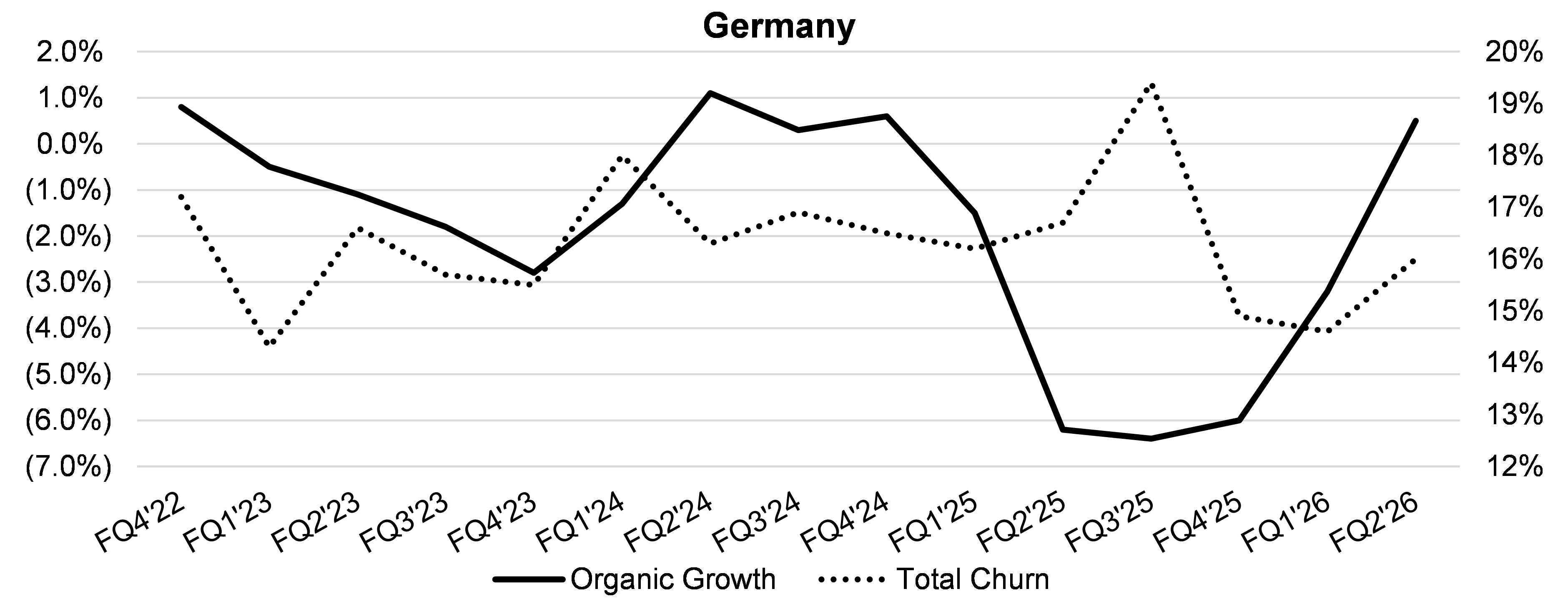
United Kingdom: From Dogfight to Duopoly
The UK market has been a four-player bloodbath for years - EE, O2, Vodafone, and Three all fighting for the same customers with returns below the cost of capital. Vodafone’s merger with Three UK closed in May 2025, changed everything. Vodafone and Three rounded out the top 4 players with 20-25% and 10-15%, respectively, and moved to becoming the largest.
Creating the Market Leader
The UK merger with Three was announced in June of 2023, owned by CK Hutchison. Regulatory approval for the ~£16 billion deal came with conditions in December 2024 and closed in May 2025. This addressed Vodafone’s scale deficit head-on, creating a combined entity with approximately 29 million subscribers, making them the largest UK mobile operator. More importantly, they have perhaps the deepest spectrum portfolio. The expected synergies are massive at £700 million annually by year five, mostly from decommissioning 8,000 duplicate cell sites, and are said to be running ahead of expectations. Management estimates the NPV of synergies at over £7 billion, or nearly equal to the current implied enterprise value of the UK business. By Q1 FY’26, the deal was operational, delivering immediate network performance gains, with management citing Three customers seeing 4G speeds jump 40% overnight through spectrum sharing.
The Regulatory Breakthrough
The approval of the Vodafone-Three merger in the UK on December 5, 2024, marked the single most transformative event for the sector in a decade. Historically, UK regulators hated “4-to-3” mergers. But the wind has shifted. The Competition and Markets Authority explicitly prioritized network resilience and investment security over short-term price competition.
The CMA approved the deal with behavioral remedies instead of structural divestitures. These include binding £11 billion investment commitment over 10 years, temporary price caps on value-tier plans for three years, and pre-set wholesale prices for MVNOs.
This was a watershed moment for both Vodafone and the UK market. For the first time in over a decade, a major European regulator acknowledged that sub-scale operators cannot fund the infrastructure investments required for 5G Standalone networks and that market structure matters for long-term investment. The shift from four to three mobile operators fundamentally altered competitive dynamics, creating rational behavior incentives that had been absent in the more fragmented structure.
The UK merger exemplifies Della Valle’s broader strategic philosophy: exit where you can’t win, consolidate where scale matters, monetize non-core assets.
DISCLOSURE
Position: At the time of publication, the author owns Vodafone shares and LEAPs. The author also holds positions in AST SpaceMobile (ASTS).
Trading Policy: The author will not materially alter this position within 48 hours of publication. After this period, the author may buy, sell, or otherwise adjust the position without further notice. Changes to the author’s view or position will be reflected in subsequent publications when material.
Conflicts: The author has received no compensation from the issuer or any party with a financial interest in this security.
Forward-Looking Statements: This report contains the author’s opinions, estimates, and projections, including price targets derived from financial models. These are forward-looking statements subject to substantial uncertainty. If these assumptions prove incorrect, the actual value may differ materially, including scenarios of significant loss or total impairment. The price target represents the author’s estimate of fair value under the stated assumptions, not a prediction of where the stock will trade.
This report is provided for informational purposes only and does not constitute investment advice. See the full Terms & Disclosures for additional important information.
Thought provoking piece, thanks for writing