


First, this post leverages the work of dozens of others who have scraped and aggregated details over years to bring the nitty gritty of the direct-to-device (D2D) market to light. It would not be possible without them - thank you. My only goal here is to provide a balanced, head-to-head comparison of the two D2D players who will likely own the market and transform communications in the next 12 months. Welcome feedback if my technical details are wrong!
This Friday, SpaceX will begins trading… SPCX… $135/share… raise of about $75 billion… valuation of ~$1.75 trillion. The largest IPO ever. Starlink, with $11.3 billion of 2025 revenue and 10.3 million subscribers, is the near term engine of any fundamental valuation.
Buried in the competition language of that S-1 is a company with seven satellites, $70.9 million of trailing revenue: AST SpaceMobile.
This post is about why those two companies, and for broadband purposes only those two, are racing for the same prize: turning every ordinary smartphone on Earth into a satellite phone. No app. No antenna. No new hardware. The phone already in your pocket, connecting to space when towers cannot reach it.
The market understands roughly half of this race, the Starlink half. The other half is one of the more interesting under-examined setups in public markets. Some institutions have shunned the other half because of the “Space Mob” stereotypes thrown around, the pre-revenue nature, or simply for fear of buying an Elon competitor. What follows is the logic, in seven pictures. I have tried to make every chart honest enough that a Starlink bull could read it without objecting to the facts.
(Disclosure and method notes at the end. Nothing here is investment advice.)
1. The race almost nobody is pricing
D2D service is already real. T-Mobile sells it today for $10 a month, powered by Starlink. Millions of people used it during the 2025 hurricane season. Apple’s Emergency SOS has quietly routed iPhone messages through Globalstar satellites since 2022.
Here is what the headlines miss: everything live today is narrowband. Texting. Location pings. Compressed voice in beta. The real prize is full cellular broadband from space to an unmodified phone, the thing that actually replaces a cell tower. That category has exactly two credible entrants, and as of this morning, zero occupants.
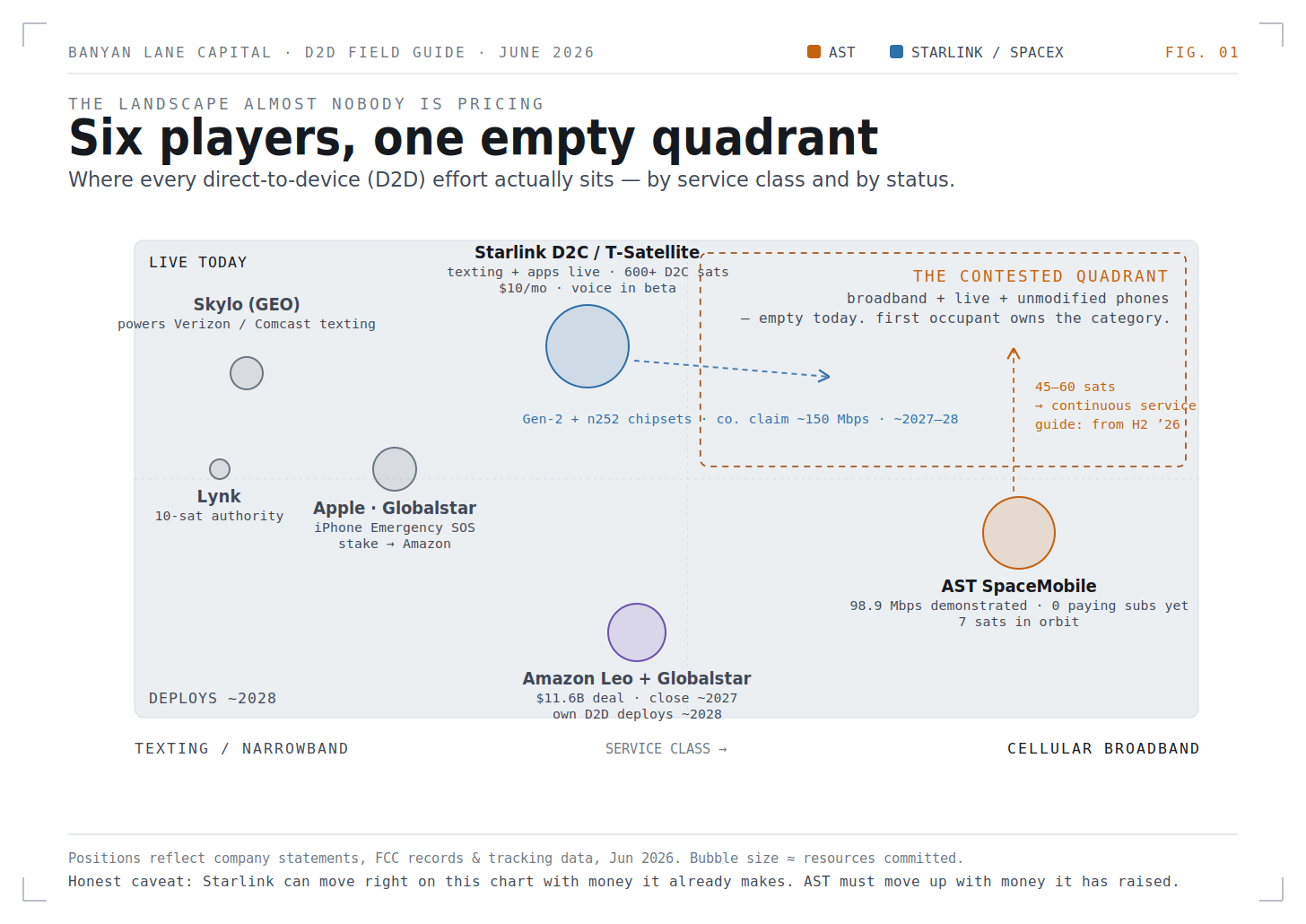
Chart positions D2D players by service class and deployment status, showing Starlink live in narrowband moving toward broadband, AST SpaceMobile in broadband but pre-commercial, and an empty contested quadrant for live broadband service.
Amazon bought its way to a third seat in April, paying $11.6 billion for Globalstar. But its own D2D system starts deploying around 2028, at best, and likely later given its leading peers have shown it can take multiple years to design and engineer the right satellites for proper service. Skylo and Lynk sell texting. China is building a parallel system closed to Western operators anyway. Through at least 2028, broadband from space to your phone is Starlink versus AST SpaceMobile.
One of those names trades at a $1.75 trillion target. The other is a roughly $35 billion company with a devoted retail following, thin institutional coverage, and near-zero recognition among the general public. That awareness gap is not itself a thesis. It is the precondition for one.
2. Two ways to build a cell tower in space
The physics problem is brutal and identical for both companies. A smartphone transmits about 0.2 watts from a tiny antenna that points nowhere in particular. To serve it from orbit, a satellite has to hear that whisper from roughly 500 kilometers up, then whisper back loudly enough to be heard indoors.
The two companies answered with opposite machines.
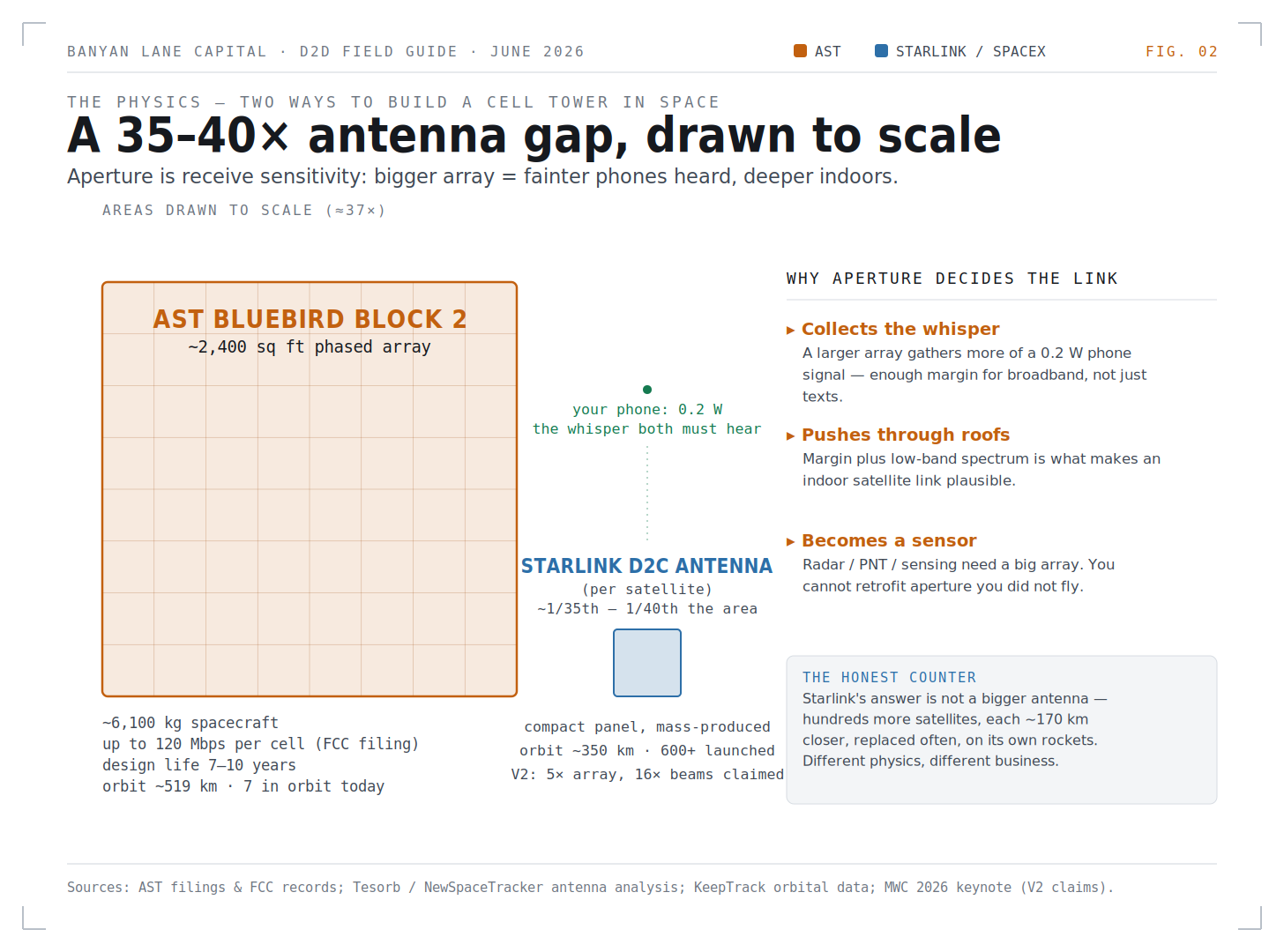
Drawn to scale. AST’s answer is the largest commercial antenna ever deployed in low Earth orbit. Starlink’s answer is hundreds more satellites, flying closer.
AST builds enormous satellites: about 2,400 square feet of phased array on a 6,100 kg spacecraft, the largest commercial antennas ever flown in low orbit. Antenna size is receive sensitivity. AST’s array is roughly 35 to 40 times the size of Starlink’s per-satellite D2D antenna. That is what lets one AST satellite deliver up to 120 Mbps per cell (per its FCC filing) and close a link through a roof. Management has guided to 150Mbps per cell and some AST sleuths have shown this number could grow by multiples as they release their new ASIC and bundle additional technology. It also opens a second business for large government contracts in defense and otherwise.
Starlink builds compact panels on mass-produced buses and compensates with numbers: more than 600 D2D satellites launched, flying about 170 km lower, replaced often, on rockets it owns. Its Gen-2 satellites claim five times the antenna and roughly 100 times the data density of today’s.
Any cell, terrestrial or orbital, is a shared medium. AST’s 98.9 Mbps demo is a link-budget triumph, not a capacity claim. Within each satellite cell, bandwidth is shared among every active user, and by my math both constellations deliver a tiny fraction of terrestrial capacity density: on the order of 0.1 Mbps per square kilometer averaged across the US. Satellite D2D is a coverage business. Starlink’s path to more capacity is more satellites and tighter frequency reuse. AST’s is wider spectrum slices and beamforming. Neither will ever replace towers where towers exist, and neither is trying to, so far.
And one asymmetry the antenna chart cannot show: the ground. AST’s design routes every call through a gateway station, so a satellite must see one to deliver service. Continuous coverage needs a parallel build-out of earth stations, with all the permitting and fiber that implies. Starlink’s laser links let satellites hand traffic to each other and come down wherever convenient, which is a genuine architectural edge in some ways and downside in others (see prior posts on data sovereignty). AST’s partial answer is baked into its business model: carriers buy the gateways. Gateway hardware is most of AST’s booked revenue today. That shares the cost without erasing the execution risk.
Neither approach is wrong. They are different bets: physics per satellite versus economics per fleet. But for the specific job of broadband to an unmodified phone, indoors, the antenna math favors the big satellite. Which leads to the more interesting question.
3. The spectrum chess game (think of it like sound)
Radio frequency behaves like sound. Bass travels through walls. Treble does not. Low-band spectrum (700/800/850 MHz) penetrates buildings, cars, and forests. Mid-band S-band spectrum near 2 GHz is crisp outdoors and dies at the drywall.
Now look at who holds what.
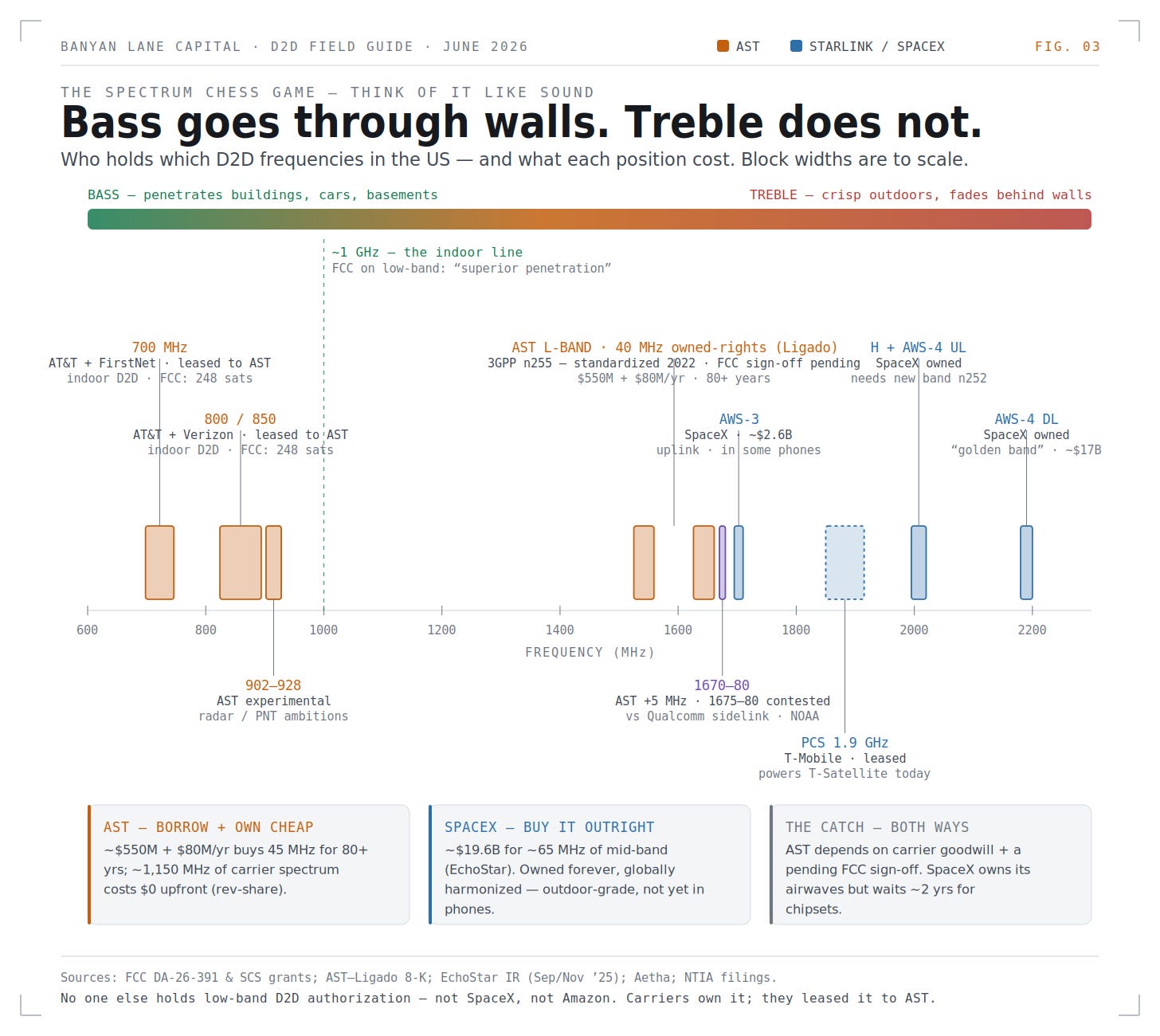
US D2D spectrum map, to scale. AST borrowed the bass from the carriers and bought the mid-range cheap. SpaceX bought the treble outright, for about $19.6 billion.
AST’s position is the one the market has not absorbed. In April, the FCC authorized up to 248 AST satellites to operate commercially on 700 and 800 MHz low-band: AT&T’s, Verizon’s, and FirstNet’s own frequencies, leased to AST for revenue share, with zero dollars upfront. No other company on Earth holds an indoor-capable D2D authorization. Not SpaceX. Not Amazon. The carriers own that spectrum, and they chose their partner.
The fine print that bulls skip: the authorization comes with leashes. Under the FCC’s Supplemental Coverage from Space rules, satellite service is secondary to terrestrial networks. Transmit power is capped to protect towers, with coordination back-offs near market boundaries and the Canadian and Mexican borders. The bass advantage is engineered for dead zones, the empty fifth of the US landmass that towers do not reach, not for downtowns, which the capacity math rules out anyway. The moat is real. It is also regulated.
On top of the leased low-band, AST locked up 45 MHz of L-band from Ligado for about $550M upfront plus roughly $80M a year for 80-plus years. Pocket change next to what SpaceX paid EchoStar: about $19.6 billion for roughly 65 MHz of S-band. SpaceX’s spectrum is genuinely valuable, owned outright and globally harmonized. It is also treble, outdoor-grade. And it has a second problem that deserves its own chart.
4. The clock inside your phone
A satellite band is only real once phones support it. This is the most underrated fact in the entire race, and it is where the two strategies diverge hardest.
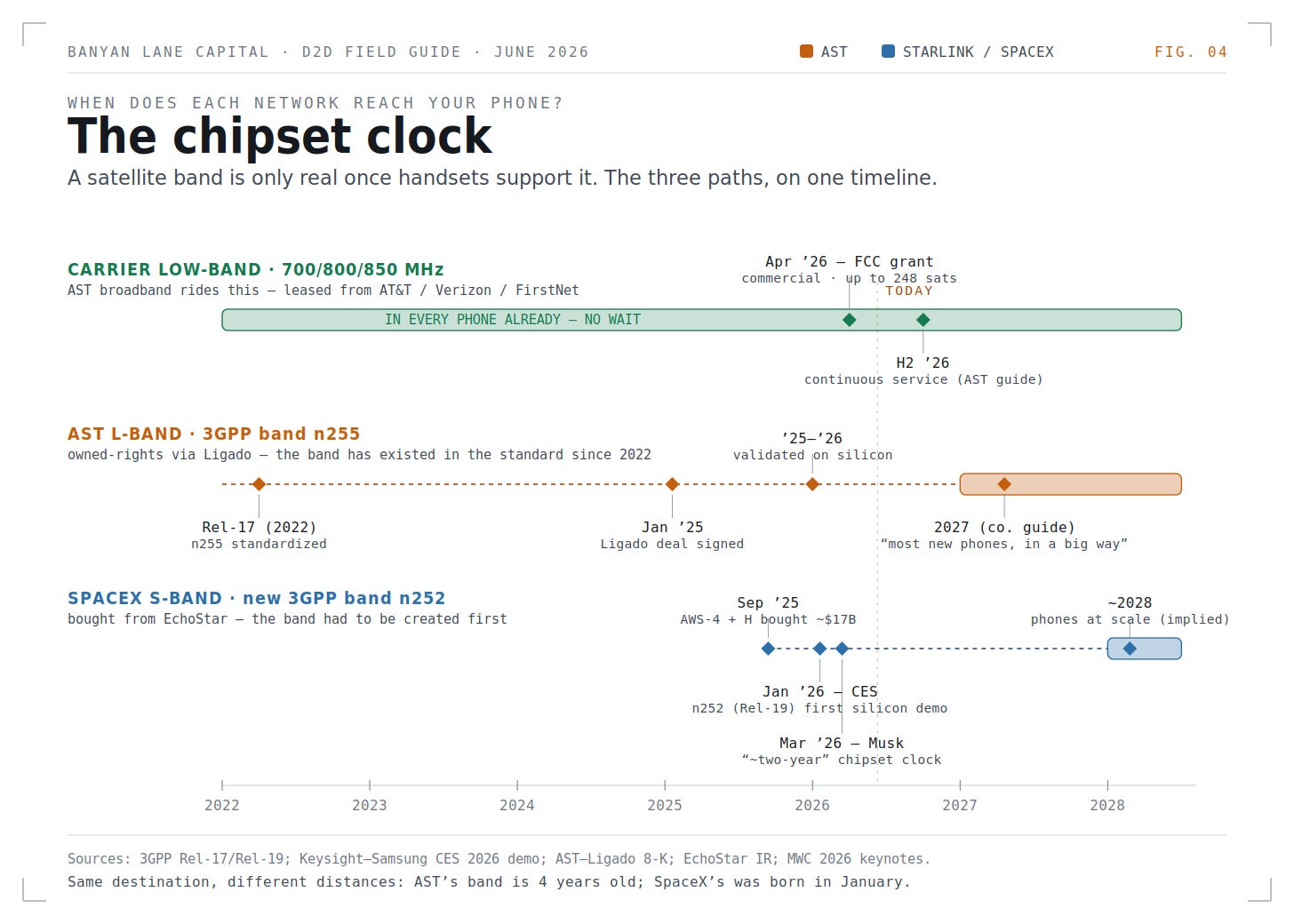
Three paths to your phone. The carriers’ low-band is already in every handset. AST’s L-band has existed in the 3GPP standard since 2022. SpaceX’s band was born in January.
AST’s primary play, riding the carriers’ low-band, requires no new chipset at all. Every phone sold in the last fifteen years already speaks 700 and 800 MHz. That is what “broadband to an unmodified phone” actually means, and AST has demonstrated it: 98.9 Mbps to a standard handset, native video calls included.
AST’s L-band sits inside 3GPP band n255, standardized in Release 17 back in 2022 and already validated on commercial modem silicon. Management guides for L-band support in “most new phones in a big way” from 2027.
SpaceX’s new S-band holdings only partially overlap the existing standard, so the industry had to create a new band: n252, under Release 19, which got its first commercial-silicon demo at CES this January. When Musk said at MWC that broad chipset support is about two years out, that was not pessimism. It is the normal speed of the standards-to-silicon-to-handset pipeline. Until then, SpaceX’s $19.6 billion band waits.
The honest sequencing: AST’s spectrum works in your current phone. Its second band arrives in next year’s phones. SpaceX’s band arrives roughly with the 2028 model cycle.
5. What they have promised, and what we actually expect
Both companies have put specific guidance on the record. The chart below shows it side by side, along with one adjustment of ours, clearly marked.
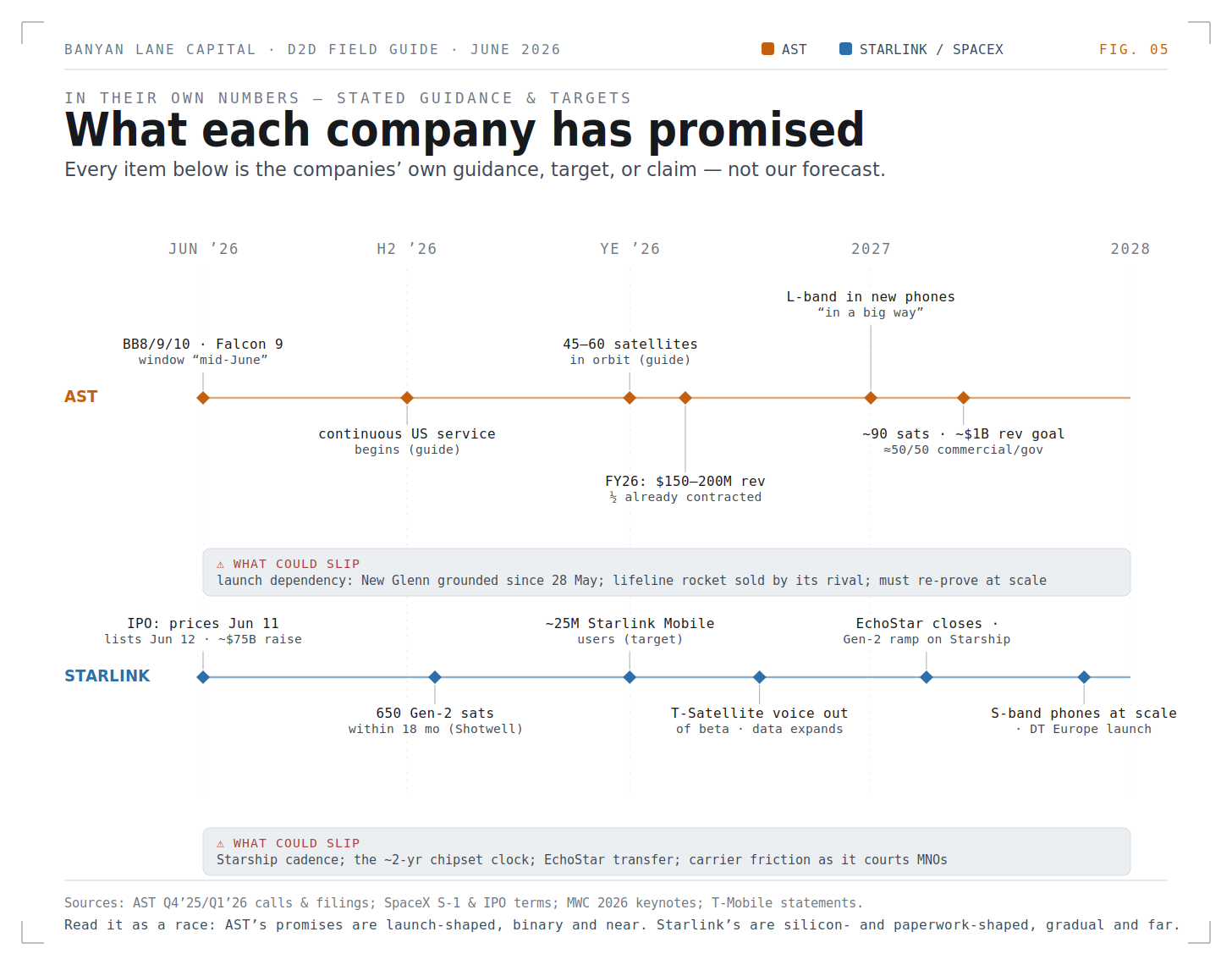
Dual timeline from June 2026 to 2028. The AST rail shows launches, continuous service guidance, revenue targets of 150 to 200 million in 2026 and about 1 billion in 2027, plus an adjusted base case of about 30 satellites by year-end 2026 with 45 to 60 shifted to Q1 2027. The Starlink rail shows the IPO, Gen-2 deployment, a 25 million user target, and 2028 chipset and Deutsche Telekom milestones.
AST has guided to: 45 to 60 satellites in orbit during 2026 (BlueBirds 8, 9 and 10 are stacked on a Falcon 9 for a mid-June window); continuous US service beginning in H2; $150 to 200M of 2026 revenue with half already contracted; and roughly $1 billion in 2027, split about 50/50 commercial and government, on roughly 90 satellites. It holds about $3.5 billion of cash and says it is fully funded for the build, at $21 to 23M per satellite. Behind the guidance sits a contracted floor: $1.2 billion of take-or-pay commitments, including a $175M prepayment from STC.
Our adjusted base case, shown on the chart: launch cadence rarely forgives. With New Glenn grounded since its May 28 pad explosion and Falcon 9 manifest slots finite, we pencil in roughly 30 satellites by year-end 2026, with the 45 to 60 threshold reached in Q1 2027. What that one-quarter slip means: continuous service and the uncontracted half of the 2026 revenue guide slide toward 2027, since carriers will not bill retail customers for intermittent coverage. Revenue leans on the contracted floor: gateway sales, prepayments, and government milestones, which usefully scale with satellite count rather than the finished constellation. With $3.5 billion of cash this is not a solvency question, but it reopens the dilution question in 2027, from a weaker share price, before carrier revenue proves out if there are issues getting service running as expected. That is the nature of a launch-shaped thesis: the same binary that can re-rate the stock this autumn can push the story out a year.
Starlink and SpaceX have guided to: 650 Gen-2 satellites within 18 months; about 25 million Starlink Mobile users by year-end (their target); T-Satellite voice out of beta and data expanding; a Deutsche Telekom launch across 10 European countries in 2028; and the IPO itself, which makes the war chest effectively unlimited. One strategic read worth a sentence: the $19.6 billion EchoStar purchase bought independence, the option to operate as a global carrier keeping 100% of the revenue per user rather than splitting it as a wholesale partner. SpaceX traded two years of chipset lead time for permanent margin control. The Deutsche Telekom deal shows it will happily run both models at once. However, DT has also publicly stated they may pursue a dual course strategy with other operators, presumably AST.
The asymmetry matters. AST’s promises are binary and near. Rockets fly and satellites work, or they do not, and we will know within quarters. Starlink’s are gradual and far: chipsets, regulatory transfers, Starship cadence. The next two quarters stress AST harder. The next two years stress Starlink.
And the honest ledger requires this paragraph. AST is behind. It has seven satellites and zero paying subscribers. It buys launch from others, currently including its rival’s Falcon 9. It must deploy, then re-prove at constellation scale what it has so far proven in tests. The hardest engineering work is plausibly done: design frozen, factories running, FCC cleared, carriers signed, capital raised. The hardest operational stretch starts now.
6. The quiet customer
Here is the part of the AST story that gets priced last, and where I will be most careful to separate fact from thesis.
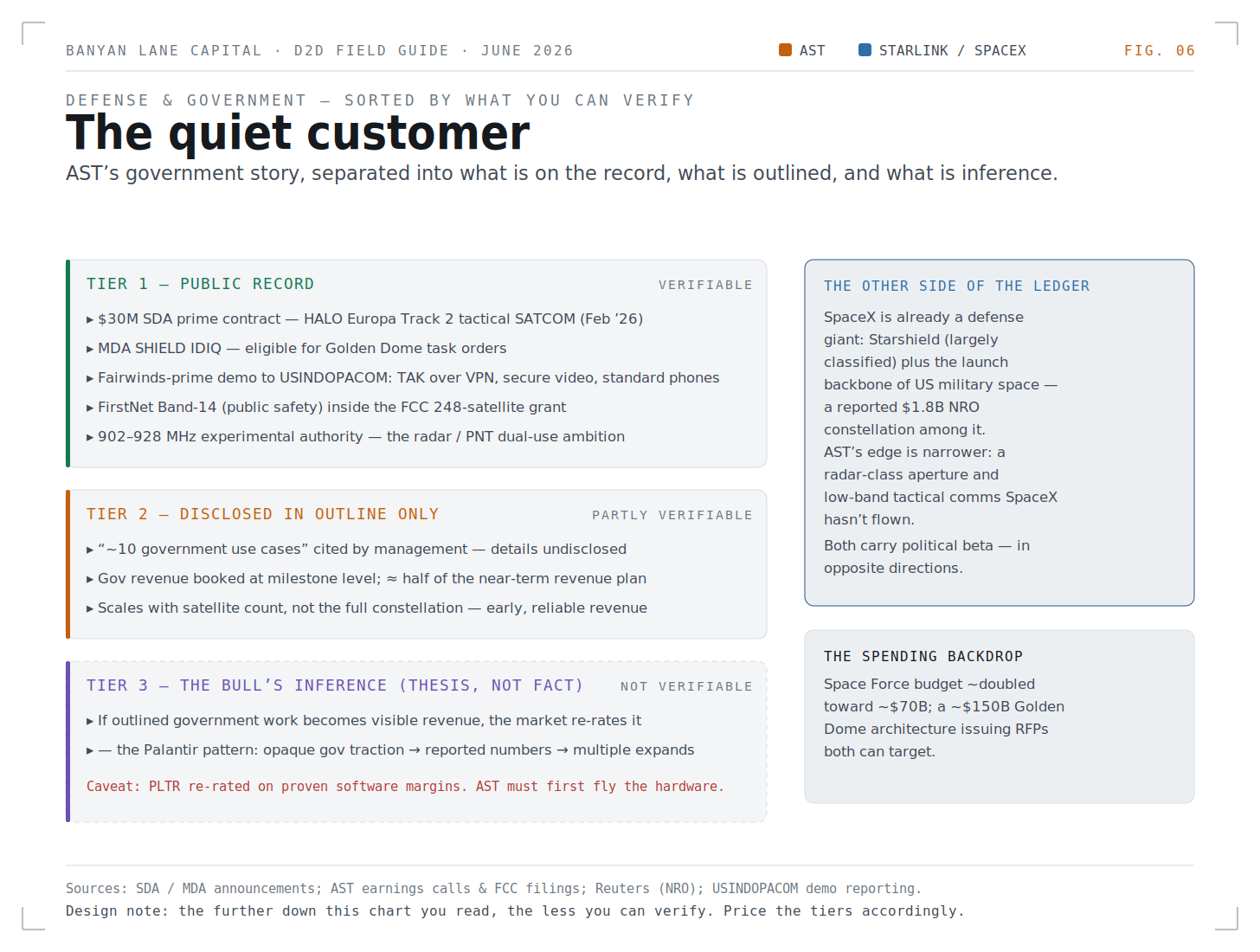
Three-tier chart of AST’s defense business: public-record contracts including a 30 million dollar SDA prime award; partially disclosed items like ten government use cases cited by management; and the explicitly labeled bull’s inference of a Palantir-style re-rating, with SpaceX’s Starshield incumbency shown for balance.
On the public record: AST’s defense subsidiary won a $30M prime contract from the Space Development Agency (HALO Europa Track 2) in February, its first as prime. It holds an MDA SHIELD IDIQ that makes it eligible for Golden Dome task orders. It demonstrated tactical communications to US Indo-Pacific Command: TAK over VPN and secure video, on standard phones. FirstNet’s public-safety Band 14 is written into its FCC grant. And it holds experimental authority at 902 to 928 MHz, the foundation of a radar ambition only a giant antenna can attempt.
Disclosed in outline only: management cites roughly ten government use cases and books government revenue at milestone level. It describes this work without detailing it. Government is roughly half of the near-term revenue plan, and it scales with satellite count, not the finished constellation. It monetizes early.
The bull’s inference, mine, clearly labeled: if that outlined government book converts into visible, reported revenue through 2026 and 2027, the market tends to re-rate companies the way it re-rated Palantir. Opaque government traction becomes printed numbers, and the multiple follows. The caveat is real and I will state it plainly: Palantir re-rated on proven software margins. AST must first fly the hardware. The pattern is plausible.
For balance: SpaceX is already a defense giant at far larger scale. Starshield is largely classified, with a reported $1.8B NRO constellation among its work. The difference is that defense is upside on top of SpaceX’s valuation, while for AST it is a second business the current price arguably does not reflect. Both carry political risk, in opposite directions.
7. The honest scoreboard
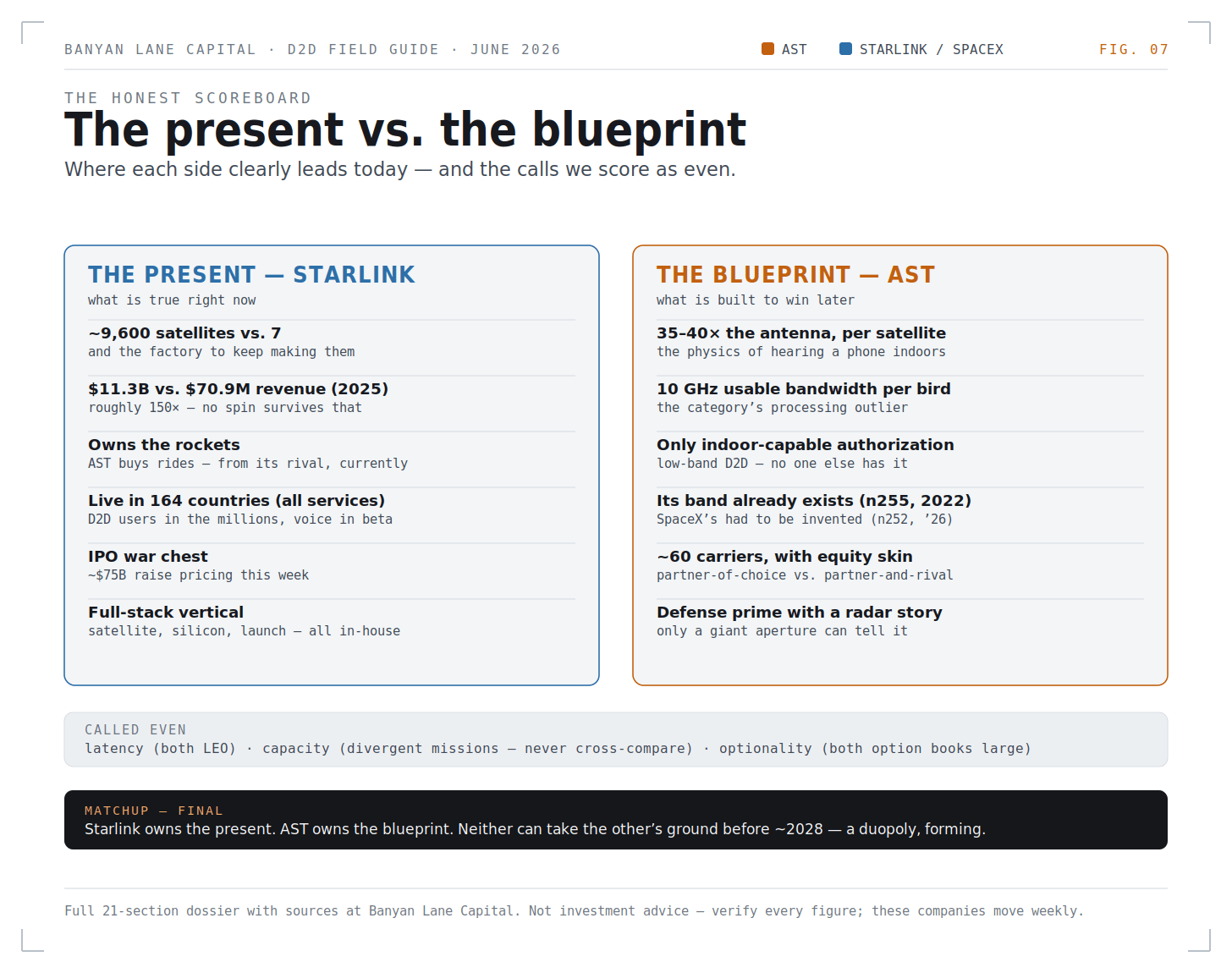
Score it honestly and Starlink wins the present on nearly every line. AST’s wins are the forward-looking ones. That is not a tie. It is a duopoly forming.
What would break the AST thesis? I keep a live list: launch cadence slipping past even our adjusted base case into mid-2027 (watch New Glenn’s return to flight, and whether the BE-4 investigation touches ULA’s Vulcan, since both are named AST providers); satellites underperforming at scale what seven units demonstrated in tests; consumer willingness-to-pay disappointing (T-Mobile’s CEO has already admitted satellite usage is running lighter than expected, which cuts at both companies’ consumer math); the FCC’s pending Ligado sign-off stalling; a gateway build-out that lags the constellation; or dilution if “fully funded” proves optimistic.
What would break the Starlink-dominance thesis is simpler: nothing breaks it before 2028. It merely gets bounded. Starlink keeps the present: the revenue, the rockets, the subscriber machine. The question the market has not priced is whether AST keeps the blueprint: the physics, the indoor spectrum, the carrier alignment, the standards head start, and a government customer that pays early.
My bottom line: this is a duopoly forming in plain sight, and only one of its members is priced like a member. Starlink owns the present. AST owns the blueprint and potential stronger path to consumers via their less adversarial structure. Neither can take the other’s ground before roughly 2028, and the next two quarters of launches will tell us whether the blueprint becomes a building.
This week alone: SpaceX lists Friday. AST’s next three satellites launch on a Falcon 9 early next Wednesday morning.
DISCLOSURE
Position: At the time of publication, the author holds a position in AST SpaceMobile (ASTS).
Trading Policy: The author will not materially alter this position within 48 hours of publication. After this period, the author may buy, sell, or otherwise adjust the position without further notice. Changes to the author’s view or position will be reflected in subsequent publications when material.
Conflicts: The author has received no compensation from the issuer or any party with a financial interest in this security.
Forward-Looking Statements: This report contains the author’s opinions, estimates, and projections, including price targets derived from financial models. These are forward-looking statements subject to substantial uncertainty. If these assumptions prove incorrect, the actual value may differ materially, including scenarios of significant loss or total impairment. The price target represents the author’s estimate of fair value under the stated assumptions, not a prediction of where the stock will trade.
This report is provided for informational purposes only and does not constitute investment advice. See the full Terms & Disclosures for additional important information.