


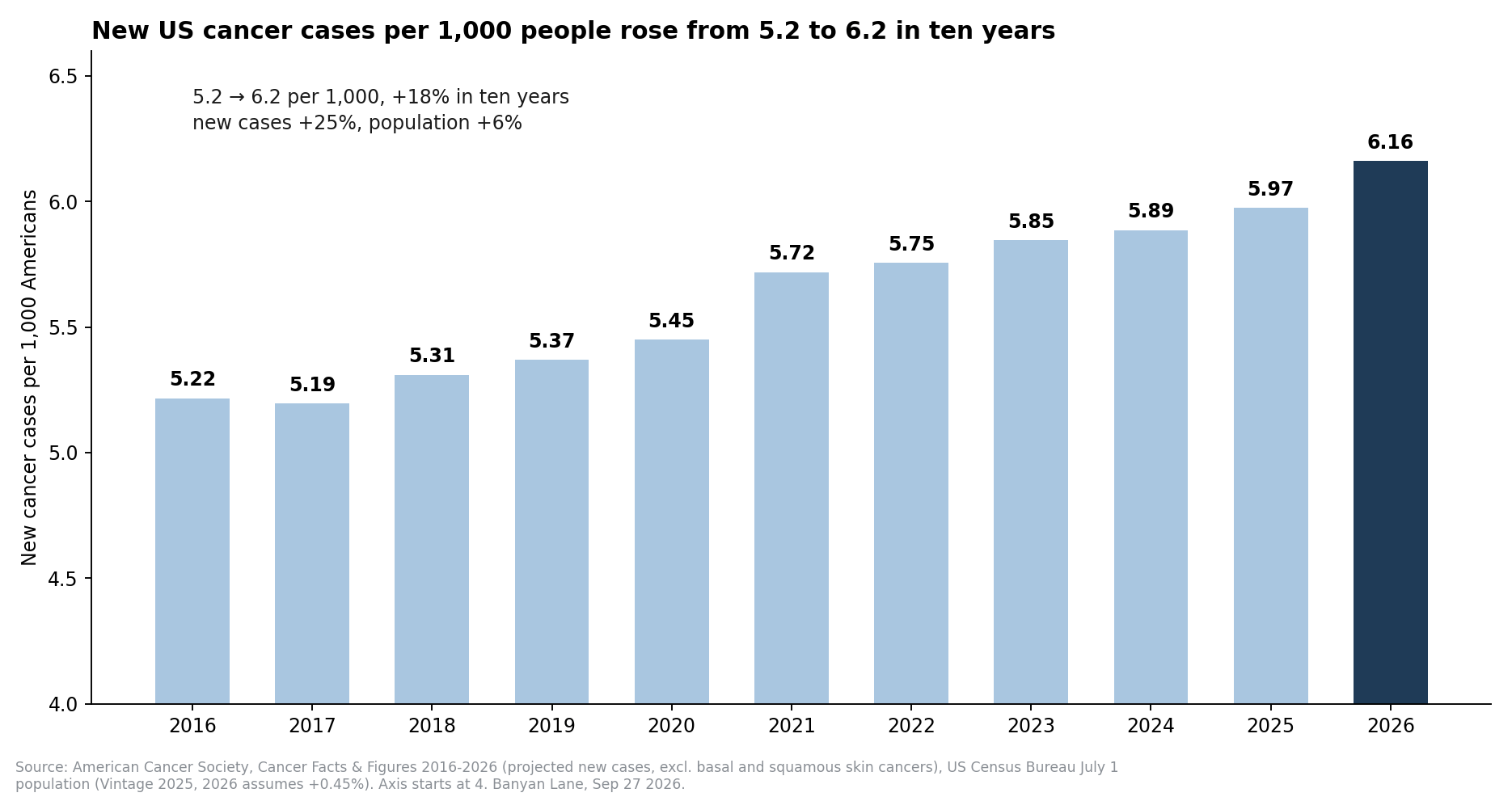
STLN’s specialty pharmacy business is very underappreciated by the market, both in quality of earnings it creates and the scale within the business. While I have not yet had the opportunity to speak to management on this opportunity, my understanding from their conversations with other investors is they confirm that it’s a great business and do not go deep into what it could become - not surprising they wouldn’t want much info out there from a competitive perspective. Nexus launch may mark an important turning point on this front. Specialty pharmacy is ~75% of GP today at ~20% GMs, which probably have a bit of upside. The GP mix will shift some toward services in the coming quarters as their new contracts ramp. My best estimate, without the upside scenarios envisioned below, is that this figure lands around 60-65% in the next few years. That is still a very meaningful share of the business. Investors need to understand what this means for the durability of STLN’s cash flows, which is very sad and unfortunate… cancer rates are only going up… let’s hope frontier models can dent this trajectory in the coming years. Put bluntly, there is a long and growing tail of demand for oncology treatments.
Personal note, experience informing opportunity for STLN
A few years ago, I spent a year as the CFO of a large direct primary care (DPC) business. Our headcount crossed the line where an employer must legally offers health insurance or pays a penalty. So we went to market with a broker, and the plan we could afford came through a TPA we already knew. Imho, there are a lot of lessons to draw from understanding both the DPC model and growing ecosystem (e.g. Aligned Marketplace) and the small but meaningful innovations that can grow in the insurance models when someone simply tries to align incentives.
If anyone has domain expertise in this space, please reach out! Would love to discuss further as I’m getting deeper into the oncology ecosystem which has massively entrenched players, and for good reason… they make so much money in the space.
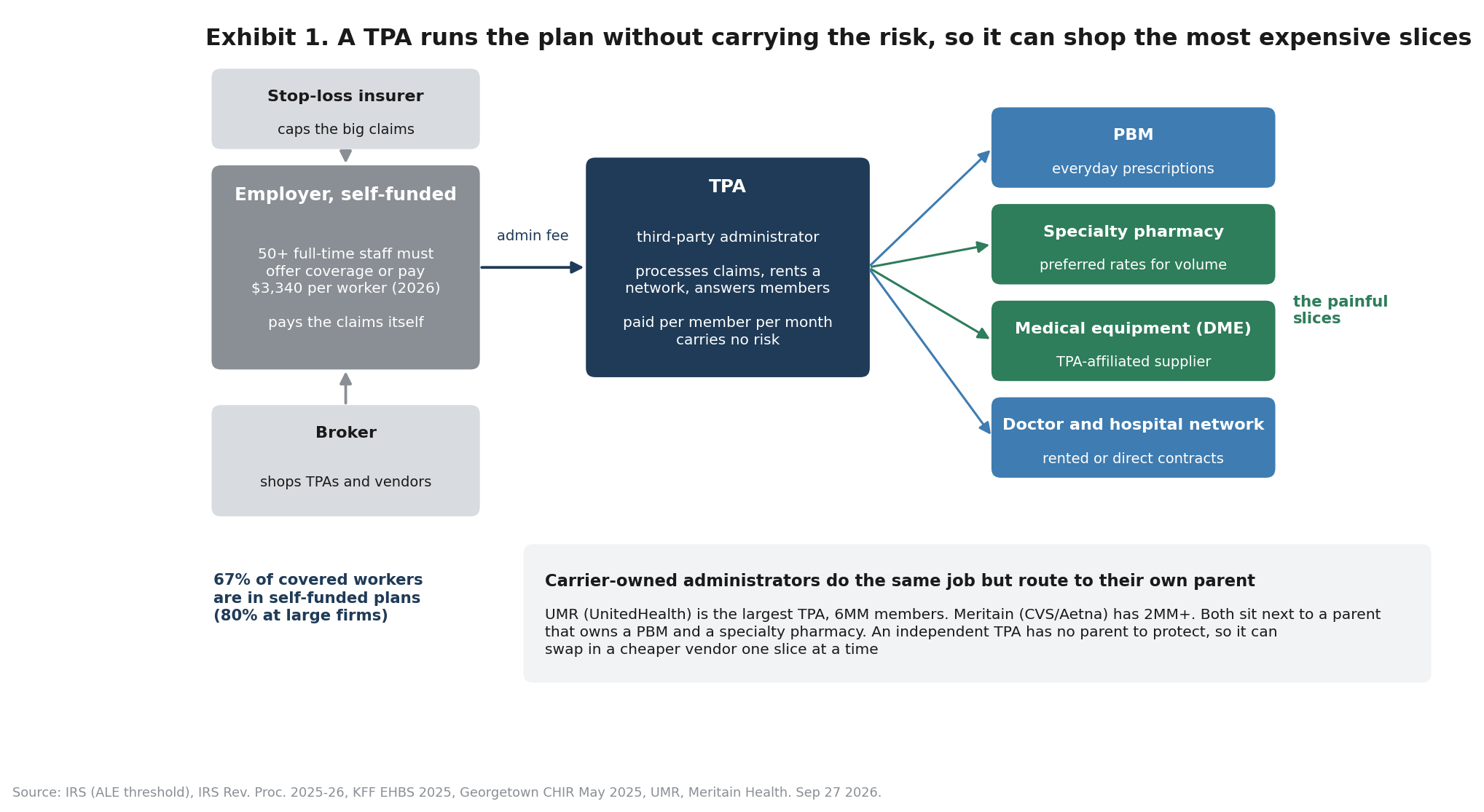
On the TPA front, the partner we chose was particularly adept at finding ways to reduce costs for an employer in order to be more price competitive on plan rates and win more business. Seems obvious, but that’s actually the opposite of how most operate. This TPA had built its own medical equipment business. It had direct contracts with specialty pharmacies at better prices. It went after the most expensive slices of a health plan one at a time, so it could quote a price the big insurers could not, and grow on that price.
TPA, third-party administrator: runs a self-funded plan’s claims, network and member service for a monthly fee, carries no risk, the employer pays the claims with stop-loss insurance behind it
Who has to offer coverage: employers with 50+ full-time staff, part-timers counted as equivalents, or $3,340 per worker in 2026, 67% of covered US workers sit in self-funded plans, 80% at large firms
Pain-Point analogy: the idea this note centers on is whoever takes cost out of the most expensive slice of a health plan wins that volume, and volume compounds
Cancer is the most painful spot in most plans, #1 cost driver for 70% of large employers heading into 2027. Enter Starling with doctors, a risk contract and a pharmacy. This is what strikes me most about STLN’s version of value-based care and why the opportunity is so large for pharmacy which is largest cost bucket.
Two pipes, and cancer runs through both
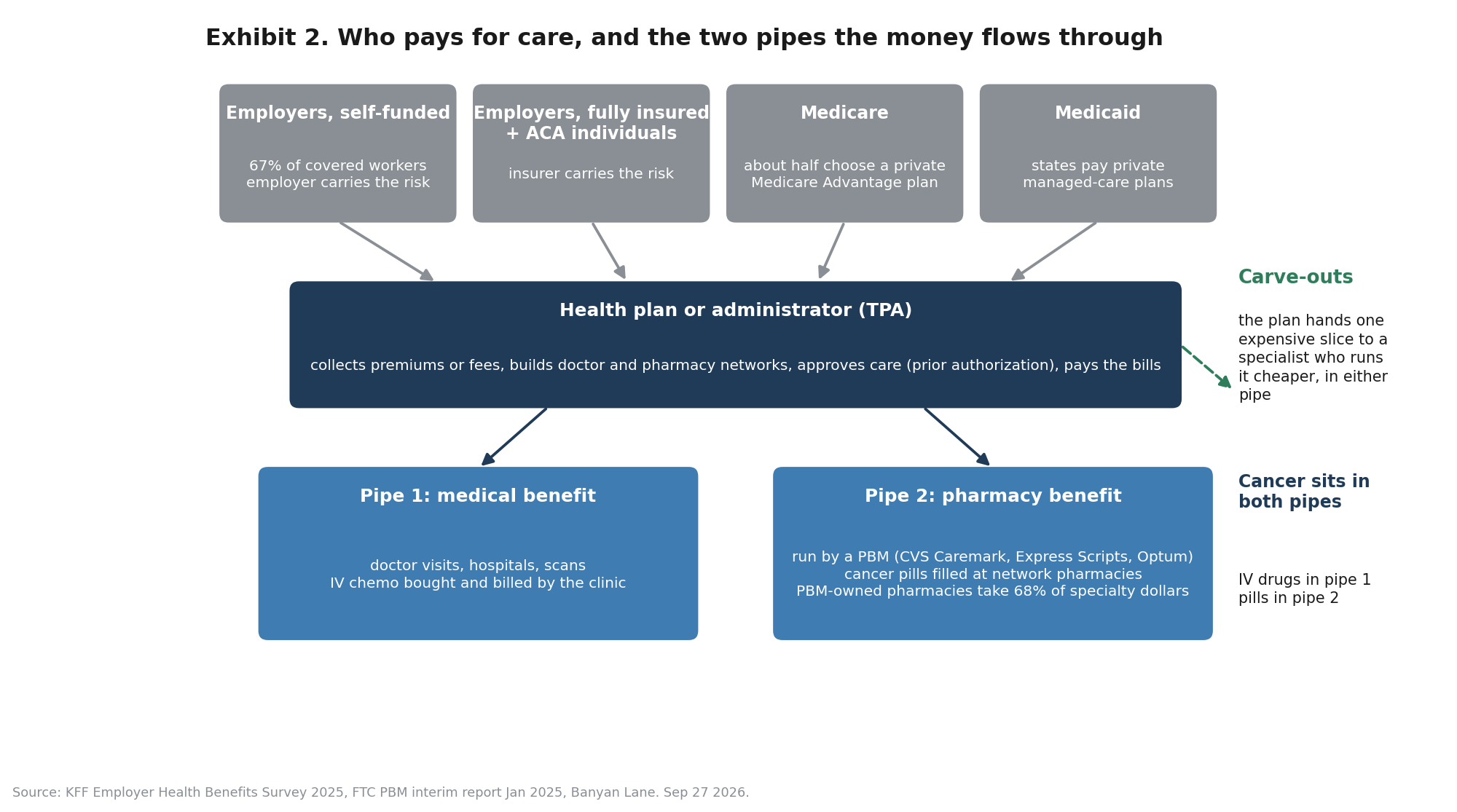
Specialty drugs: too costly, fragile or complex for a retail counter, new oral cancer drugs run ~$10K a month
Almost nobody manages both pipes for the same cancer patient, except Starling
How the industry got here
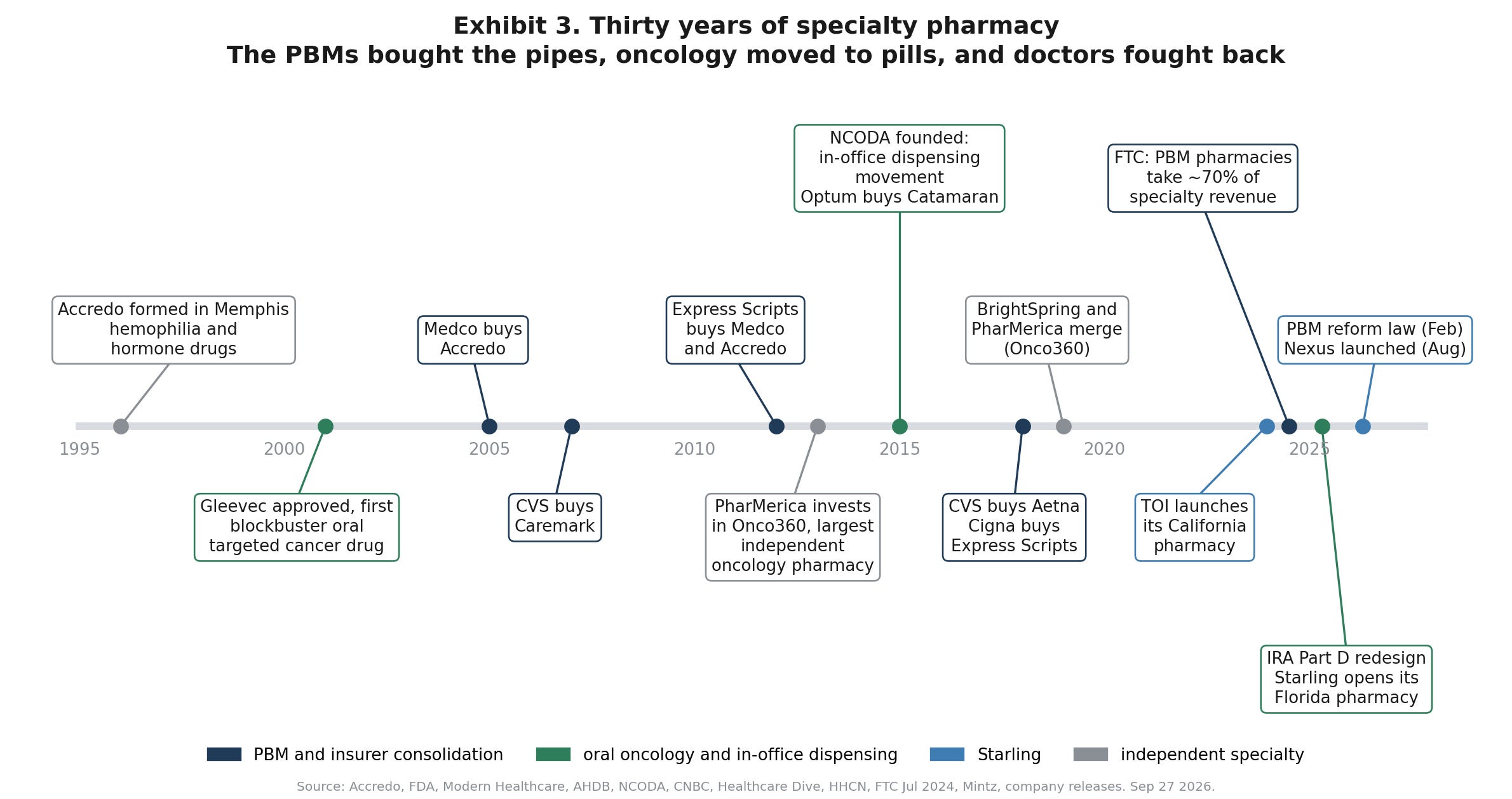
1990s: home-delivery pharmacies for hemophilia, HIV and transplant drugs, Accredo formed in Memphis in 1996
2001: Gleevec approved, the first blockbuster pill that targets a cancer, the start of oncology moving from IV bags to bottles
2005 to 2018: the PBMs bought the specialty pharmacies, then the insurers bought the PBMs, CVS-Aetna and Cigna-Express Scripts both closed in 2018
2015 onward: oncologists pushed back with in-office dispensing, NCODA formed to set the standards
2024 to 2026: regulators caught up, FTC reports on PBM markups, the IRA Part D redesign, the Feb 2026 PBM reform law
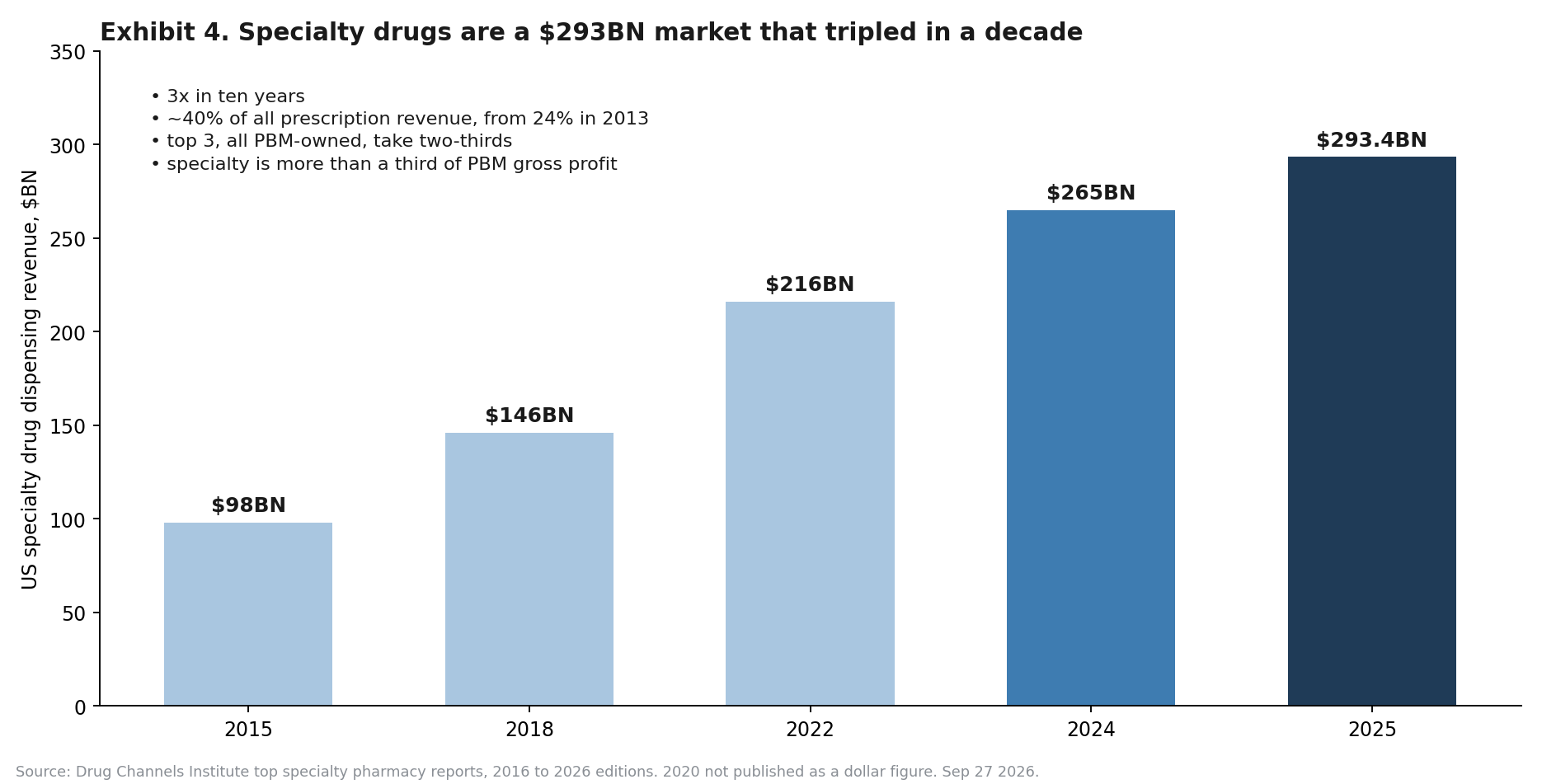
Specialty pharmacy business is huge for PBMs…
Who earns what on a cancer pill
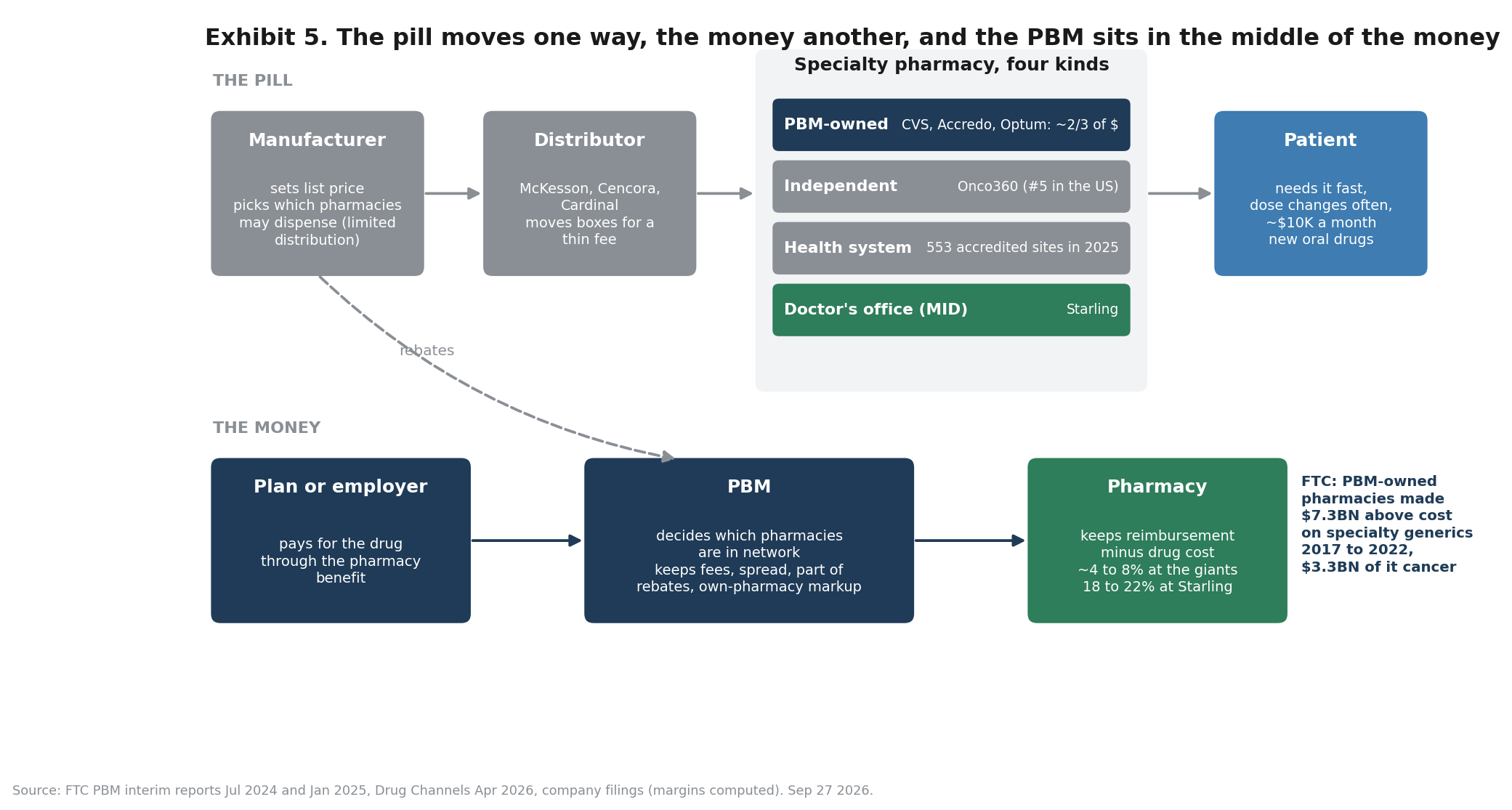
Whoever controls the network decides who fills
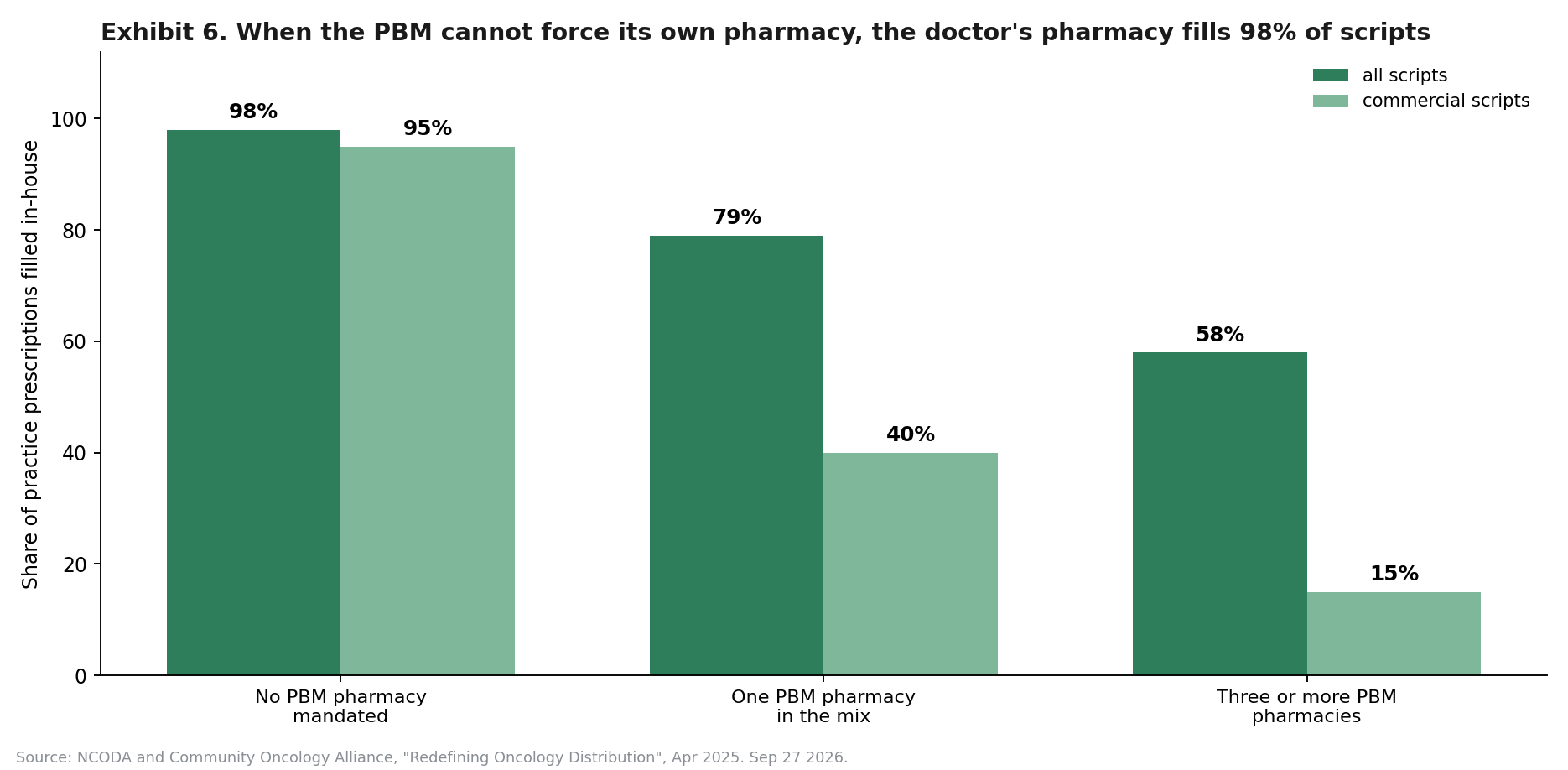
Doctor’s offices fill 98% of own oral cancer scripts if no PBM pharmacy mandated
One PBM pharmacy in the mix drops that to 79%, three or more to 58%, commercial scripts fall to 15%
The script belongs to whoever sits at the gate, the lesson that makes Nexus matter in section 5
Where Starling sits
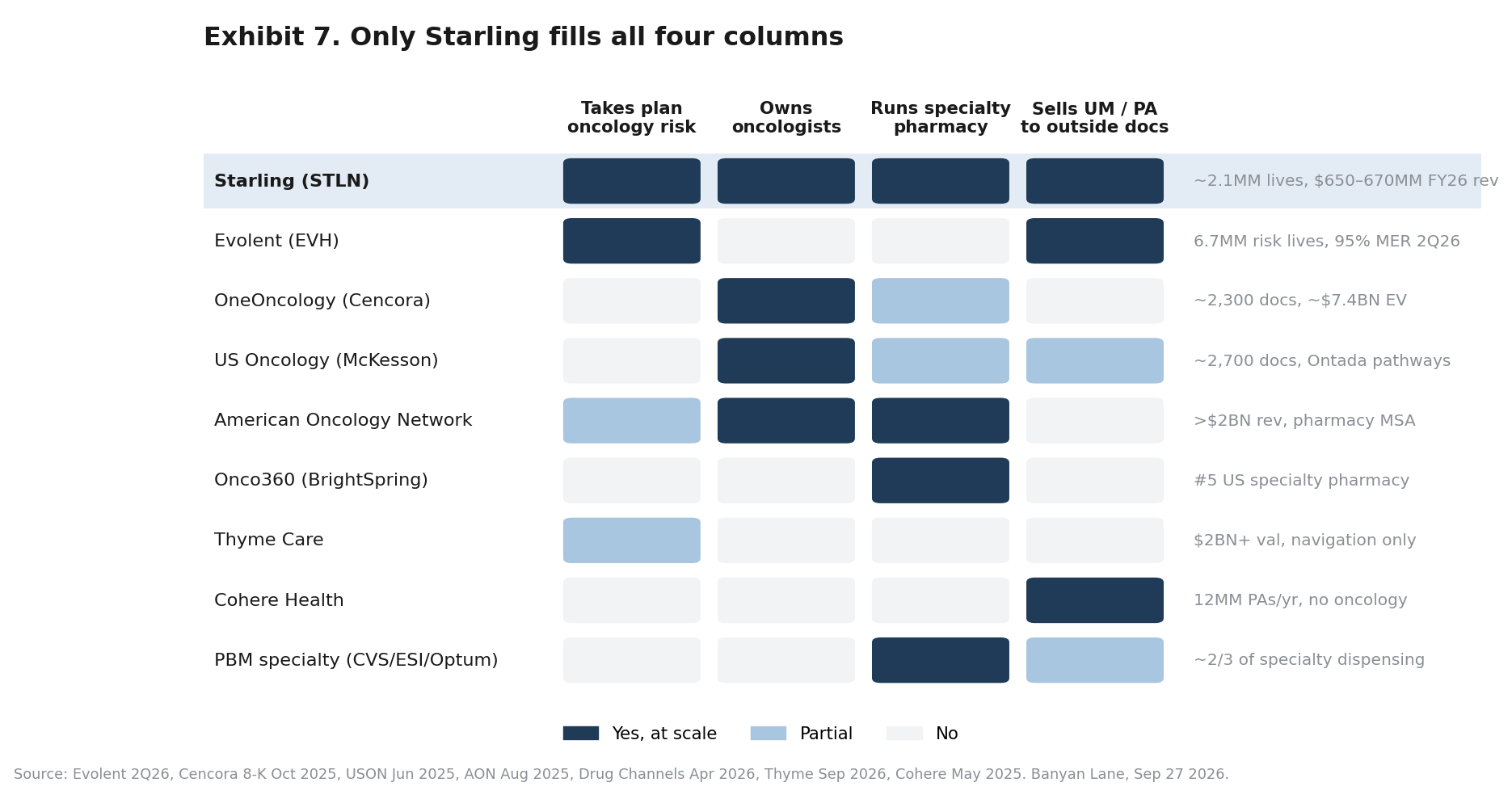
Evolent: takes plan risk and sells approvals, owns no doctors and no pharmacy, 95.3% medical expense ratio in 2Q26
OneOncology, US Oncology, AON: own thousands of oncologists, cannot take a plan’s full oncology risk
Onco360, PBM pharmacies: own the pharmacy, no prescriber relationship
Thyme Care ($2BN+ valuation): guides patients through care, approves and dispenses nothing
Starling: the only row with all four
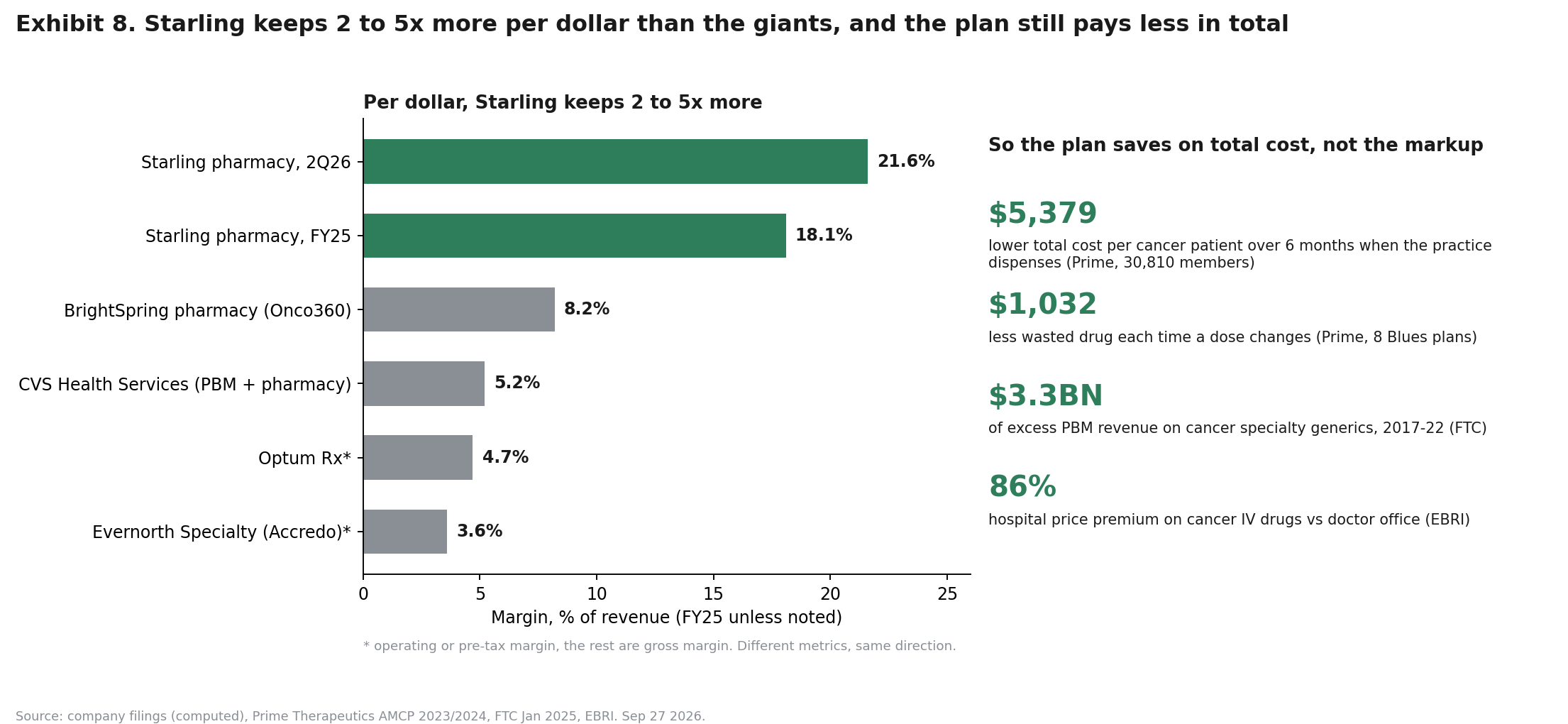
Starling keeps 18-22% of each pharmacy dollar, the giants 4% to 8%
The plan still pays less in total, $5,379 lower cost per cancer patient over six months when the practice dispenses
$1,032 less wasted drug each time a dose changes, and treatment in the office instead of a hospital that charges 86% more per unit
The pitch to a payer is a lower total cancer bill
People don’t stop getting cancer
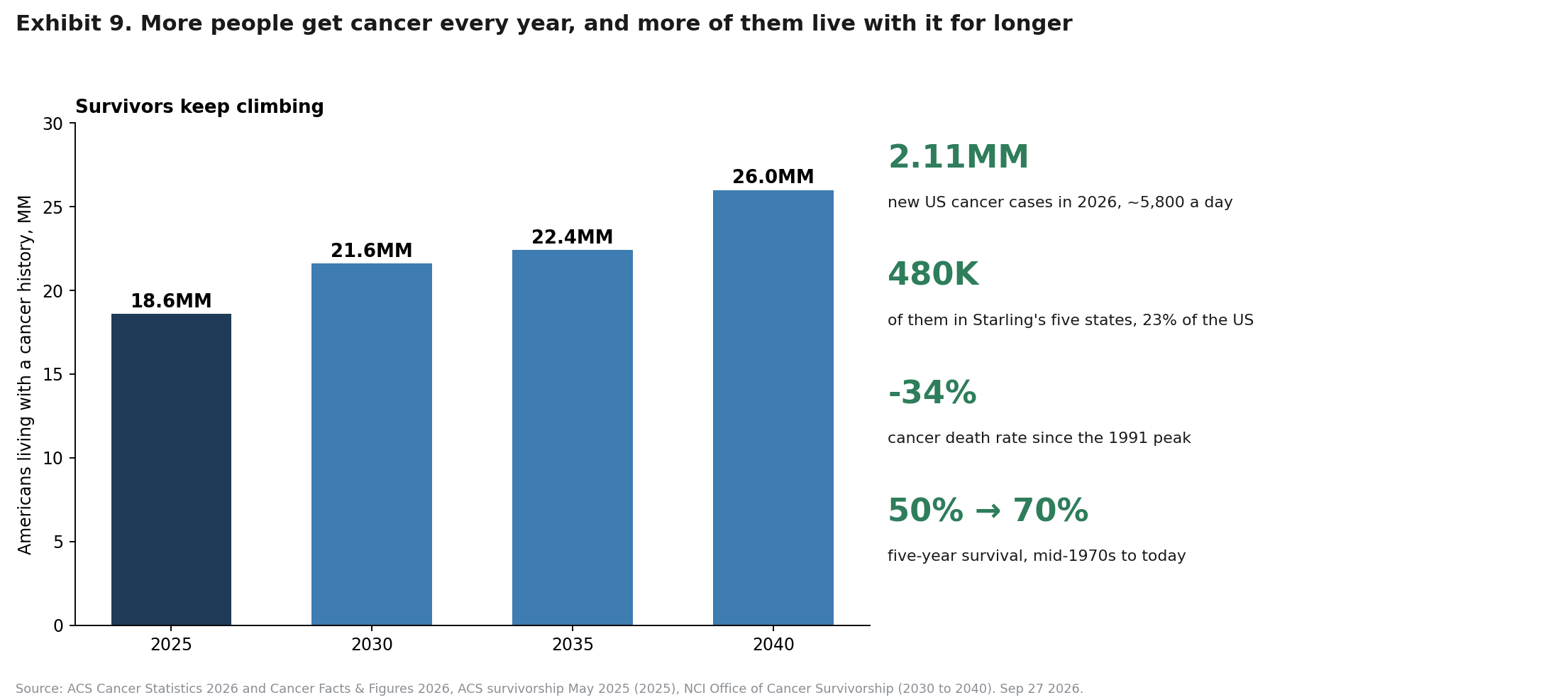
Pills keep taking share, 8 of 11 novel cancer approvals in 2019 were oral
Oncology spend per member rose 11.6% in Prime Therapeutics’ commercial book in 2024, Evolent planned for 12% in 2025
Price is the one number moving the wrong way. Medicare’s negotiated prices cut revenue per fill even as fills grow.
Imbruvica 38% below its list price in 2026
Xtandi, Ibrance, Pomalyst and Calquence 40% to 60% below list in 2027
Starling’s revenue per fill fell 12% yoy in 1Q26 while fills rose 103%
Starling’s pharmacy today
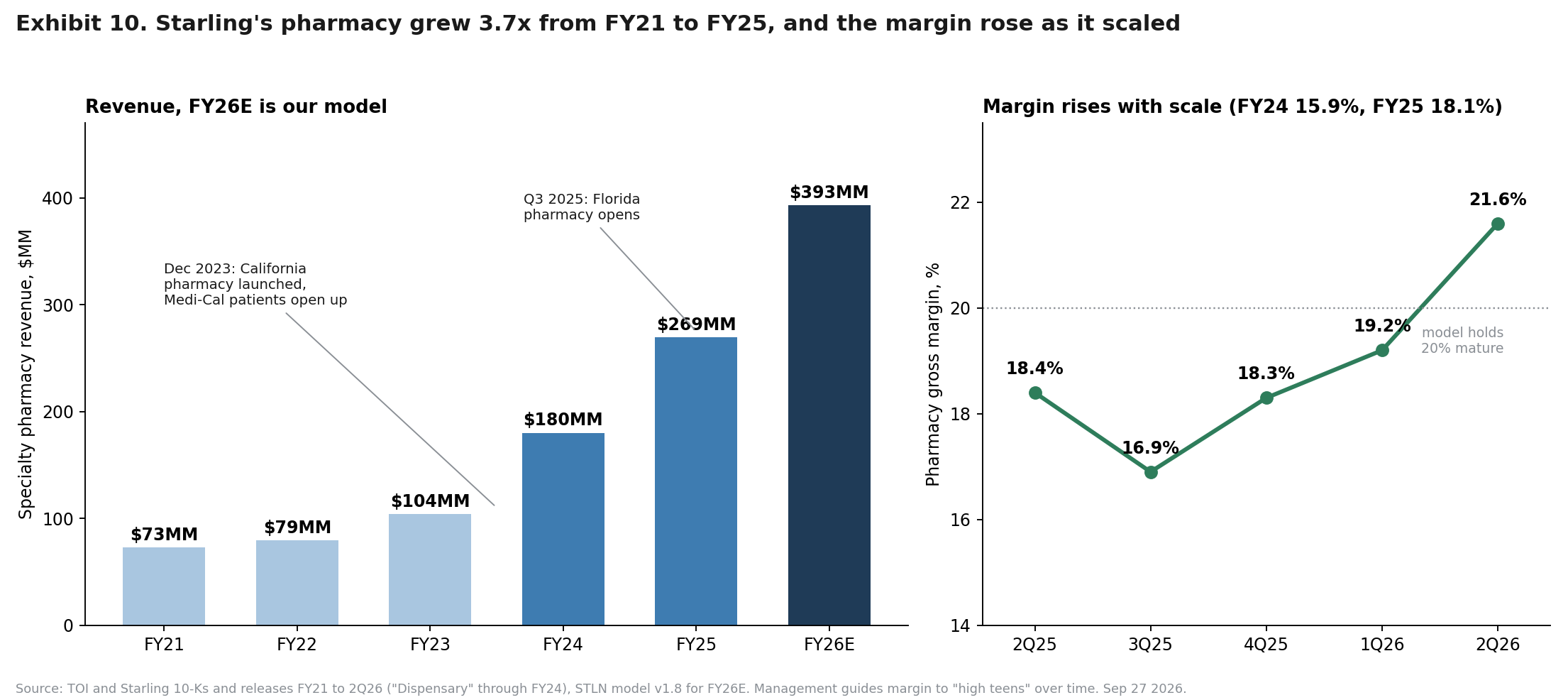
Gross margin 15.9% in ‘24, 18.1% in ‘25, 21.6% in 2Q’26, management guides to “high teens” as a procurement benefit fades, our model holds 20%
Scripts per 1,000 clinic visits 107 to 264 over eight quarters (Sep ‘26 investor deck)
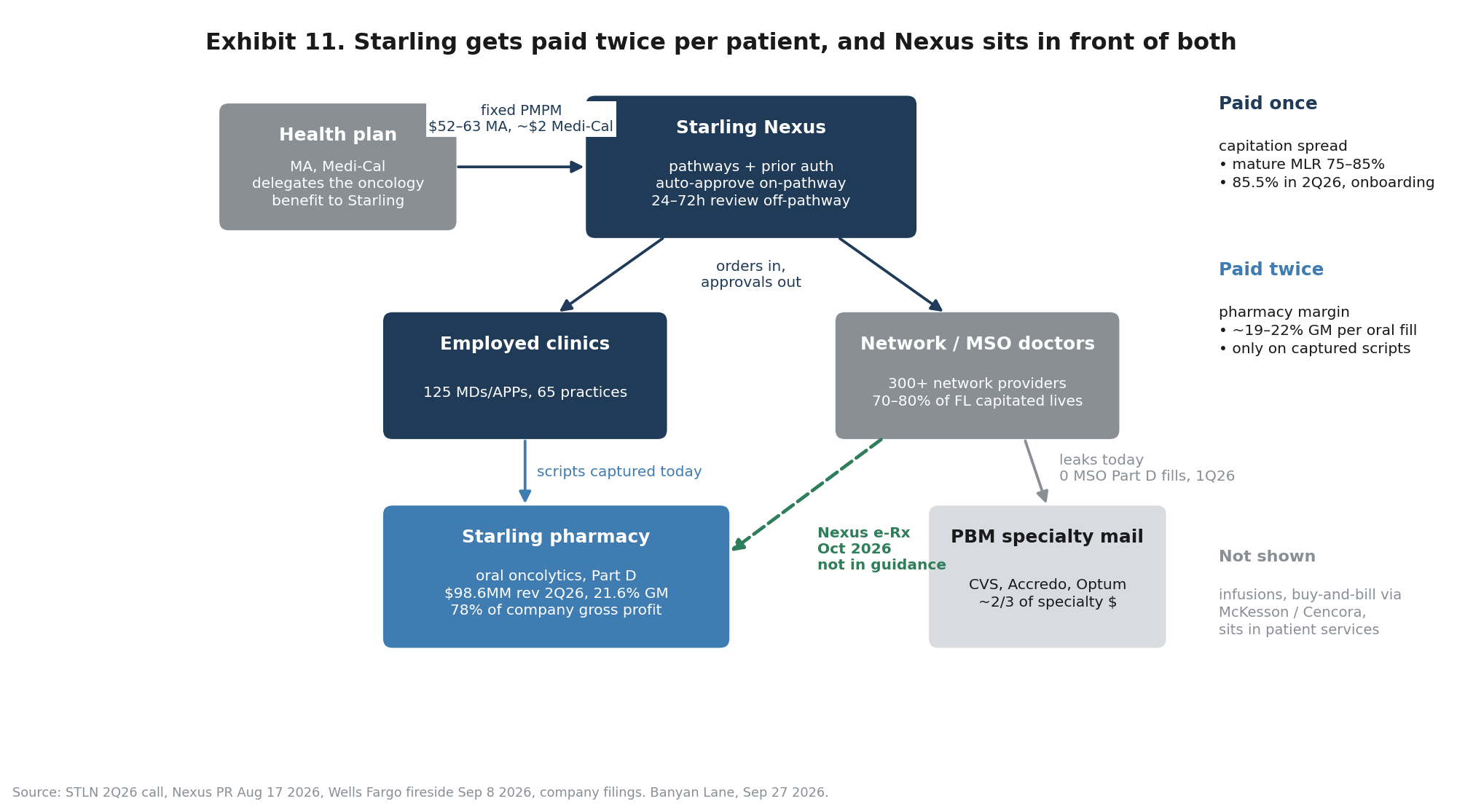
Paid once: a fixed monthly fee per member to run the plan’s cancer care, mature loss ratio 75% to 85%
Paid twice: the margin on every oral script those patients fill at Starling
The second payment only lands when the prescription reaches Starling’s pharmacy, and today that means Starling’s own doctors
“When we launch these deals, there is always, 100% of the time, pharmacy attachment associated with that.” Rob Carter, CFO, Wells Fargo Healthcare Conference, 9/8/26
“Our current Part D fills are all from our employed physician base. There are no Part D fills flowing through to our MSO providers.” Carter, Q1’26 call
Nexus
Why the approval step is the valuable one
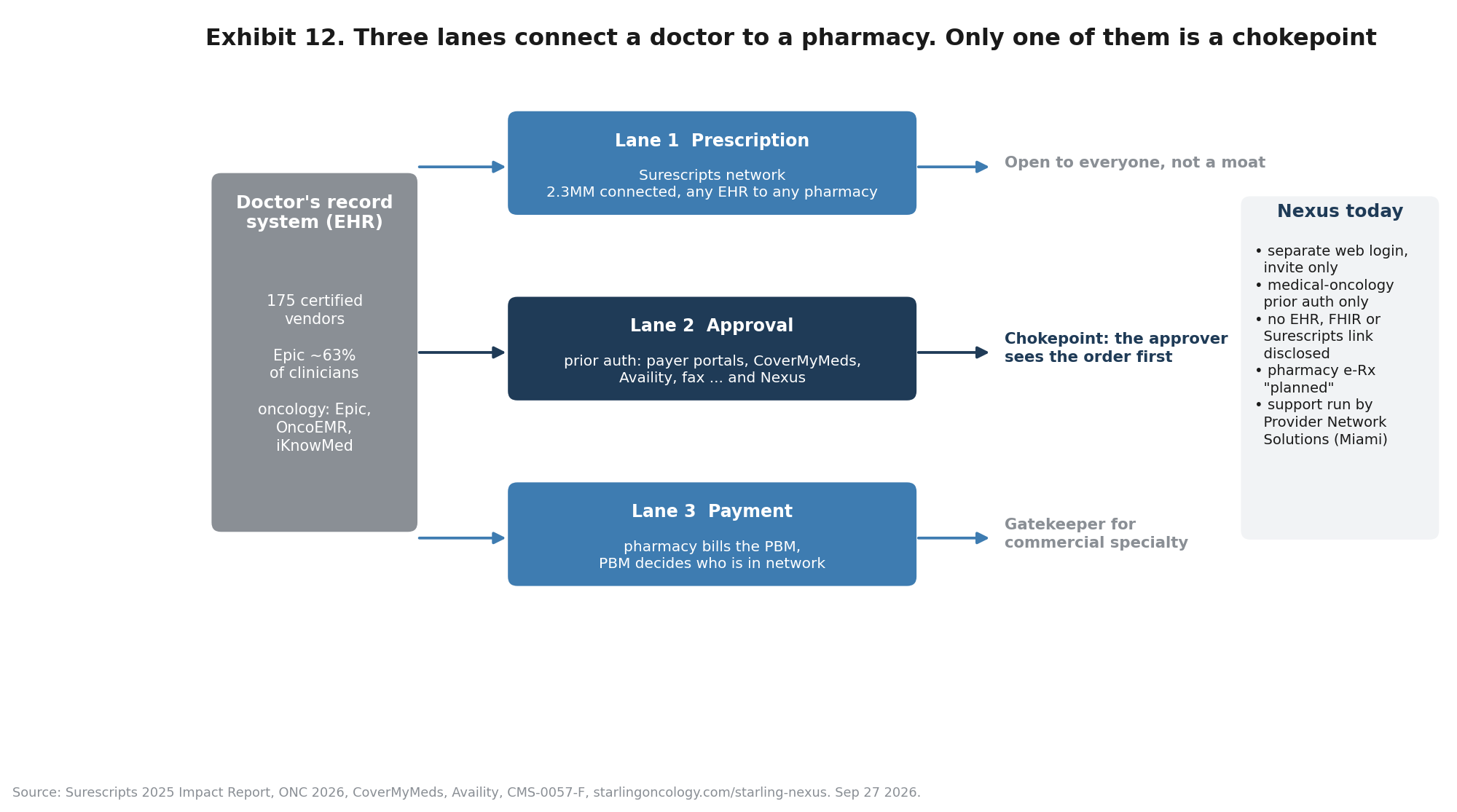
Prescription lane: any doctor’s record system can already send a script to any pharmacy over Surescripts, 2.3m connected users, no moat there
Payment lane: the PBM decides which pharmacies are in network
Approval lane: before a costly cancer drug is covered, someone approves it, and whoever approves sees the order first
When a health plan hands Starling its oncology risk, Starling holds the approval lane for every doctor treating that plan’s members, including the 300+ network doctors it does not employ
What Nexus is
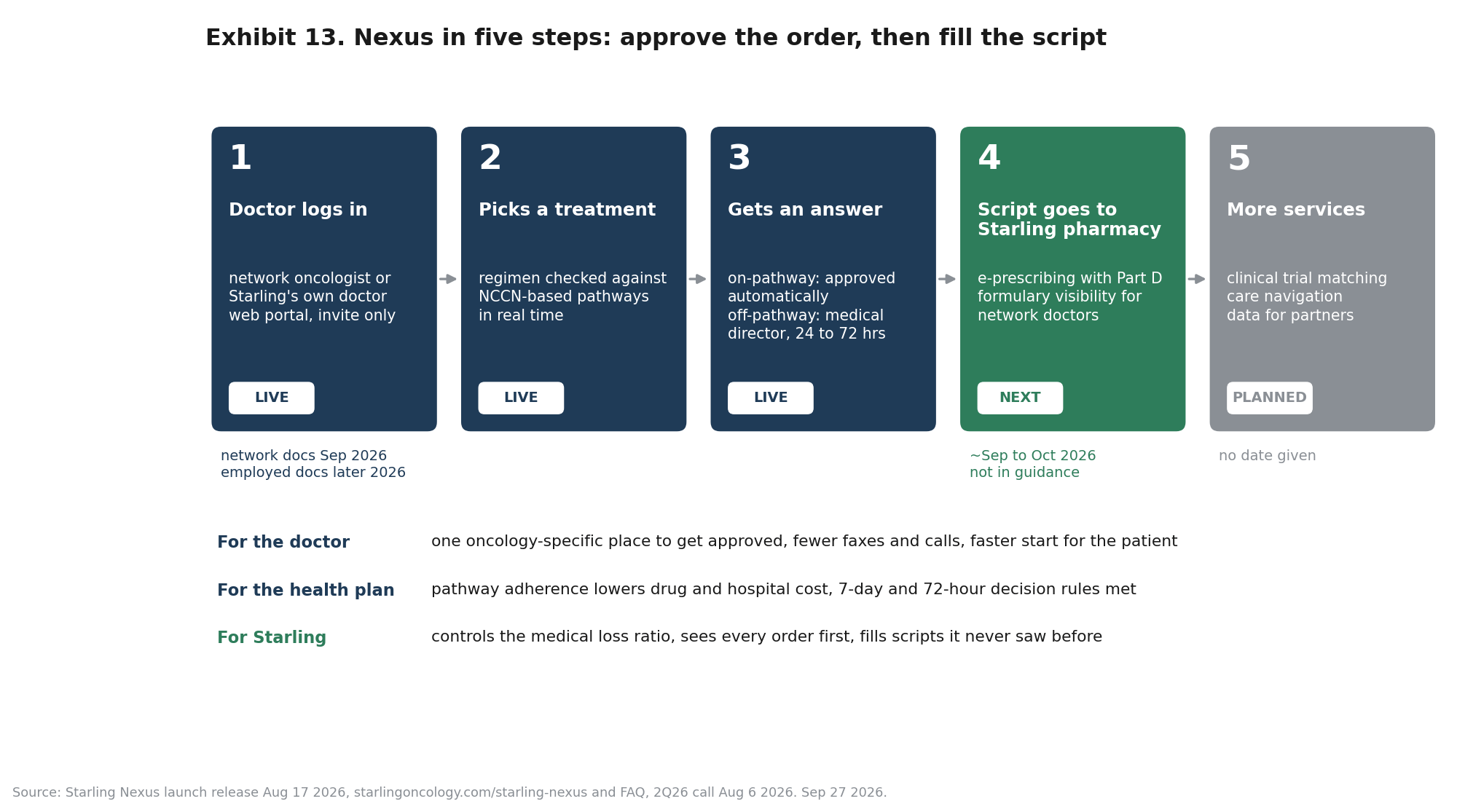
Web portal launched Aug ‘26, built for oncology
Network doctors onboarded in Sep ‘26, Starling’s employed doctors later this year
A doctor picks a treatment, Nexus checks it against NCCN-based pathways, on-pathway orders are approved automatically, off-pathway orders get a medical director within 24-72 hours
E-prescribing with Part D formulary visibility follows in ~Sep to Oct 2026, the first time a network doctor can send a script to Starling’s pharmacy from the same screen as the approval
Trial matching, patient guidance and data for partners are planned - no date given
Today it is a separate login, no link to outside record systems has been disclosed, the hub version sits inside the doctor’s own record system and the plans’ new prior-authorization connections that CMS requires from Jan ‘27
“Once fully launched, all of our providers, both PC employed and network providers will use the portal to submit treatment orders and obtain pre-authorizations from us... the portal will be a hub to drive ancillary services such as our Part D pharmacy, decentralized clinical trials and other value-add offerings to our network providers.” Dan Virnich, CEO, 2Q’26 call
“It is not something that we have guided to specifically, but it is certainly upside.” Asked whether that was all upside: “100%. That’s right.” Carter, Wells Fargo, 9/8/26
