Serial acquirers all run a similar playbook… buy smaller businesses cheaply, improve them, let the public market pay a higher multiple for the consolidated entity. Those that fail typically suffer from deteriorating organic growth, inability to grow margins, or overpaying. “Platforms” can quickly become a pile of unintegrated P&Ls wearing one ticker. In an ideal scenario, they are actually buying high quality niche businesses that can grow faster and achieve higher margins, thus “buying down” the forward multiple vs. the acquisition multiple. In other words, what looks like paying 10x EBITDA on TTM metrics actually turns out to be paying 6x EBITDA 2 or 3 years later. This is true value creation, as long as it lasts. Harvest the cash flow and repeat.
Arxis, Inc. (ARXS) is an explicit “Buy-Down Machine.” As CEO Kevin Perhamus puts it, “[we] grow the EBITDA of the acquired business at a higher rate than the base of Arxis in the next three years”, and can it “buy down the multiple to less than 10 times within 36 months”. Thirty-five acquisitions in ~6 years. The two most recent large deals were disclosed together at ~12x forward EBITDA.
And what comes after is even more important… ARXS printed 21% organic growth and a 42% adjusted EBITDA margin in 2Q26, its second quarter as a public company, and the shares have ~doubled from a $28 April IPO. Given it’s market cap of ~$22bn, this business is entering what we believe is a sweet spot of scale in its lifecycle… large enough to do $1-5bn transactions but small enough so that these actually matter. We’ve seen too many large acquirers/compounders suffer from scale, and this is an opportune time to look at one with nice runway ahead.
Overview
ARXS designs and manufactures proprietary electronic and mechanical components for harsh environments. Connectors, RF and microwave devices, sensors, capacitors, self-lubricating bearings, seals, ducting, radar-absorbing materials. To cut to the chase…
~90% of revenue is proprietary, sold to >600 platforms for more than 5k customers
Top 10 customers 36% of revenue, none >7%
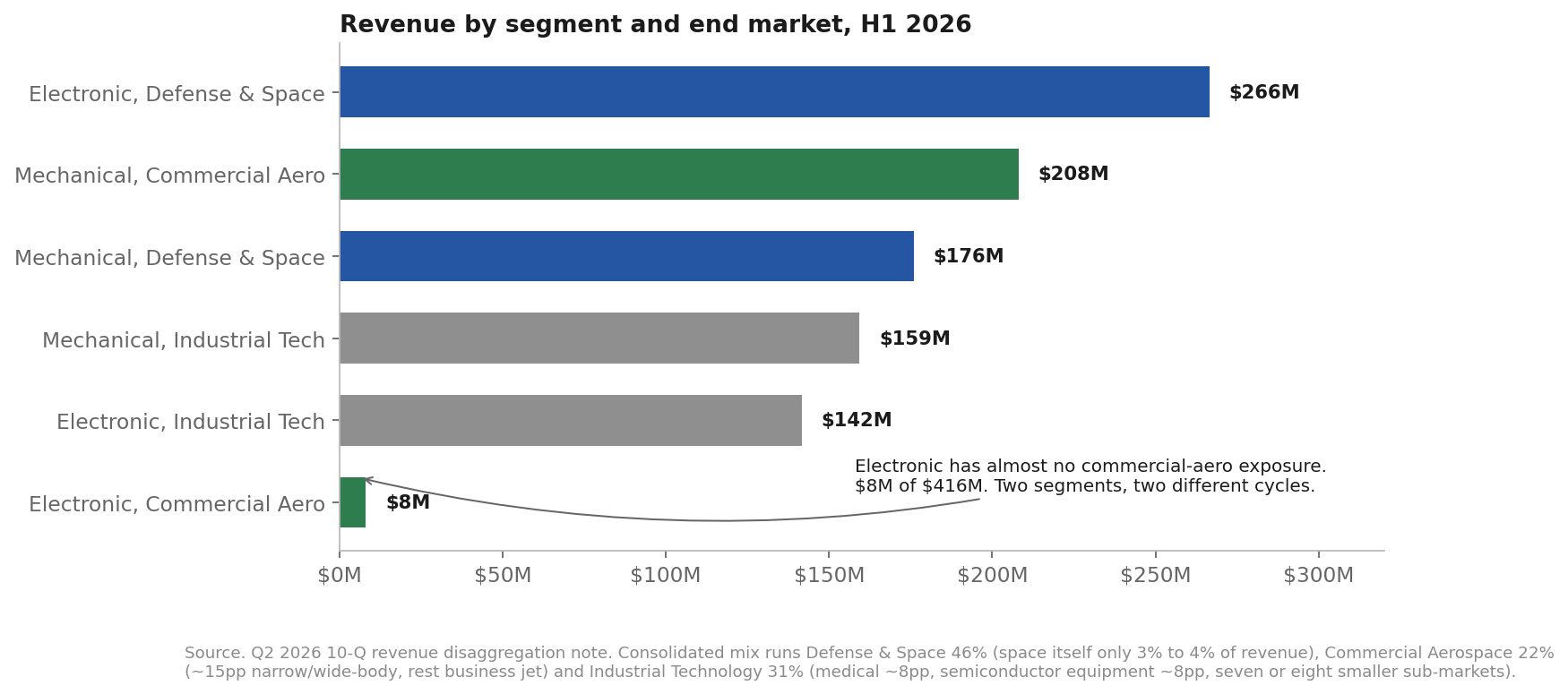
Defense and space 46%, commercial aerospace 22%, industrial technology 31% (includes med devices, surgical robots, semiconductor equipment and factory automation
Parts typically cost less than 0.01% of the platform… too cheap to fight about, too critical to remove… qualified years before production, usually as the only approved source, on platforms that produce for 20 years and fly for 40
Platforms are diverse… F-35, DDG-51, Virginia-class, SPY-6 radar, missile-tracking satellites, 737 and Airbus A320, the LEAP, CFM56, PW1000G and PT6 engine families, Gulfstreams G650, G700 and G800, and in medical the contacts are built to survive 15 years inside the human body
So the budget line that matters is R&D, not procurement. A designed-in supplier wins its next positions during platform development, and the Pentagon’s RDT&E request stepped from ~$143BN in FY25 to $179BN in FY26.
In the company’s own words, positions are won because “our engineers meet with our customers’ engineers. They solve a problem which results in a custom product that gets designed into the bill of materials, typically as the only qualified part, and then stays there for decades.” ARXS owns 67 foundational technologies across 48 business units. A good example of this is the KAron bearing liner, which turns a standard bearing into a custom product with “five to ten times the value.” KAron went onto the Gulfstream G650 in 2008, then spread to five more models. It produced “approximately a 965x increase in our revenue from this product line and customer.”
Two structural facts about ARXS that set this business apart from average roll-ups…
First, they have an actual operating system that everything together called Arxis EDGE which also enables a scaled and decentralized model. EDGE is a purchase-order-level system that digests 6k orders / month. ARXS runs 48 decentralized business units across ~70 focus factories under 16 block leaders. That’s why 2026 was guided in a $20MM revenue range and then raised by $100MM a quarter later. By late July, 95% of 2026 revenue sat in firm orders, with “another $150 million or so left to go to book for the year.” More than 450 of the company’s ~5,750 employees are paid on new-business wins, and the EDGE cross-sell pipeline grew from ~50 opportunities in 2021 to more than 2,000 by mid-2025… so they have a large proportion of employees who are highly incentivized to grow volumes (on which they’ll surely take ongoing price) and track every order. This is important as it means management can quickly triage with problems before they become large.
Second, they actually decompose growth… their algorithm is MSD new business, plus MSD price, plus whatever the market gives. They put up 17% organic in 1Q26 and 21% in 2Q26, and the entire acceleration was the market bucket… “new business remains at mid-single digit. The price that we’re gaining remains at mid-single digits. All of the delta that you’re seeing is in the base business.” So the long-term guide is high-single-digit organic growth, converting at ~50% incrementals into low-double-digit EBITDA growth, before any acquisition.
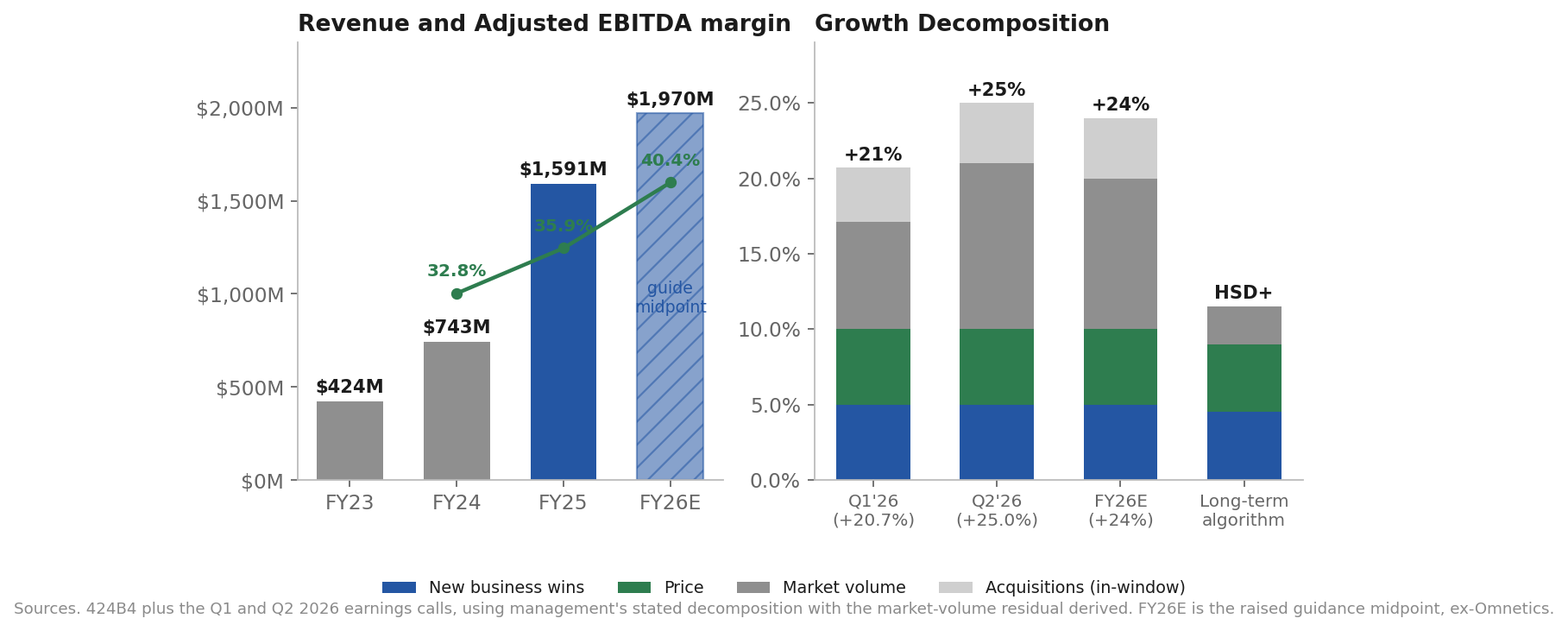
Adjusted EBITDA margins should land near 40% for 2026, up 3pts YoY. High teens FCF margins in 2026 will help reduce net leverage toward 1.3x from 4.2x at IPO. CapEx runs ~3% of sales. This is one of the nicest compounding models I’ve come across at what seems to be a sweetspot… wish had finished the work sooner! Share are almost 15% off their highs.
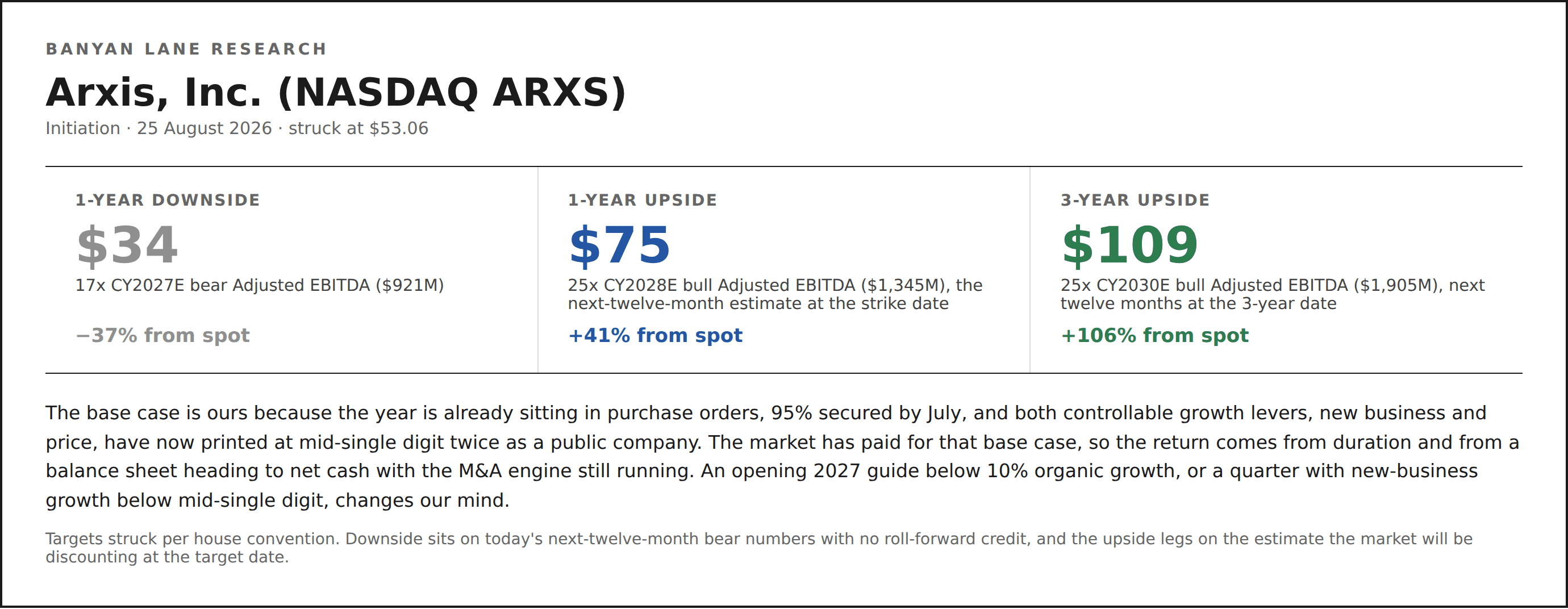
We provide the following targets as a range of scenarios overtime. These are not meant to be explicit price targets, more so they provide a framework for where the stock could across different sets of outcomes. The details for all of this, and more, are below the paywall. Despite the run-up post IPO and large headline multiple, there remains a nice opportunity ahead, and the 13F scrape suggests this is genuinely underowned the funds that would typically be involved in a name like this.