


VLRS a speculative, multi-year turnaround with a wide range of outcomes and a large skew to the upside. At $8.50 the combined Volaris and Viva group trades at ~4.5x LTM EBITDAR, and that EBITDAR was earned with jet fuel above $4 and more than 50 jets grounded.
One year, downside. ~$5 per ADS. Heavy merger conditions and a lower multiple.
One year, upside. ~$24. Light conditions and fuel falling back toward $3.
Three years, upside. ~$38. Merged group with its engines back and growing again.
Size it as a speculative position. The downside is real and the debt is real. The upside is several times the downside. FULL DEEP DIVE COMING LATER THIS WEEK.
Why the stock is cheap
Volaris spent seven years absorbing shocks it did not cause.
COVID in 2020.
An FAA downgrade of Mexico in 2021 that froze new US routes for 28 months.
A cap on Mexico City’s airport that cut flights at the country’s busiest hub.
A Pratt and Whitney engine recall that grounded as many as 41 of its 154 jets.
A US border scare in 2025 that hit the family traffic between the two countries.
Jet fuel above $4 a gallon this year as the Strait of Hormuz closed.
The market has priced these as permanent, but each one is either over or ending. The FAA restored Mexico’s rating in 2023. The US lifted its freeze on new Mexico City routes on 16 October. Grounded jets fell from 41 in January to 21 in the third quarter, and management expects normal operations by mid-2028. Oil has fallen for two weeks on talks to reopen Hormuz.
What the market is missing
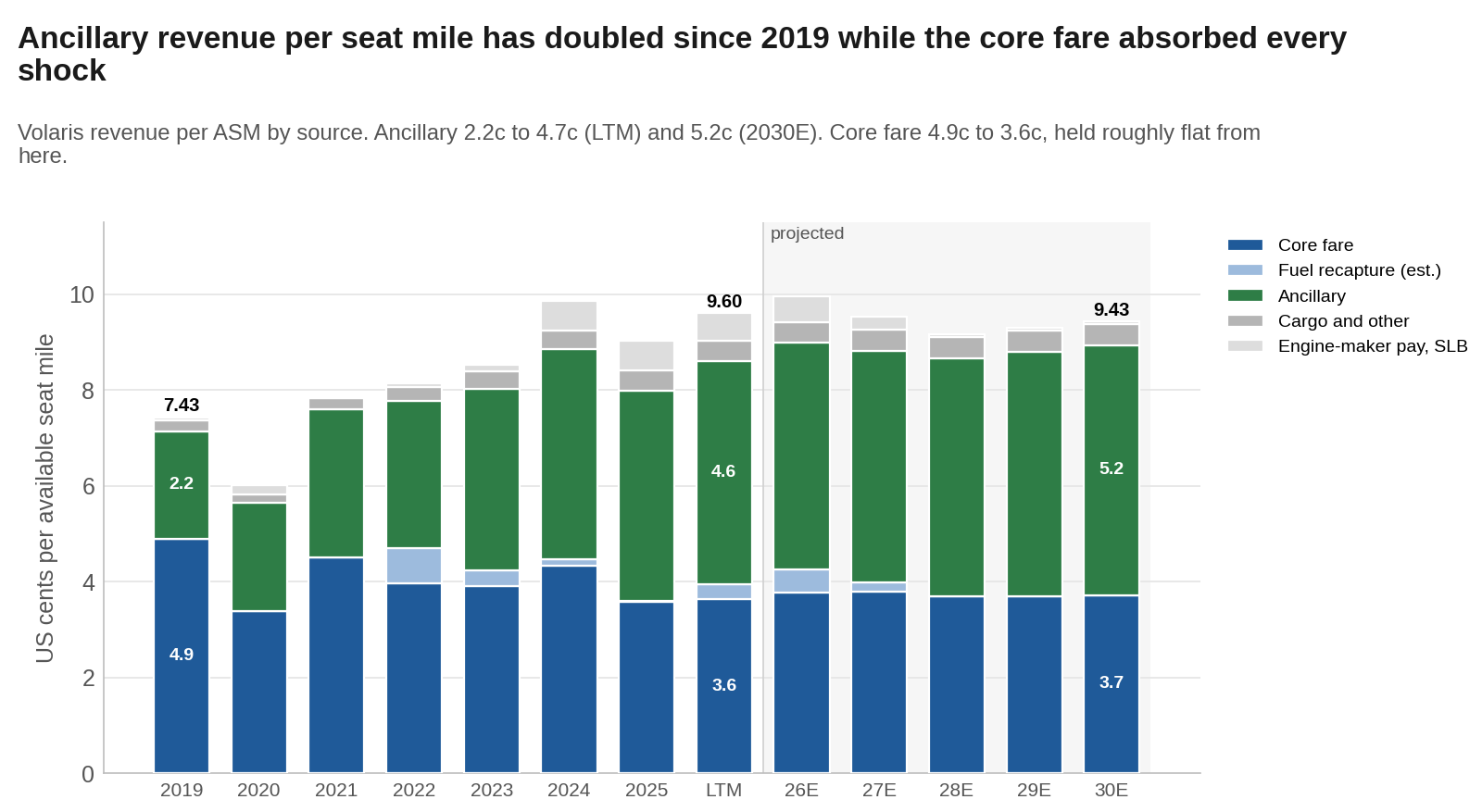
The airline under the shocks got better. Volaris cut fares to fill planes in every crisis and let fees carry the revenue. Ancillary revenue per seat mile went from 2.2 cents in 2019 to 4.7 cents today. More than half of revenue now comes from fees, its membership club and its co-branded credit card. Those streams hold up in a downturn far better than fares do.
Three more things improved…
Fuel efficiency… Each gallon flies 11% more seat miles than in 2019, a record 110 in the third quarter.
The network moved north... 1/2 of October’s capacity flew international, the highest ever. US routes recover nearly all of a fuel spike through fares, but domestic routes recover a fifth.
The balance sheet held... 84% of the debt is aircraft leases. Cash has exceeded bank debt at every year-end since 2019. Liquidity is $823m plus an undrawn $300m credit line.
The third quarter showed all of it at once... revenue passed $1bn for the first time, unit revenue rose 19%, and EBITDAR margin 25% with fuel at $4.10 a gallon (3pts above guidance).
The merger is the swing factor
Volaris and Viva agreed to combine in December 2025 as a 50/50 merger of equals. Together they carry about three quarters of Mexico’s domestic passengers. That is the deal’s value and its risk.
About 55 grounded jets return to the two airlines by 2028. Domestic demand is growing about 3% a year. If each airline refills its fleet on its own, seats run 9% ahead of passengers and fares fall. Combined, the group can hold capacity back and send spare jets to the US. That discipline is worth about $230m of EBITDAR a year, plus about $90m of cost savings.
Mexico’s new antitrust agency, the CNA, is the last approval. US antitrust and Colombia have cleared it. Reuters reported in October that the CNA is leaning toward approval with light conditions, such as holding a share of fares low and keeping most routes. Volaris’s CEO said on the Q3 call that the file is still with technical staff. We expect approval with conditions in the first half of 2027.
We risk-adjust our forecasts for this… each step up in conditions costs 5% of group EBITDAR. Light conditions cost 5%, heavy conditions 10%, and a block 15%. The whole merger benefit is about 13% of 2028 earnings, so that range covers it.
Three prices
We built the merged company with oil abating, cut its earnings for the regulator, and put a multiple on the result.
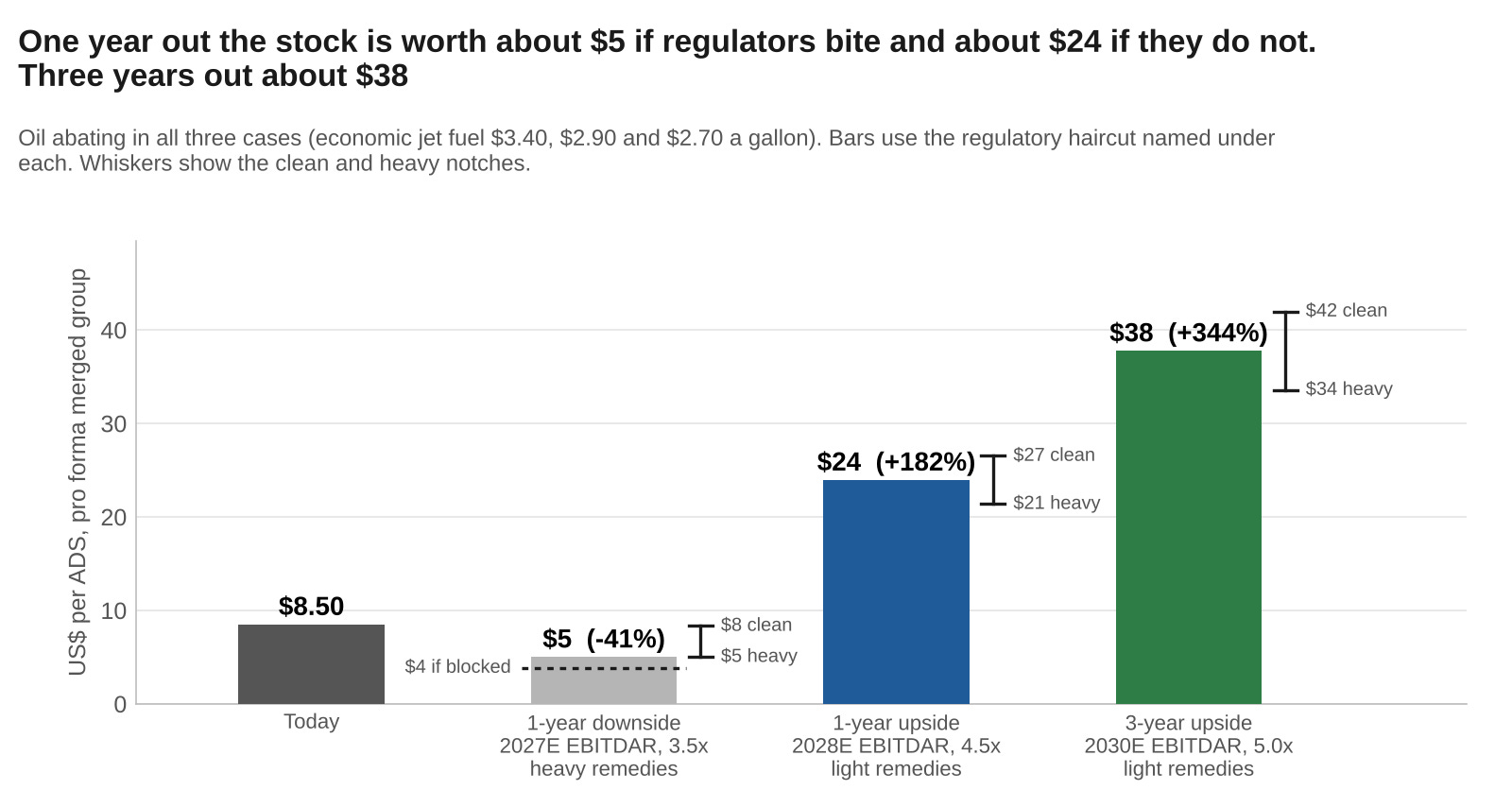
Downside: $5. 3.5x 2027 EBITDAR of $1.8bn, cut 10%. That is 0.5x below the October low. If the deal is blocked, about $4.
One-year upside: $24. 45.x 2028 EBITDAR of $2.4bn, cut 5%.
Three-year upside: $38. 5.0x 2030 EBITDAR of $2.8bn, cut 5%. Debt by then is 1.6x EBITDAR.
None of the three needs fuel back at its 2019 to 2025 average of $2.55. We use $3.40 in 2027, which is close to the US government’s October forecast, then $2.90 and $2.70.
What would prove us wrong
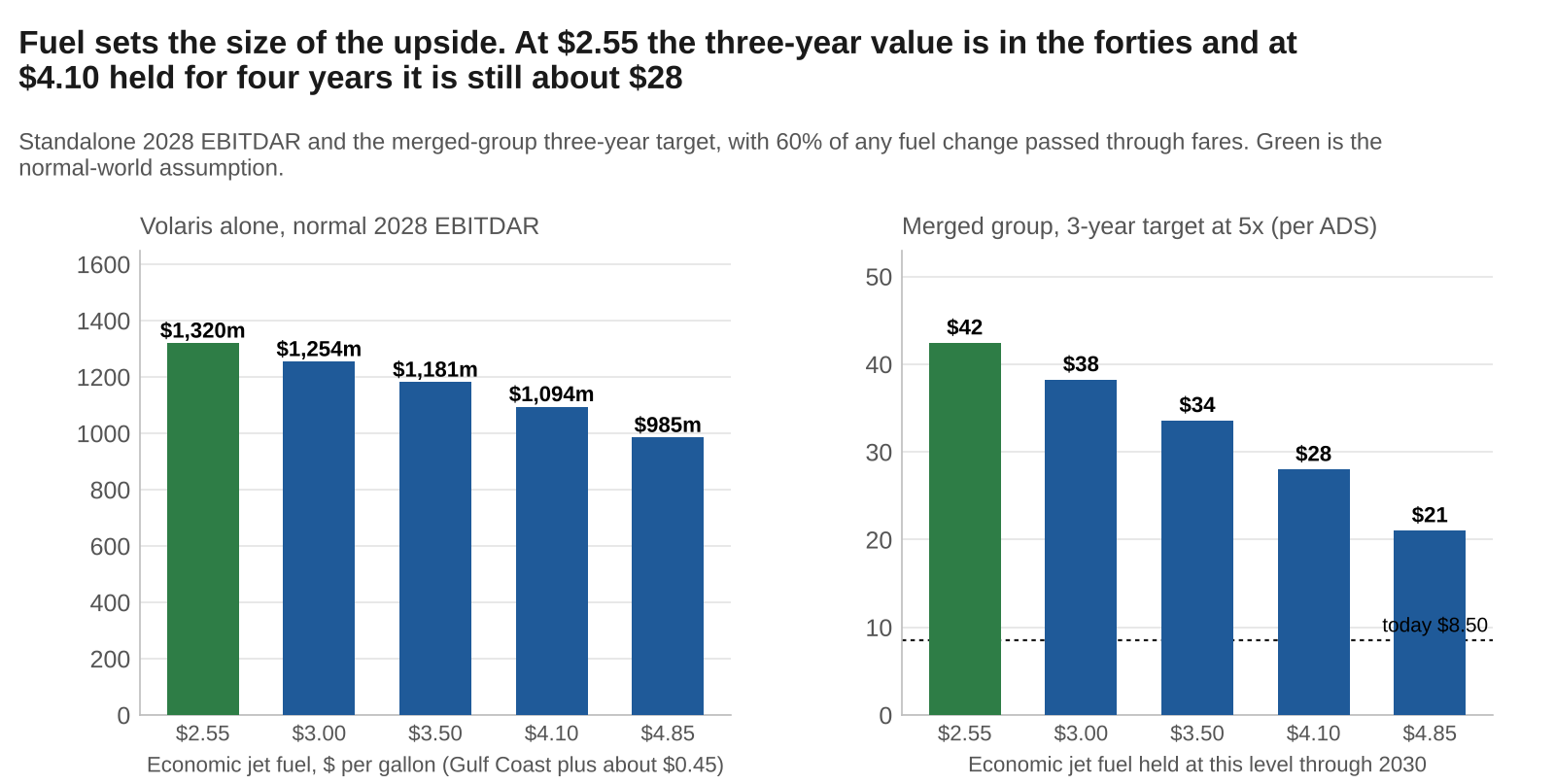
Fuel is the variable that matters most. The chart below holds fuel flat at each level for four years.
Three things would break the thesis.
Fuel stays above $4 through 2027... The Hormuz talks have failed once already this year.
The merger is blocked and both airlines refill… That is a fare war in a flat market. Our trigger is Viva growing domestic capacity more than 3% while Volaris has fewer than 22 jets grounded. Viva cut domestic capacity 5% in the third quarter.
A second FAA downgrade... An August audit of Mexico’s regulator found 21 issues. The FAA checks progress in December and rules around February. A downgrade would freeze the US growth the 2027 plan relies on.
What to watch
The CNA decision. Watch for the file moving from staff to the commissioners. Slot give-ups are cheap. Fare or capacity commitments are not.
The FAA in December and February.
Fourth-quarter results in late February. A 2027 plan with domestic capacity down and no new fleet debt fits our case.
Jet fuel. A quarter below $3.25 at the wing tells us the oil peak is in.
The full deep dive, with the regime history, the lease book, the merger model and the futures panel, follows this week.
DISCLOSURE
Position: At the time of publication, the author holds a positions in VLRS.
Trading Policy: The author will not materially alter this position within 48 hours of publication. After this period, the author may buy, sell, or otherwise adjust the position without further notice. Changes to the author’s view or position will be reflected in subsequent publications when material.
Conflicts: The author has received no compensation from the issuer or any party with a financial interest in this security.
Forward-Looking Statements: This report contains the author’s opinions, estimates, and projections, including price targets derived from financial models. These are forward-looking statements subject to substantial uncertainty. If these assumptions prove incorrect, the actual value may differ materially, including scenarios of significant loss or total impairment. The price target represents the author’s estimate of fair value under the stated assumptions, not a prediction of where the stock will trade.
This report is provided for informational purposes only and does not constitute investment advice. See the full Terms & Disclosures for additional important information.