


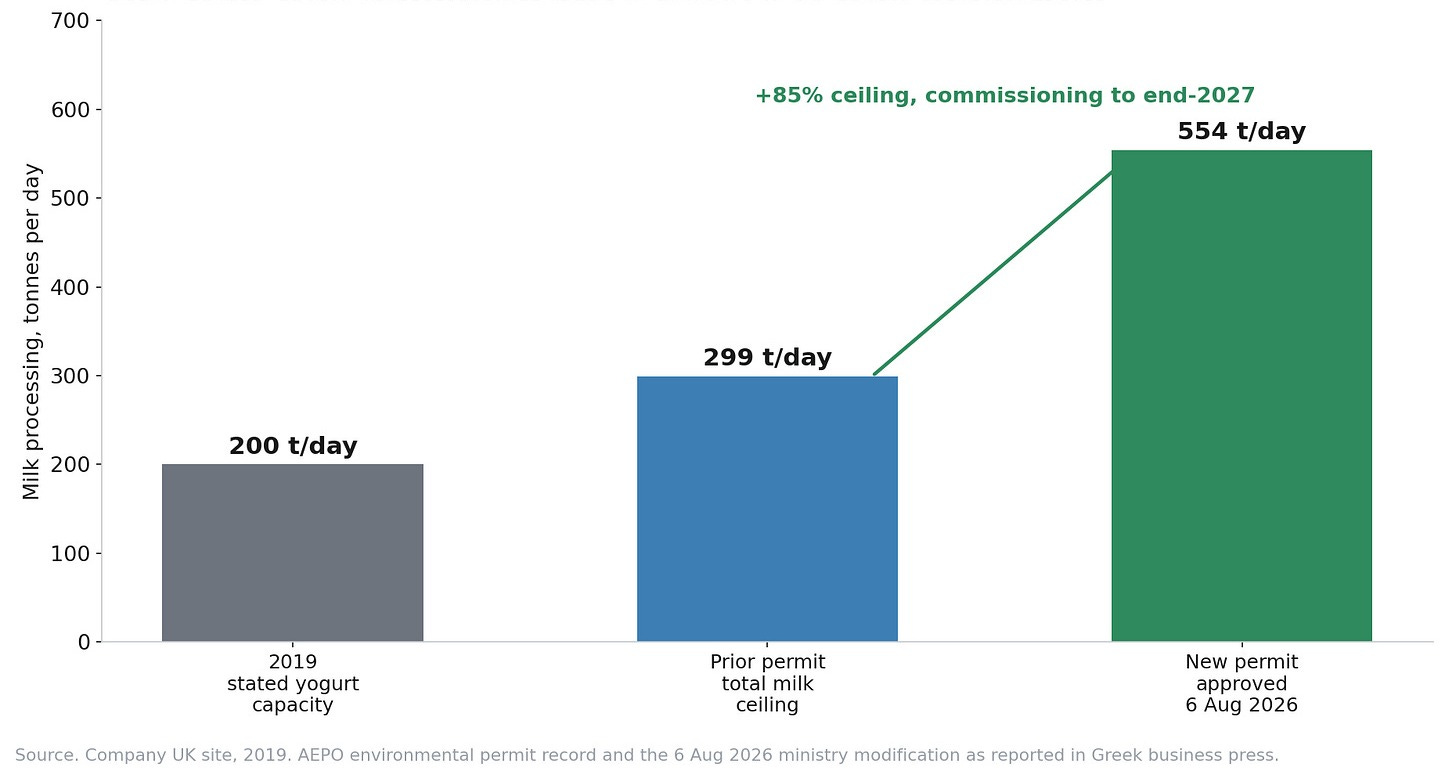
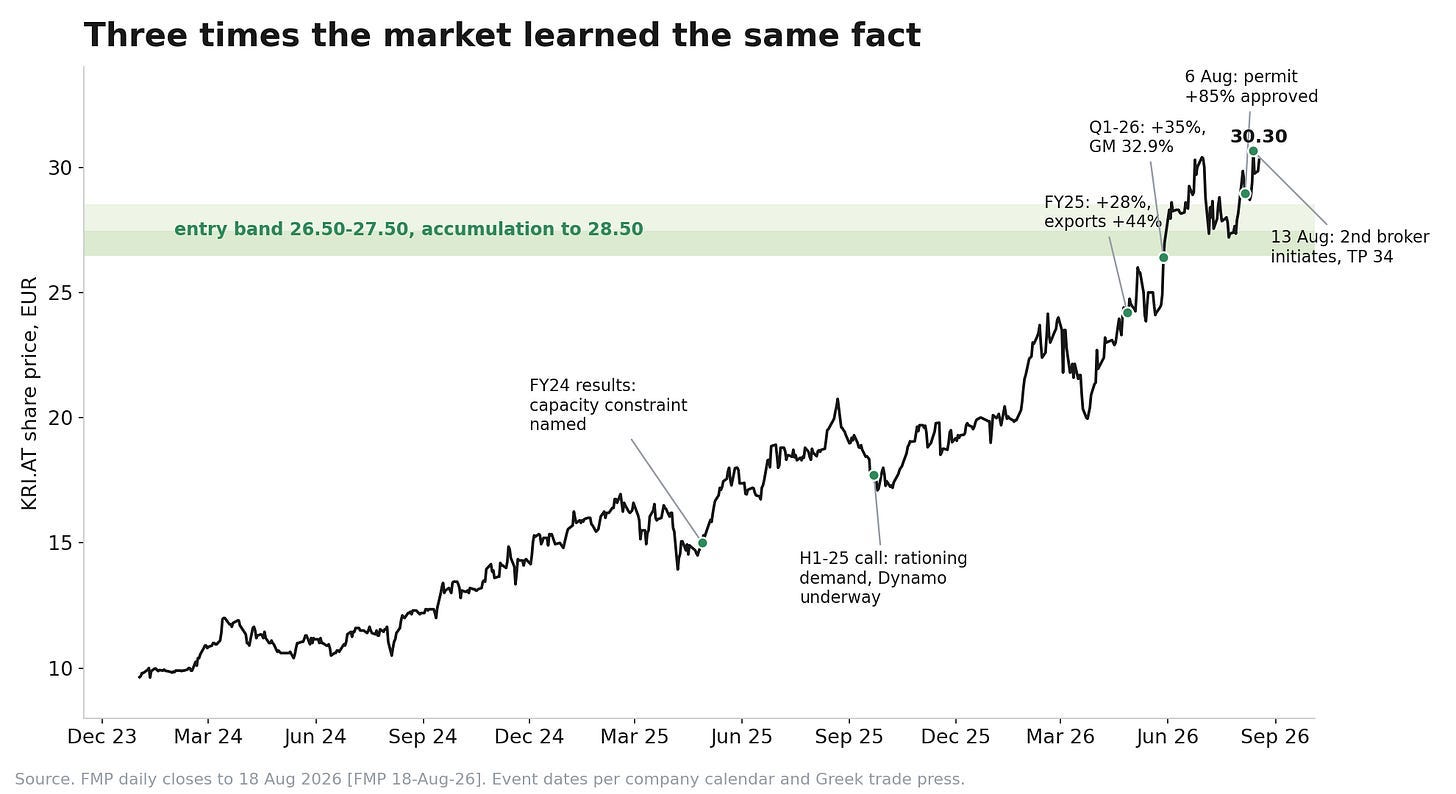
Some businesses are limited by what people will buy, but this one has limited by what the government allows them to make… and that is about to change. On August 6th they were granted a permit to expand production by 85%. This will drive nice growth through the end of the decade after even admitting on earnings calls that they were turning away customers.
Kri-Kri makes Greek yogurt in one plant in Serres and sells most of it as supermarket own-label across Europe. Revenue grew 28% last year, and we estimate the plant ran near 92% of the milk intake its environmental permit allowed. Management deferred taking on new customers, and reported wasting product by over-running lines. Soon they’ll be able to show investors how much demand really exists in Europe for “authentic” Greek label yogurt (labels matter in the EU) just as GLP1 adoption also ramps.
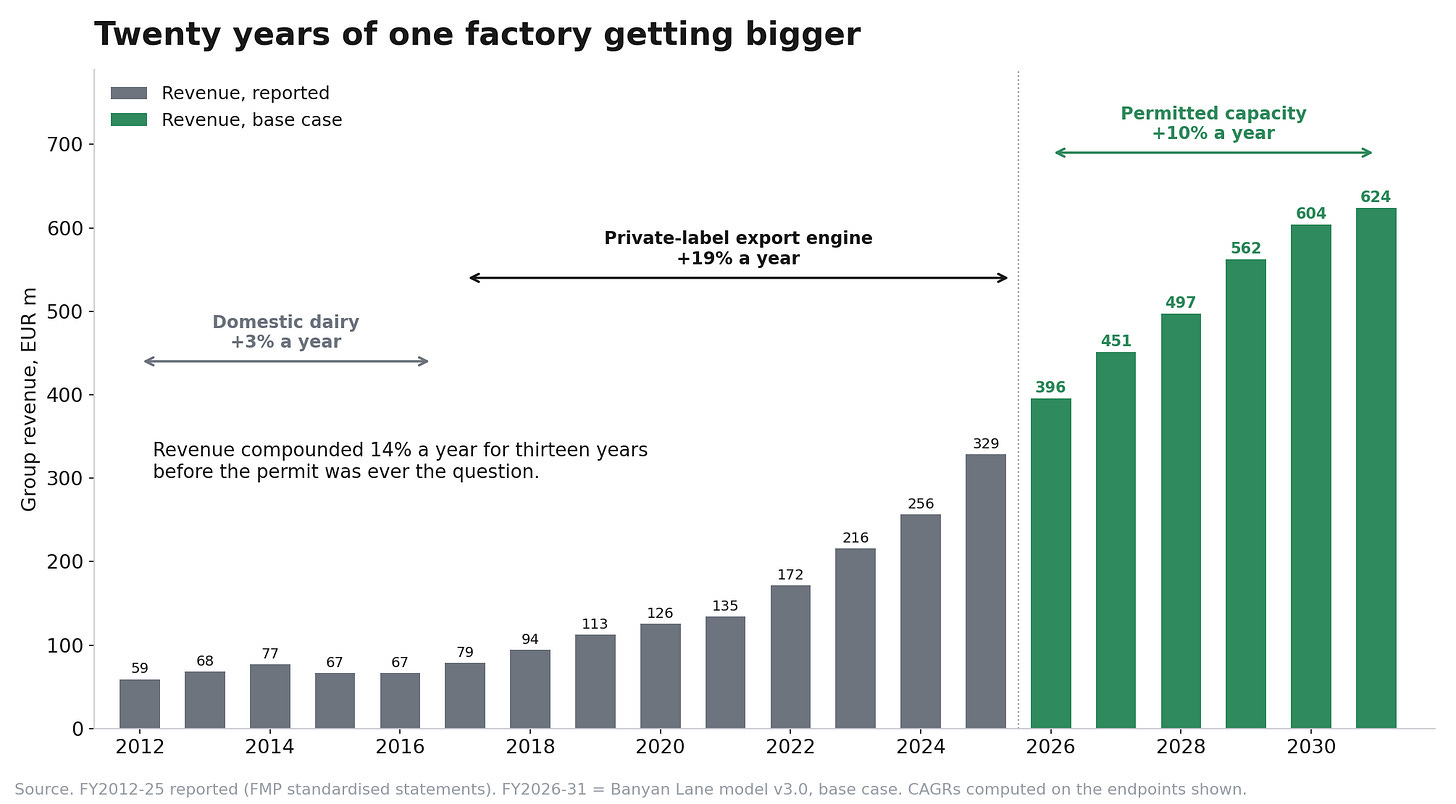
Across fourteen reported years Kri-Kri compounded revenue at 14% a year. It did that from one site, through an energy war, and a milk inflation cycle. Demand has been solid, and now they need more room to run.
The market has picked up the permit alongside a sell-side note and run with it. We still see nice compounding upside on every time frame. The stock is breaking out and multiple modestly expanding but not demanding given the durability and drivers of growth. We are still looking for a call with management to understand the nuances and shape of the growth to come, but feel it’s reasonable to assume this capacity gets eaten up by end of the decade. The other important driver we’re trying to pin down and refine the range of outcomes for is milk input prices. These can swing and move GMs, but increasingly imported feedstock should also keep a lid on absolute costs (more on that below).
Secular demand growth
Kri-Kri is best analyzed as a manufacturing business, not a consumer brand. While their brand means something in some regions, the growth from here is increasingly exported and private label. Regardless, evidence points to the fact that they’ll be able to sell what they produce for the foreseeable future. There are three stacked demand curves… modest yogurt category growth, strong Greek yogurt share within the category (healthy and protein trends along side GLP1 growth, and now opportunity for them to take incremental share…
UK Greek yogurt consumption growing 40%, importing some Kri-Kri already
Authentic Greek, meaning strained yogurt made in Greece, is taking share inside yogurt.
Europe sits at 2% GLP1 adoption against 12% in the US
A Cornell basket study finds yogurt is the largest positive category shift among GLP1 users
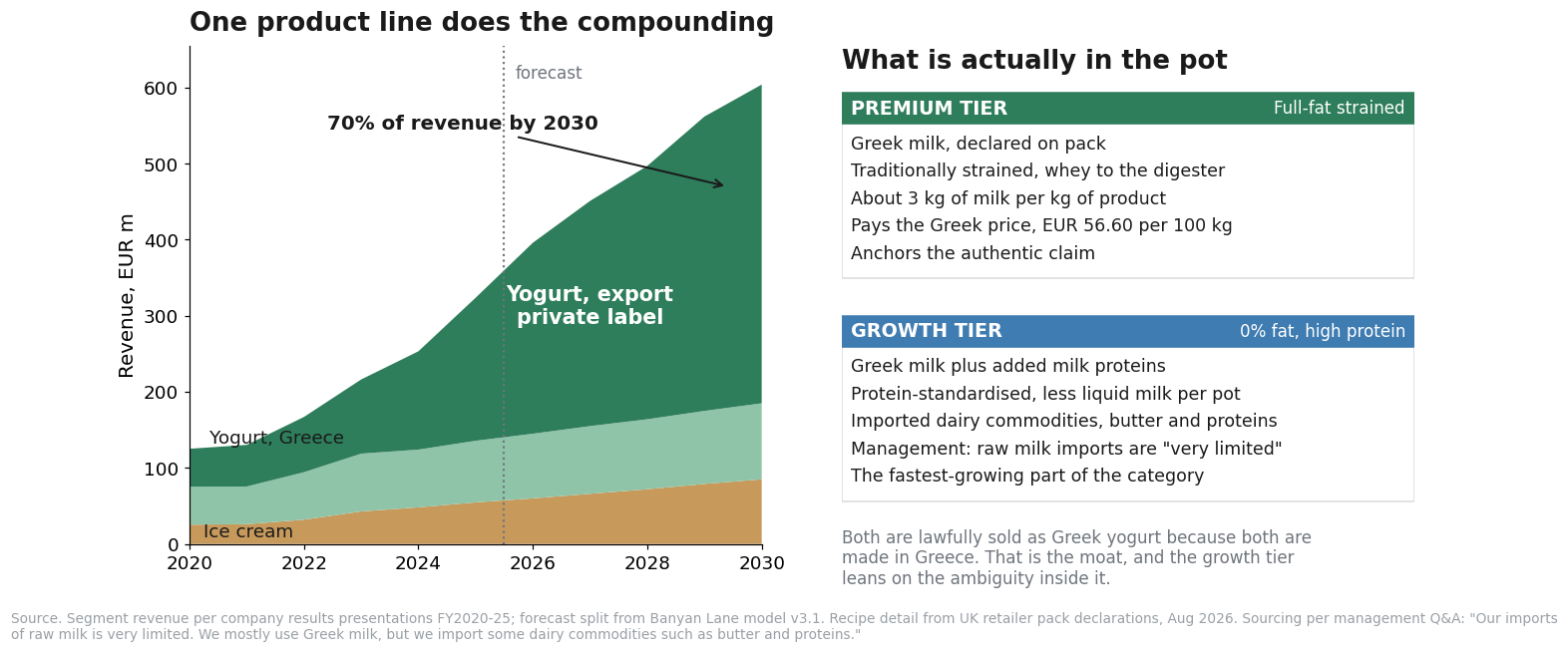
Kri-Kri taking share in authentic export private-label manufacture… we estimate it is the largest exporter, with 33.6% of a EUR 559m market that grew 42% in 2025.
So the growing demand of exported Greek yogurt has a very long runway supporting continued expansions. This is the type of long-term runway you want to look for to find multi-baggers. Nothing is guaranteed but it certainly leaves plenty of room to compound for years in a category where healthier eating habits can be driven by broad populations organically changing habits or via regulation or via GLP1 use incentives.
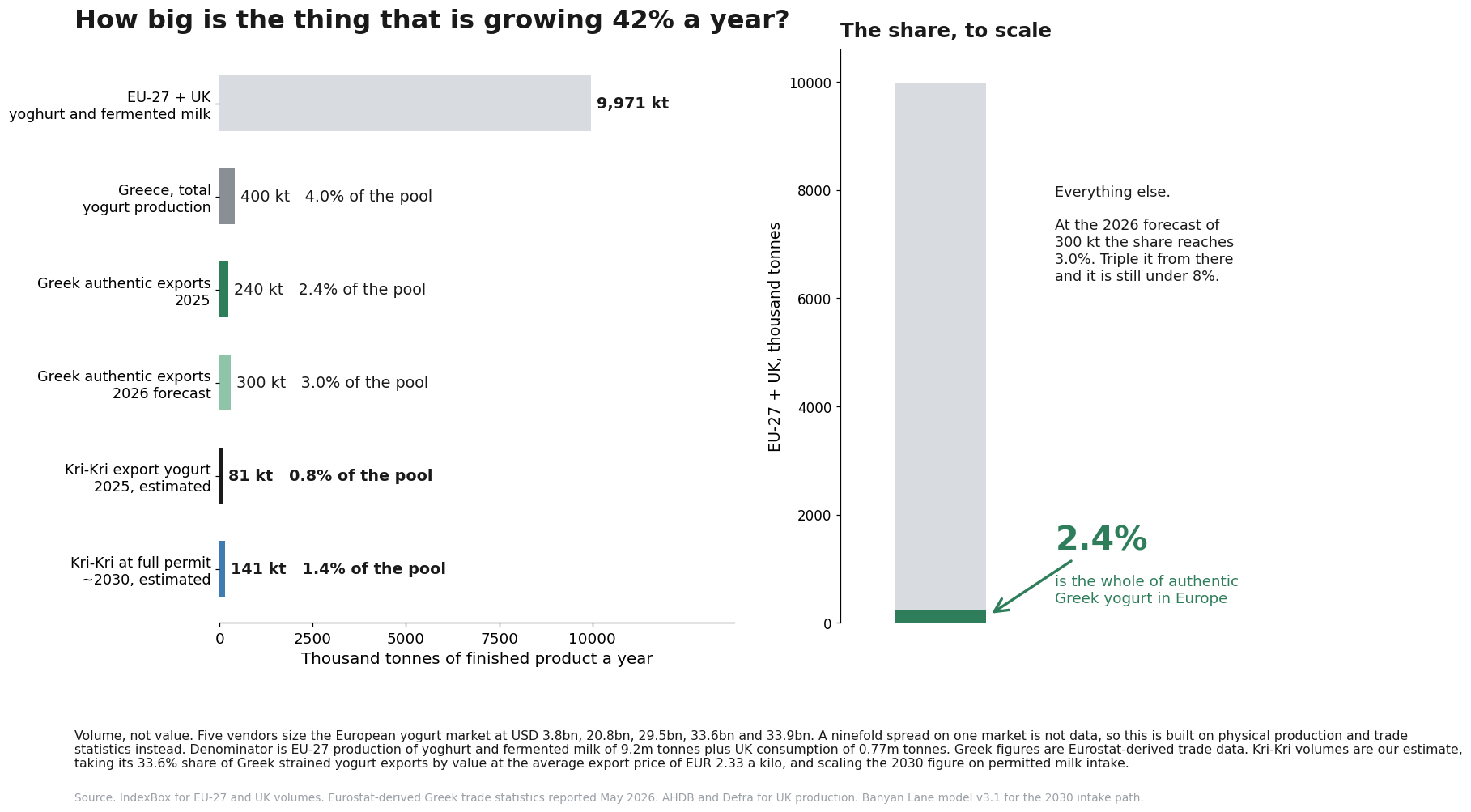
And for Kri-Kri, this is clearly their sweetspot and where they have been focusing the most effort.
Supply
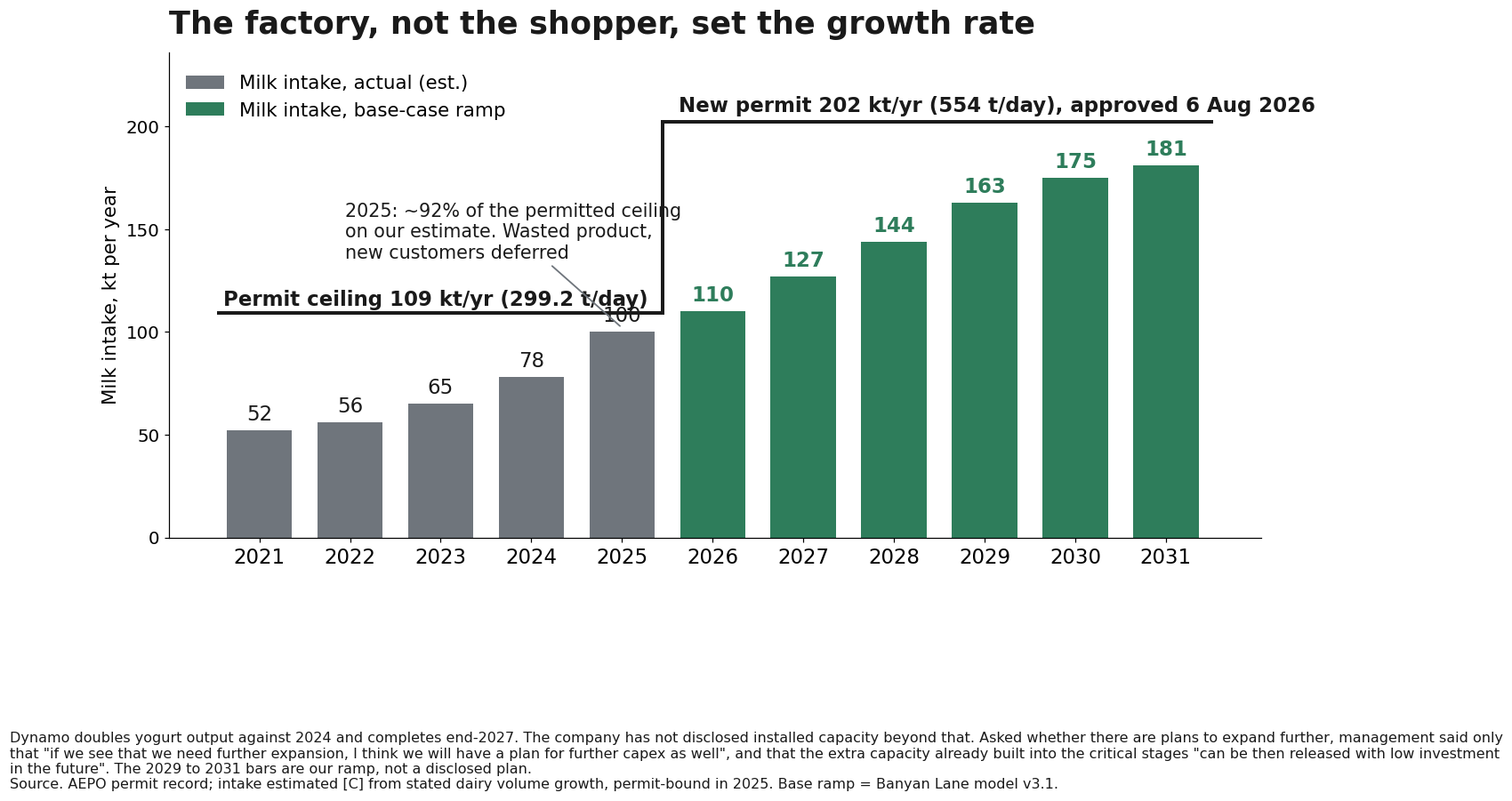
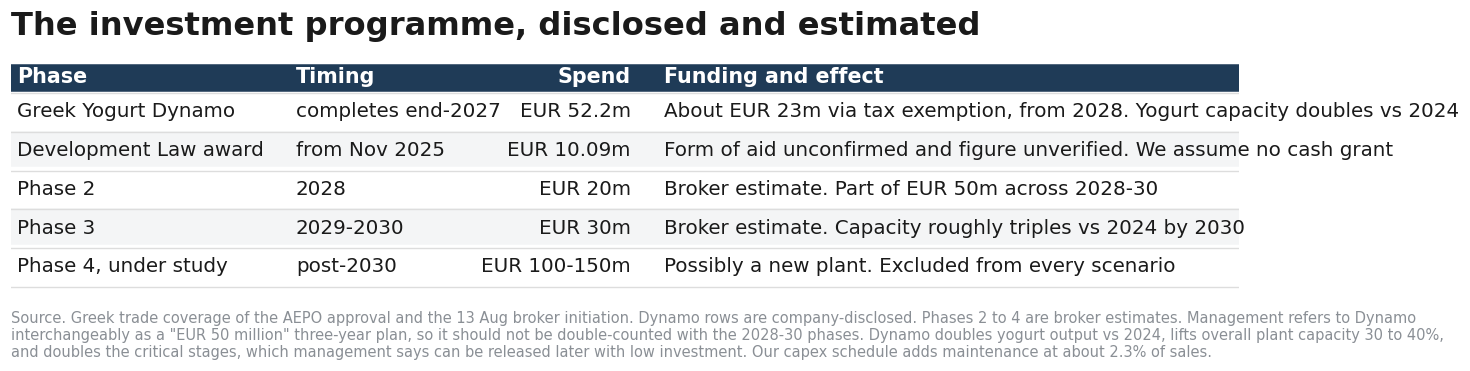
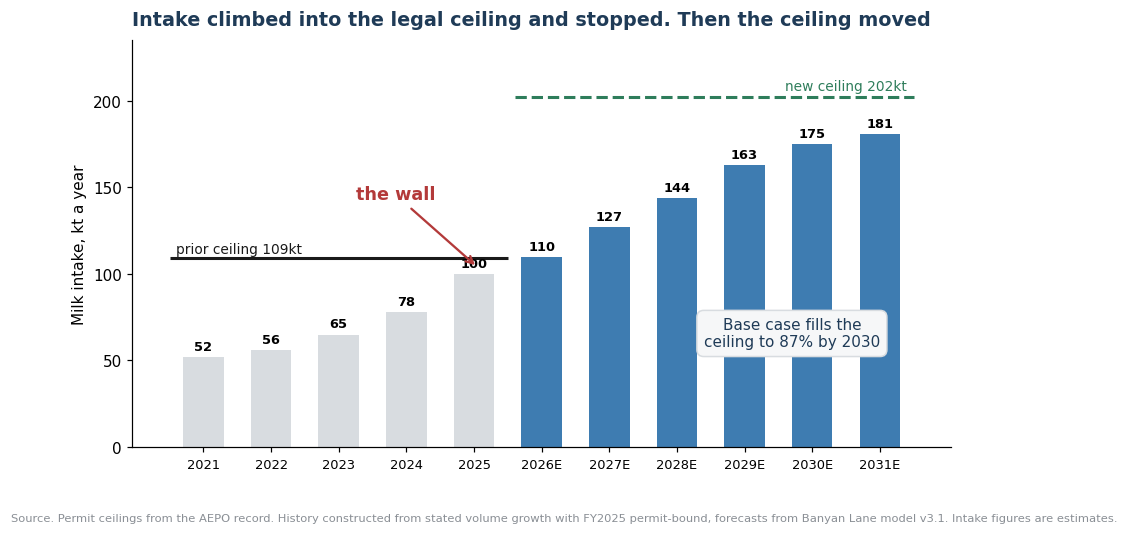
The Serres plant operated under a permit capping milk processing at 299 tonnes /day, roughly 109k tonnes / year. Our intake reconstruction puts 2025 at about 100k tonnes. Management’s own commentary corroborates it. The ministry approved 554 tonnes / day, about 202k tonnes, split 480 dairy and 74 ice cream. The site expands 62%, water rights rise 39%, and a second whey digester doubles the straining bottleneck’s relief. The state co-funds the expansion. About EUR 23m of tax relief becomes available after the project completes at end-2027, so it phases from 2028, and a separate certified relief of roughly EUR 6.5m is already in hand with about EUR 4m usable in 2026.
How fast can the new plant ramp, and what is it worth?
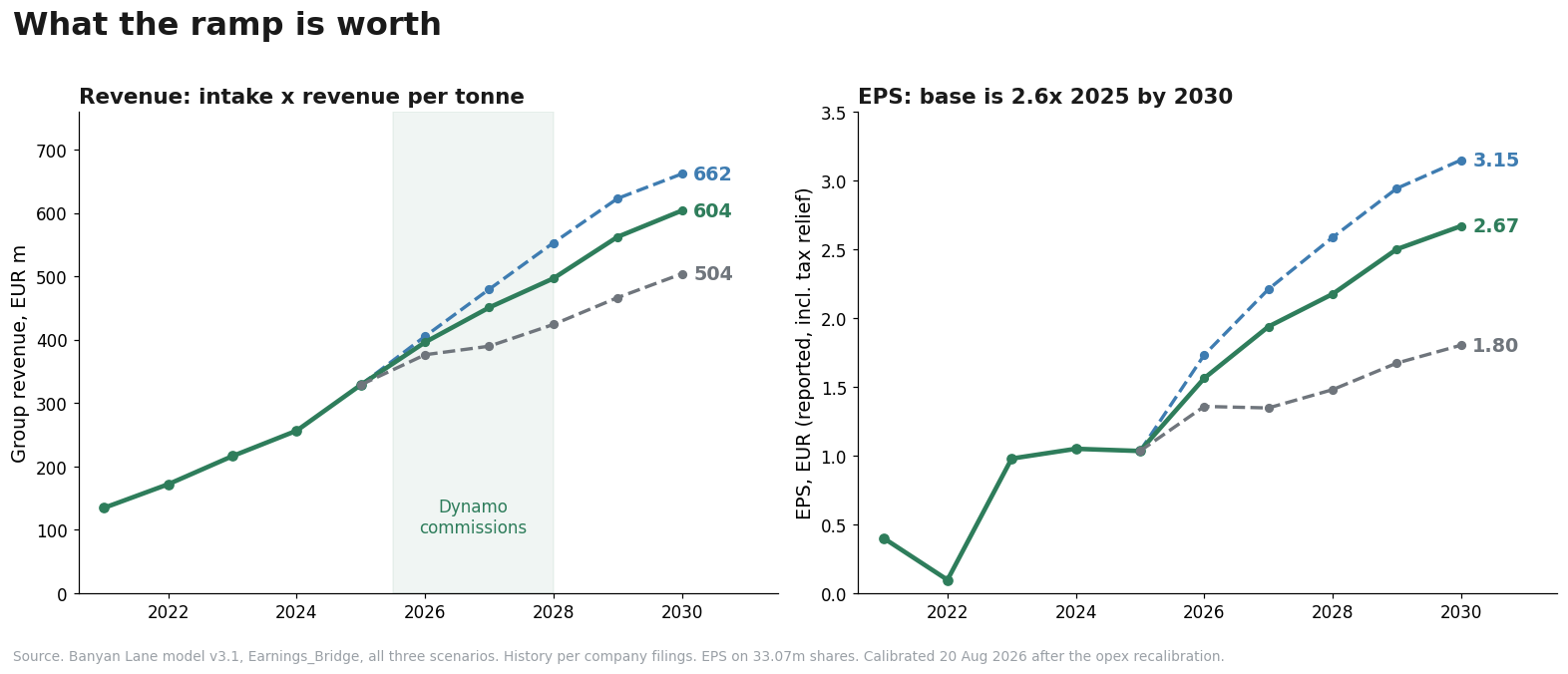
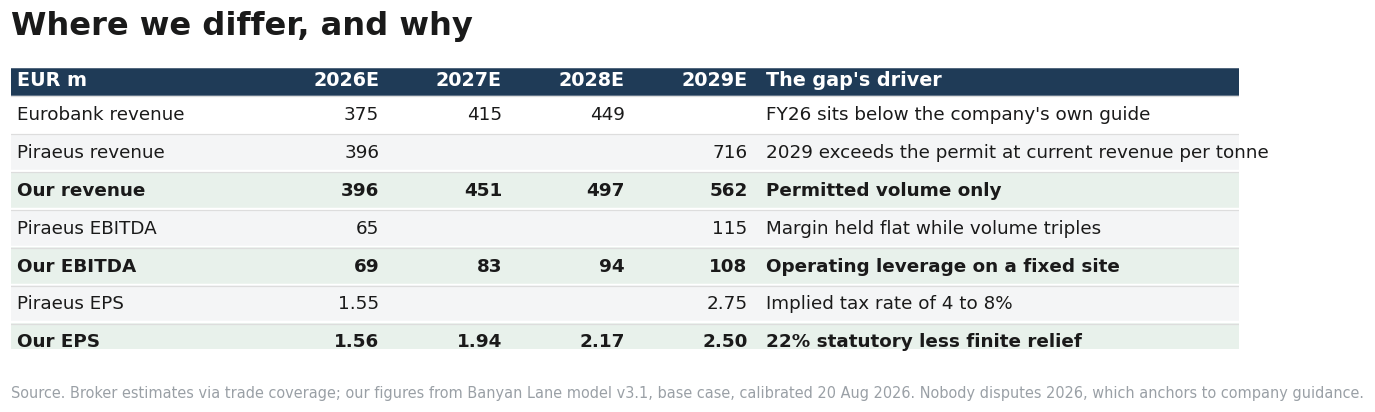
Our base case fills the new ceiling to 87% by 2030, and net income roughly doubles against 2025 by 2029. The build is mechanical with milk intake times revenue / tonne, then margins from the milk work below. Revenue per tonne drifts from EUR 3.3k toward 3.5k on mix. That gives revenue of EUR 396m this year, EUR 497m in 2028 and EUR 604m in 2030. Management frames the current expansion as capacity for about EUR 500m of sales, and was careful to add that it depends on demand. Note that management states the Dynamo doubling against 2024, not 2025. Our plant-defined mid-case at full utilization is EUR 600m. The three anchors agree.
The cadence is the model’s biggest unknown. A doubling that arrives in one step in late 2027 and one that phases across six quarters are different stocks for a year. The company has never disclosed the sequence. Until it does, our 2027 carries the widest error bars in the model.
One broker models EUR 715.8m of revenue in 2029. At the company’s 2025 dairy revenue per tonne of milk, that needs about 263k tonnes of intake, or 130% of the approved ceiling. Their number is only reachable through a large mix shift toward fortified recipes, an unannounced further permit, or both. Perhaps there is further upside in scale or mix, but we would not underwrite this without confirmation from management.
Milk prices and margins
The cost base is roughly 90% Greek liquid milk. Asked directly what share of cost of goods is Greek versus EU milk, management said imports of raw milk are very limited, that they mostly use Greek milk, and that what they import is dairy commodities such as butter and proteins. So the cheaper leg is commodities, not liquid milk, and the premium full-fat cups and the domestic book carry Greek milk throughout. Greek farmgate stands near EUR 56.60 per 100 kilos against an EU average of about 41.84. The spread is above a third, the widest on record, and it helps through the commodity line rather than the milk line. The gross margin expansion of 5.5 points in Q1 is better explained by the price adjustments management took from H2 2025 and by falling dairy commodity prices, which management cited directly when noting the energy surcharge was largely offset.
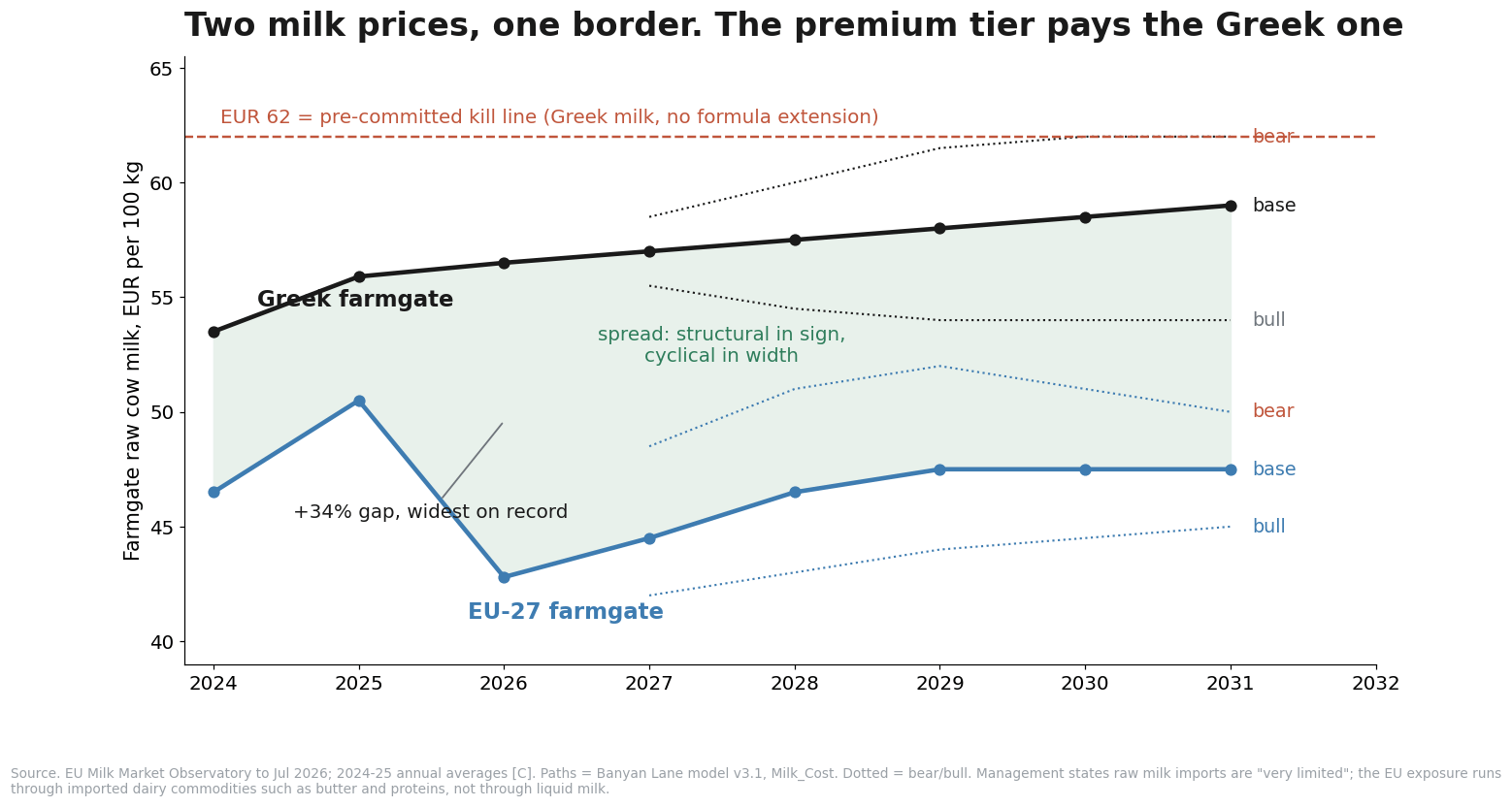
Greece produces roughly 40% of the cow milk it consumes. Feed is imported and runs 60-75% of production cost. Farm numbers fell 42% in a decade, and 358 farms now deliver nearly three quarters of the pool. A price ~30% above the EU average has produced supply growth under 2%. The 2026 EU price decline is driven by a shrinking herd while the heifer pipeline is the thinnest in decades. EU prices firm into 2027 and 2028, exactly when the new capacity lands. Meanwhile, a growing competitor plans to triple production with a EUR 150 to 160m plant into the same market. Thus, we have tried to prudently give back some margins after a great 2026 for this spread.
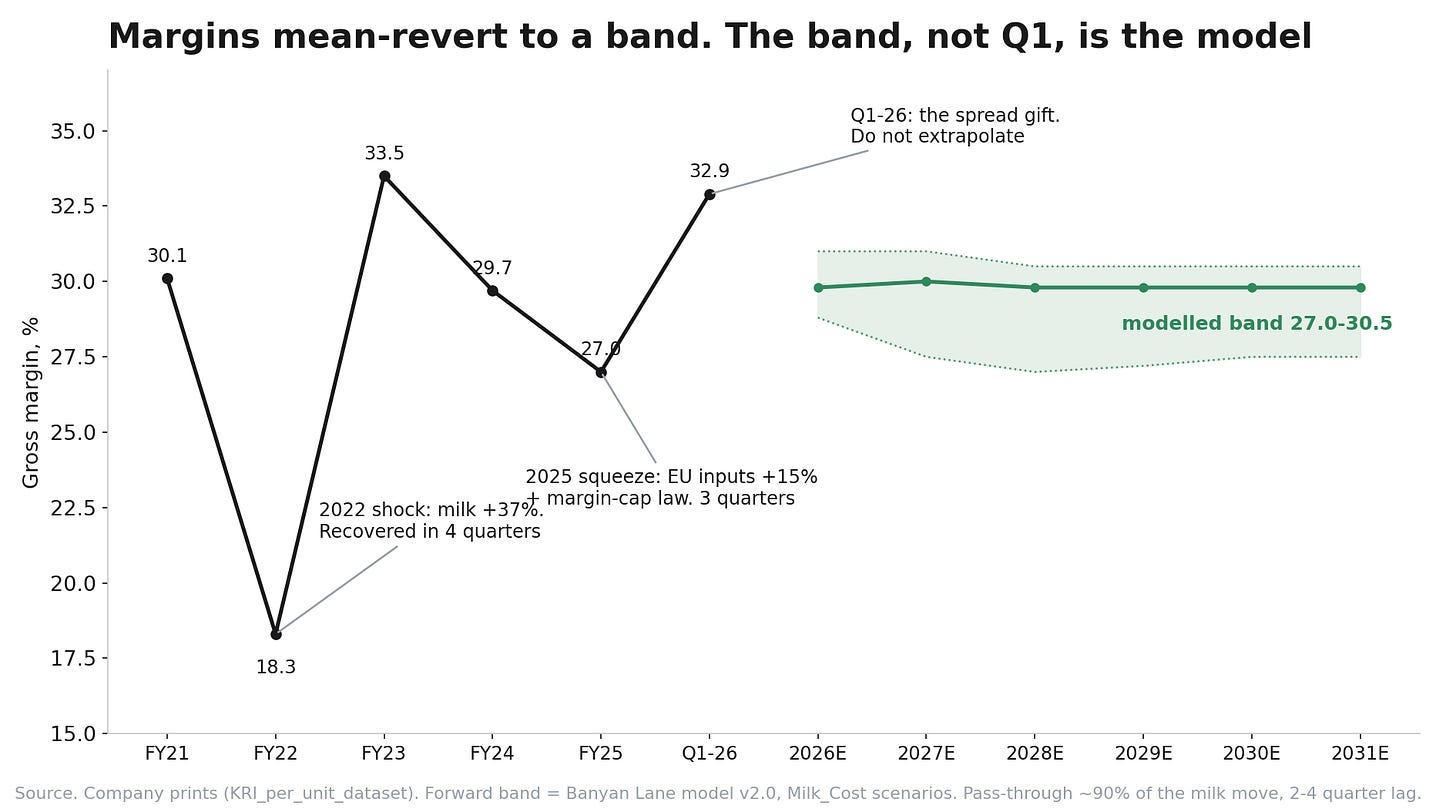
However, this remains a key risk to monitor… a double squeeze, EU inputs recovering fast while Greece stays high, produced 2025’s 27.0%. Our bear carries exactly that.
Free cash flow coming
Today’s modest net cash position supports the buildout. Prior years saw lumpy working capital and CapEx leading to minimal FCF. Normal cadence with more scale and similar CapEx as those years will yield a growing net cash balance to nicely support the dividend (current 1.5% yield, or EUR 0.45).
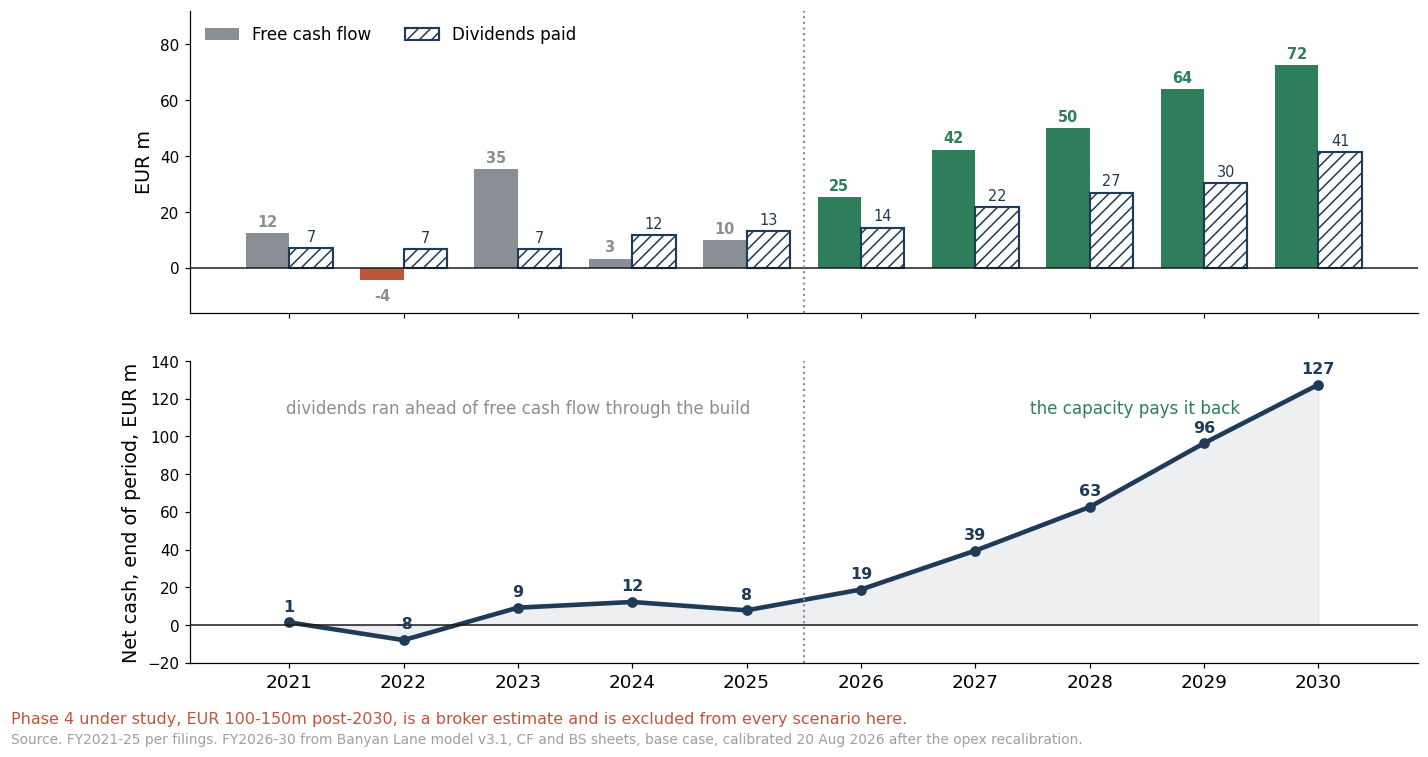
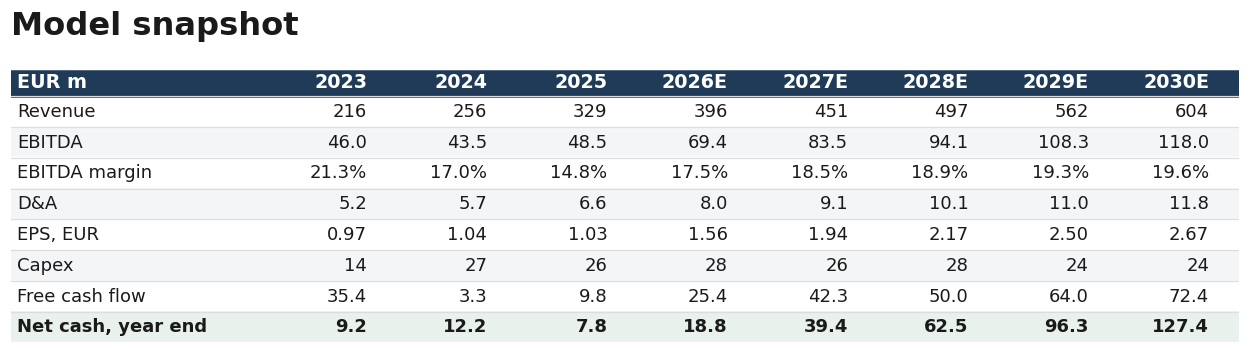
Cumulative free cash flow after dividends from 2026 to 2030 is about EUR 111m. Phase 4, the post-2030 study, is EUR 100 to 150m. The cash the plant generates and the next project management is contemplating are the same size.
Valuation
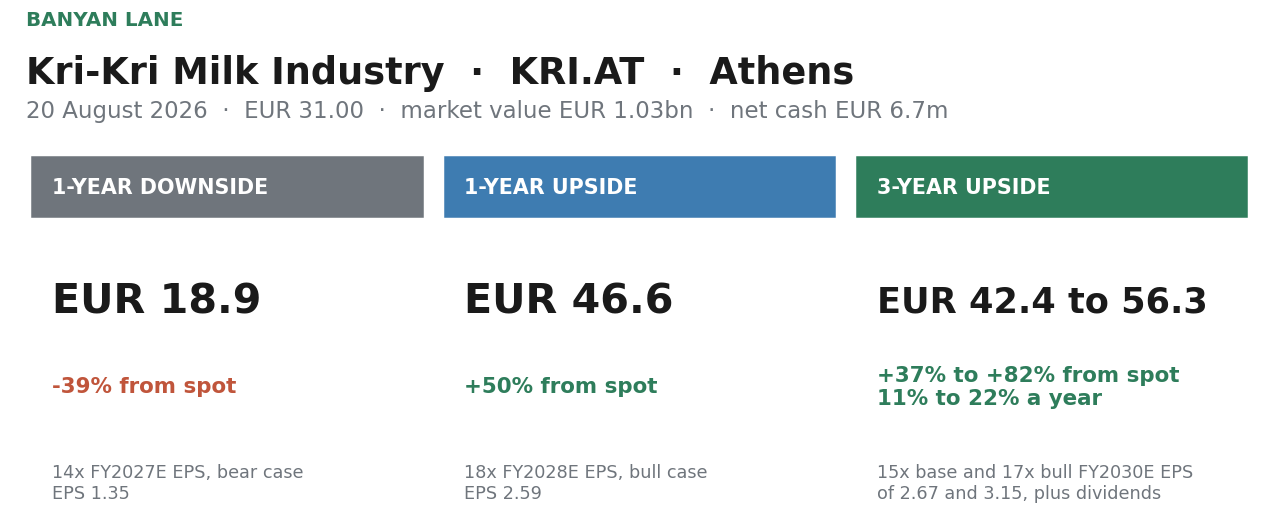
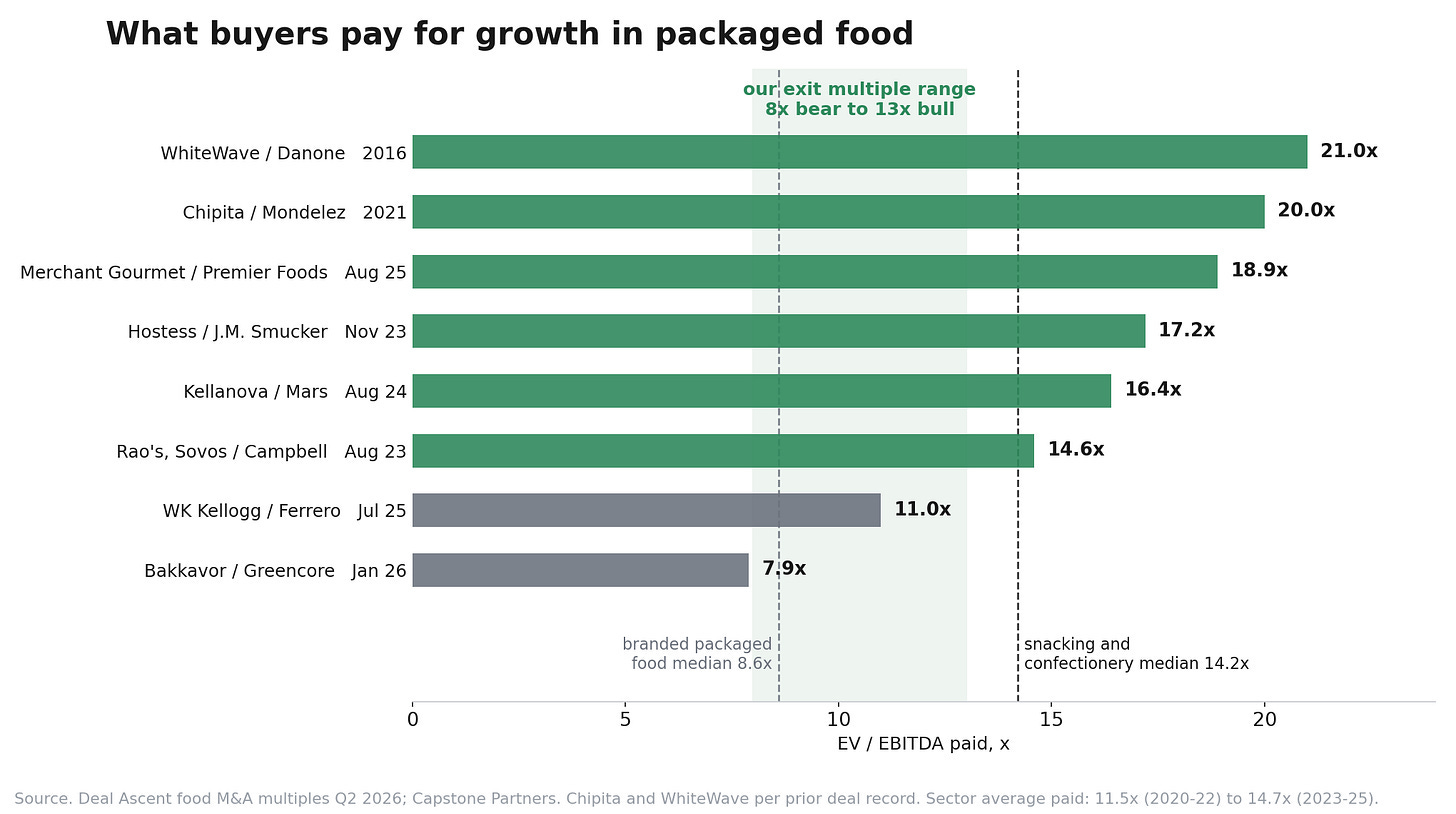
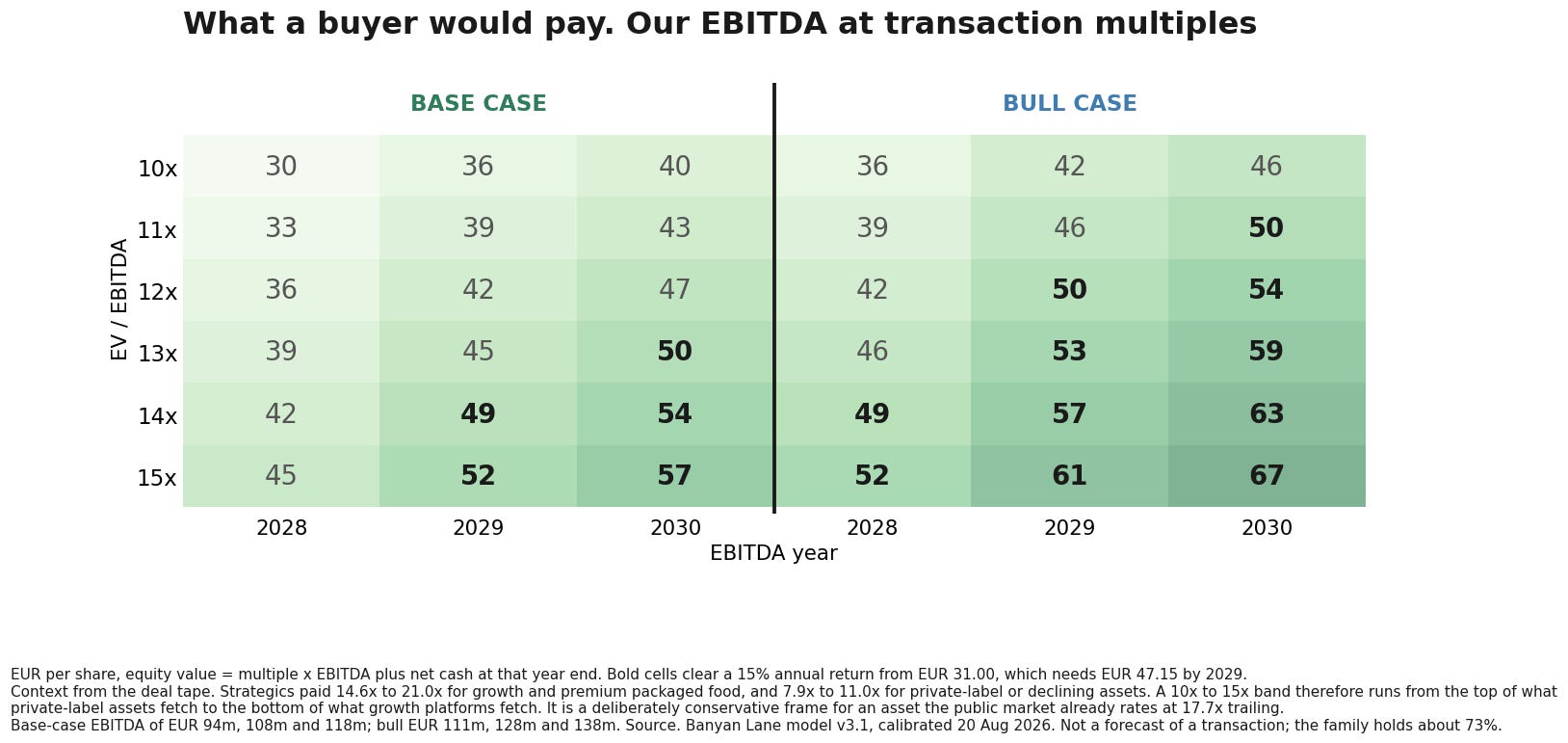
We value the business on EPS as the going FCF will likely be given back in a few years to support further expansions. Importantly, past EPS declines were largely driven by GM compression resulting in real pullbacks in the stock. However, the underlying demand and volume growth support a nicely growth EPS algorithm when margins are normalized and observed over any multi-year time frame. We use a range of multiples of just 14-18x which result in a very modest PEG ratio. There is a scenario where finding growth stocks, with durable trends, in the EU becomes hard in the coming years as a result of so many secular headwinds… this could see Kri-Kri trade at a multiple of 20x EPS or higher.
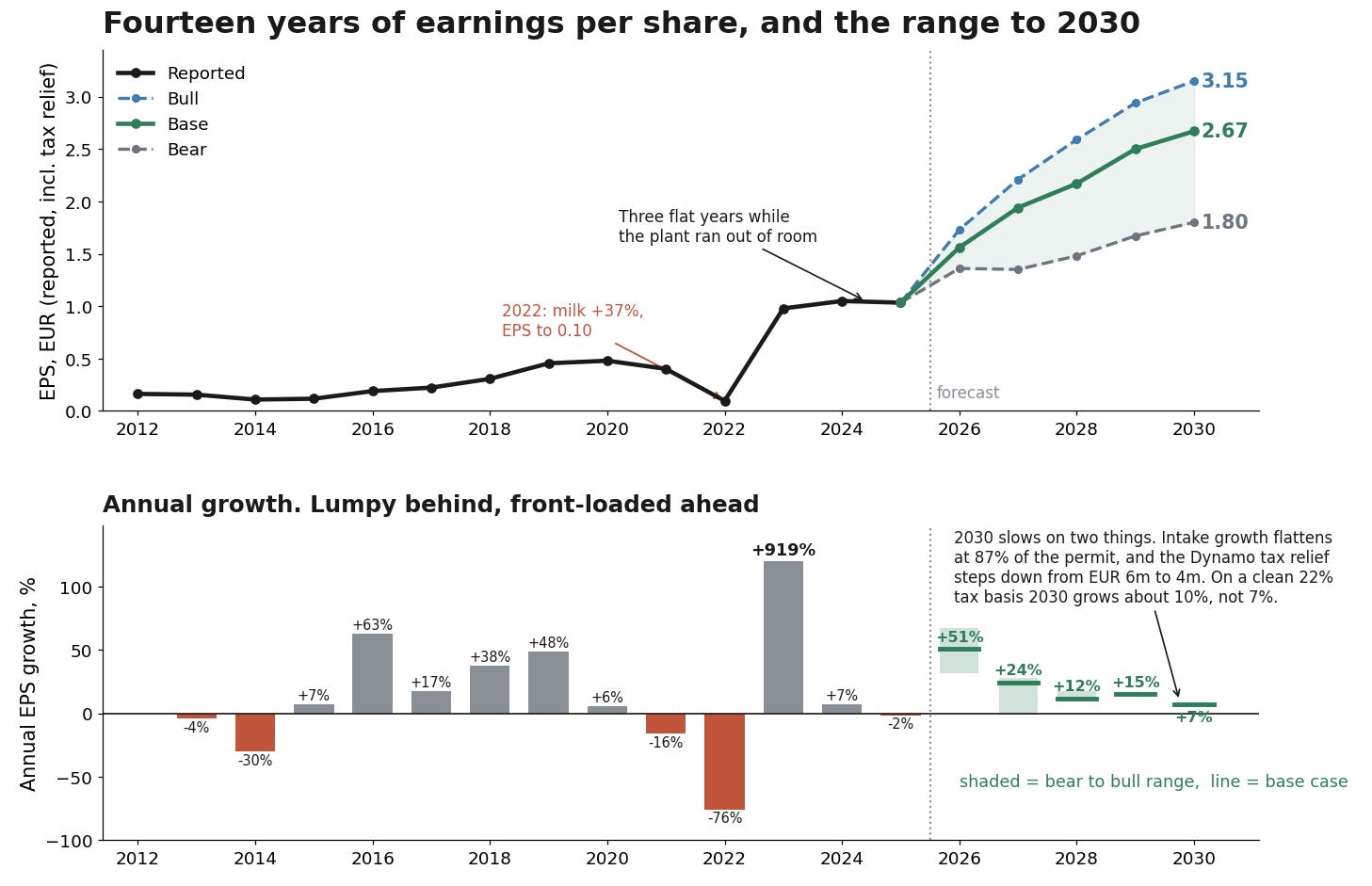
The multiple range is not arbitrary. It comes off what buyers actually pay.
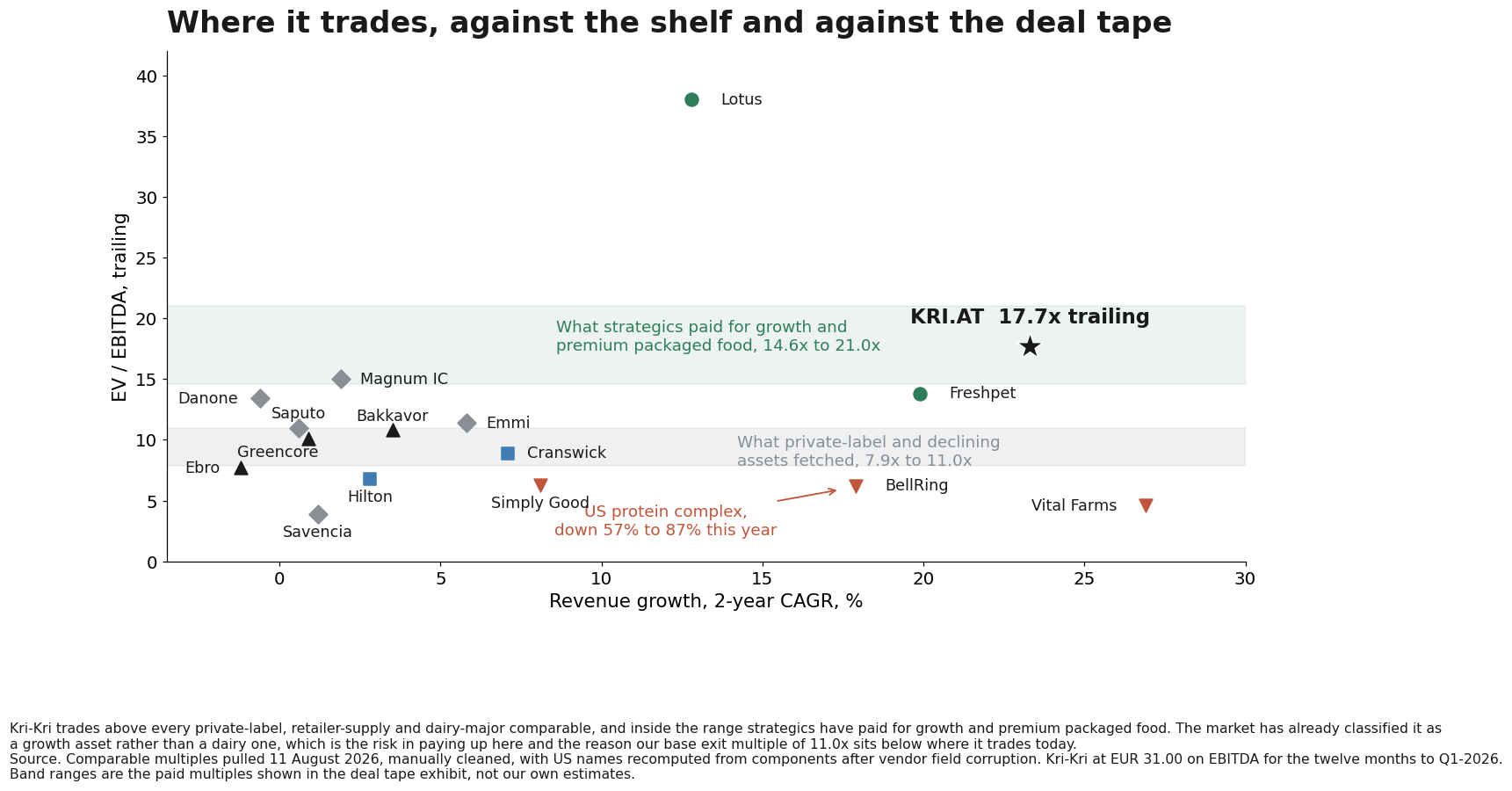
The transaction comps below should be viewed as the high end of what is possible.
Risks
UK case law defines Greek yogurt as made in Greece, traditionally strained, without additives. The fastest growing tier is protein-focused recipes lawfully declaring EU dairy inputs. A purist litigant or a front-page investigation into what authentic means could compress the whole category’s premium. Two mitigants are real... the practice is industry-wide, since Greece’s entire 400k tonne yogurt output could not exist on traditional straining from a 640k tonne pool.
Second, the input squeeze. BellRing fell 80%+ when protein inflation and club own-label broke its margins. Kri-Kri buys the same protein complex for its growth tier. However, they are unlevered, have a strong brand position, and pass-through on most UK voluemes.
Third, a competing plant is tripling capacity with state funding and is backed by the country’s most successful food-export builder. It arrives after our ramp fills, which is why it caps the terminal multiple and growth rather than the base case in order to strike a conservative approach. However, they will also begin bidding for the same fixed milk pool, so Greek farmgate drifts up in our base case rather than flat.
Fourth, capital allocation as the cash accrued through 2030 is likely to be redeployed again for expansion, it seems.
Conclusion
Kri-Kri is the manufacturer behind Europe’s fastest-growing food category, and the binding variable was never demand. Expansion is coming which will support multiple years of growth at the same time GLP1 adoption grows. This type of durable demand profile is rare to find in packaged goods, and we believe the market will pay a healthy multiple for it. It has secular, thematic growth, is self-funded, and entering new markets that are rapidly absorbing product. The risk remains input costs which will certainly swing over time, but this should be manageable. The large ~70% family ownership makes an outright acquisition unlikely, but acquisitions of this sort of growth and margin profile have come at multiples well above our underwriting cases. Current valuation is fair and we aim to get a call with management to drill down on the most important drivers.
DISCLOSURE
Position: At the time of publication, the author holds a position in KRI.AT.
Trading Policy: The author will not materially alter this position within 48 hours of publication. After this period, the author may buy, sell, or otherwise adjust the position without further notice. Changes to the author’s view or position will be reflected in subsequent publications when material.
Conflicts: The author has received no compensation from the issuer or any party with a financial interest in this security.
Forward-Looking Statements: This report contains the author’s opinions, estimates, and projections, including price targets derived from financial models. These are forward-looking statements subject to substantial uncertainty. If these assumptions prove incorrect, the actual value may differ materially, including scenarios of significant loss or total impairment. The price target represents the author’s estimate of fair value under the stated assumptions, not a prediction of where the stock will trade.
This report is provided for informational purposes only and does not constitute investment advice. See the full Terms & Disclosures for additional important information.
Very good. I enjoyed this. It's interesting to read other people's analysis on names that I have done deep dives on. I particularly enjoyed the chart with the reasons for the price moves added in.
No paywall - a look at the style of deep dives. Real numbers and outputs, no handwaving.