I look back on my 10 years at several hedge funds and most regret one thing… not buying and tucking away compounders when the market started to price them as broken. Every compounder people wish they had bought in year one or on weakness when the algorithm was broken but was priced as such… for me it was Transdigm, Roper, Berry Plastics, Ametek, Lifco, FAST, and on and on… They typically share one pattern… it’s not the sector but the organic volume growth above GDP from any number of dynamics coupled with some kind of customer lock-in or essential nature or immutable value proposition. Add some (or sometimes a lot) of pricing on top and strong execution and you get healthy, expanding margins converting into real FCF that can be recycled for growth or buybacks etc. Those that have been the most dramatic can recycle cash flow into repeatable, accretive M&A.
The pattern is easy to admire five years after it becomes apparent and when the record is public and the multiple agrees. It is only ever available at a reasonable valuation when something breaks the price without breaking the machine.
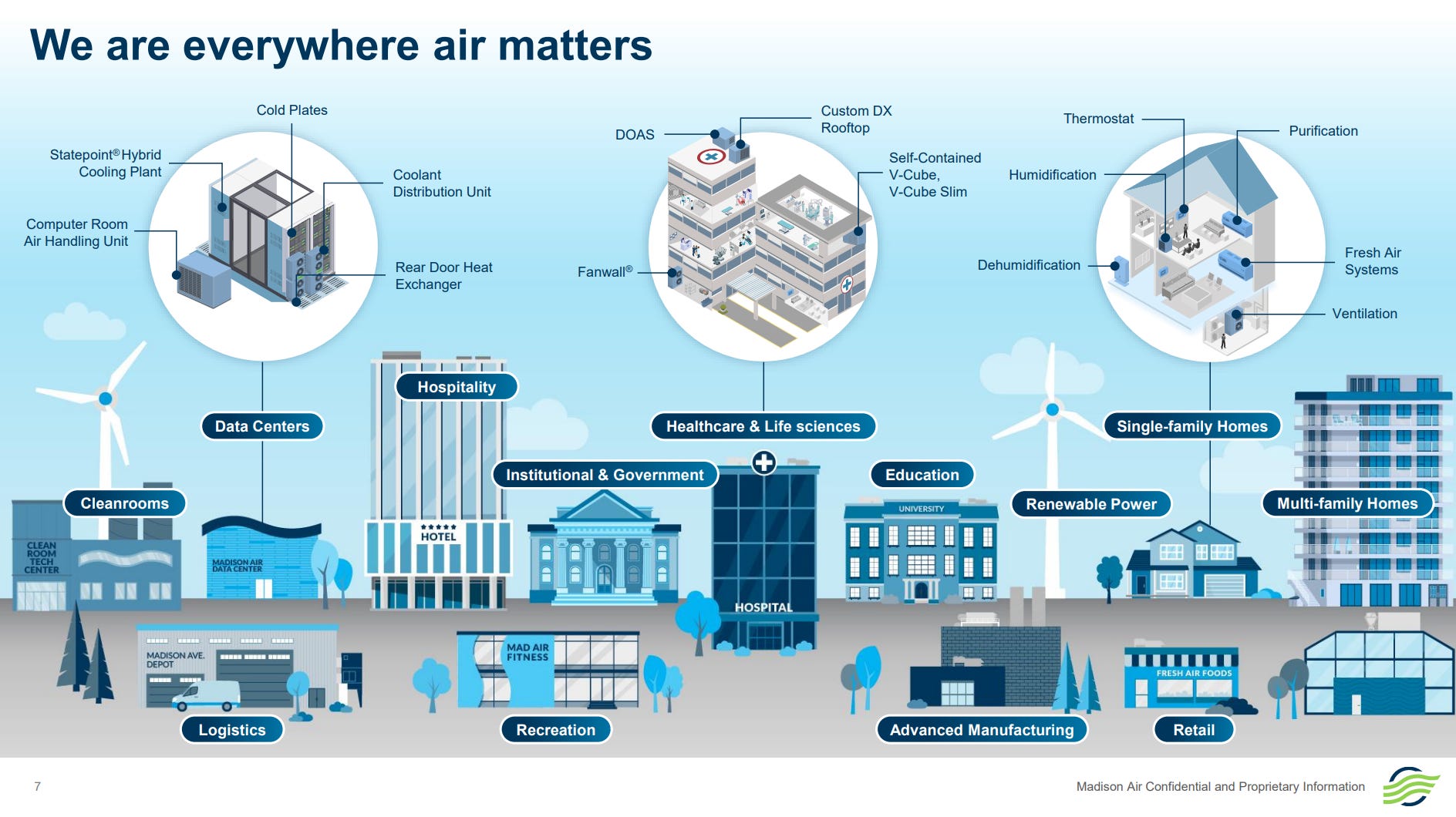
Madison Air Solutions (NYSE: MAIR) came public in April at $27 and just broke deal price. (See our prior work on this dynamic here… shouldn’t be entirely surprising is the takeaway link.) Shares peaked in the first few months at 27x NTM EBITDA - expensive by any measure. Add a softening macro on numerous fronts and higher rates and a BIG acquisition with equity to be raised alongside 4.0x net leverage and it’s no wonder why the stock is now ~45% off its highs. Then, add a restatement the market is anxious about was disclosed in the IPO prospectus back in March (balance sheet reclassification of redeemable NCI, restating 2023 and 2024, with no impact on income, revenue or cash flow). We look at the acquisition and path forward and are immediately reminded of acquisition indigestion seen many times before for similar businesses. Taking a view beyond this short-term hiccup yields material upside and an attractive risk:reward.
Overview
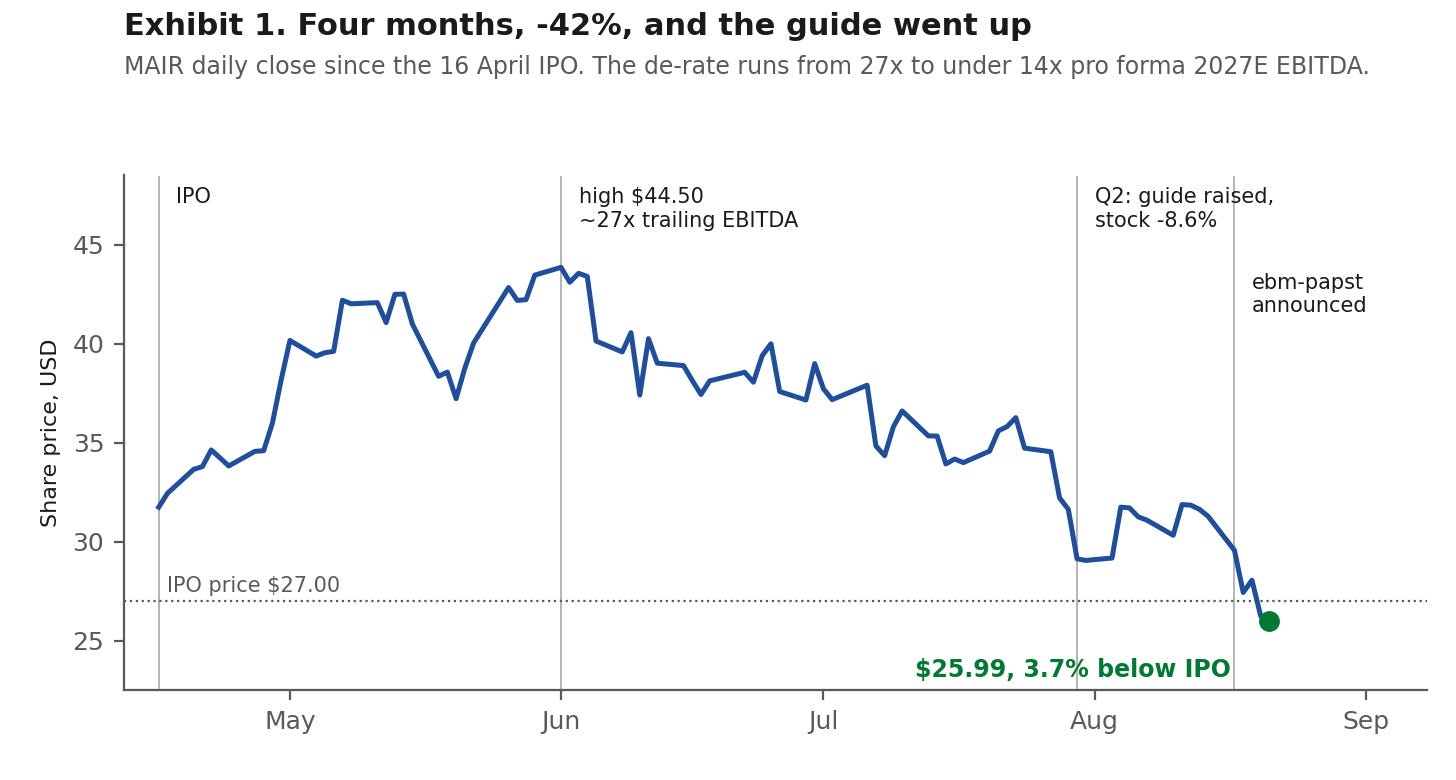
MAIR was the largest US industrial IPO in quite some time, and quickly ran to an intraday high of $44.50 creating a multiple problem. Then the tape turned against duration industrials. The Q2 print raised the sales guidance and the stock fell 9% anyway. On August 17th, the company announced a transformative acquisition, at an EV larger than its own public float, with underwritten debt and an equity component whose size and price are still undisclosed.
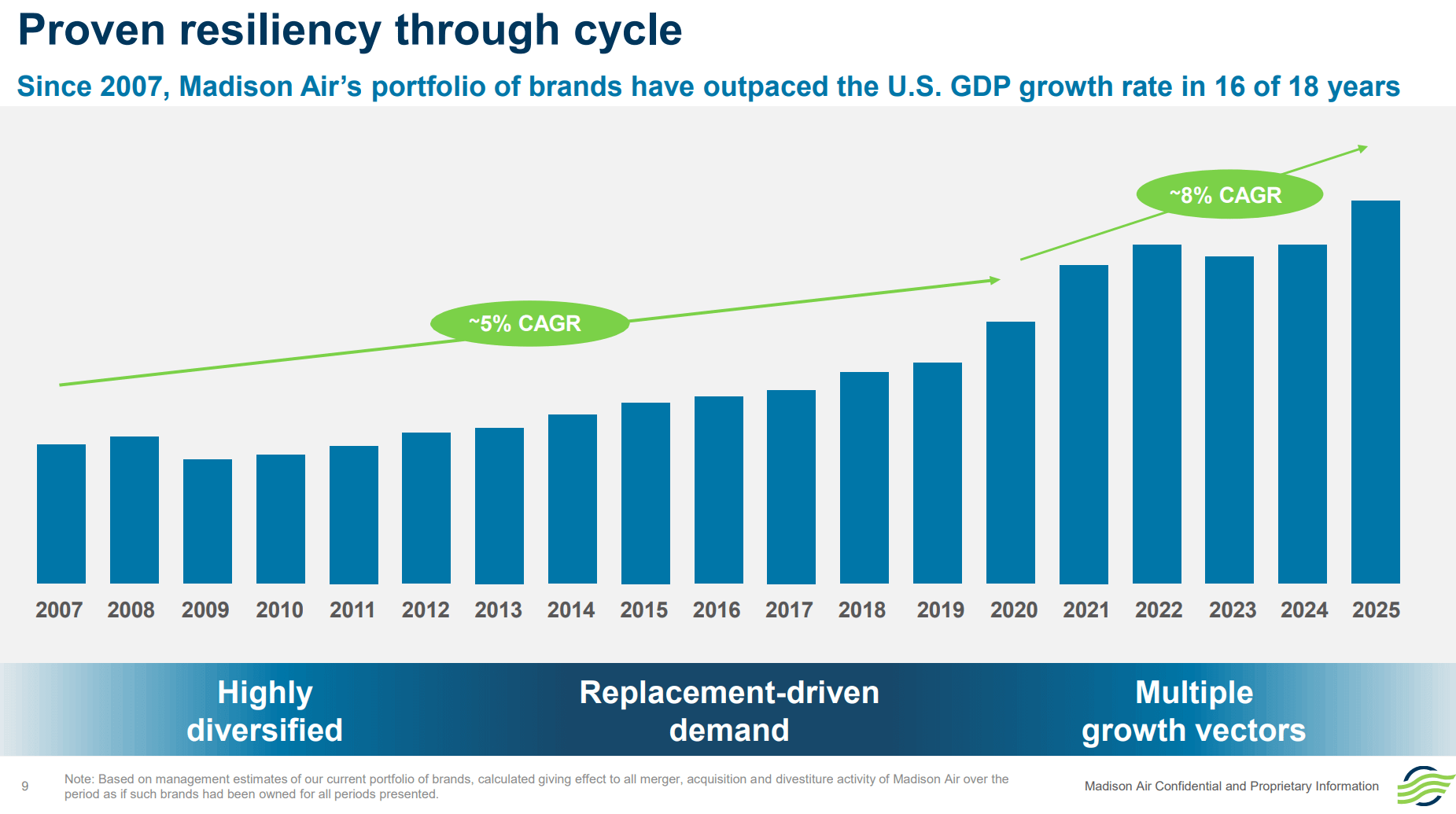
Looking forward, we should be most focused on whether the compounding algorithm is impaired. The CFO’s own decomposition on the Q1 call speaks to this… of 13% pro forma net sales growth, “volume was about 9 points, price was about 4. Commercial growth was mostly volume driven. That’s typically a backlog-driven business.” Then in Q2 they achieved 11 points of volume and 3 price. The company has outgrown US GDP in 16 of the last 18 years through 2025 (when measured on an if-owned basis).
Over the same four months in which the stock fell 42%, the business raised full-year sales guidance, grew Commercial orders more than 70% (up roughly 50% even excluding data centers), grew Resi through a falling housing market while expanding that segment’s margin by 423bps, and ended June with a record backlog near $2.9bn, more than half of it converting in 2027 and beyond, at 2.8x net leverage.
Today, pro forma for the deal, the stock trades at just under 14x 2027 EBITDA… for a business whose stated algorithm is mid-single-digit revenue growth converting to high-single-digit EBITDA growth before any synergy credit. From 27x to under 14x while guidance went up. We believe they are entering a unique window where EBITDA will compound above stated algorithm and assume no further M&A, nor a buyback, and very modest Resi / housing recovery out to 2030.
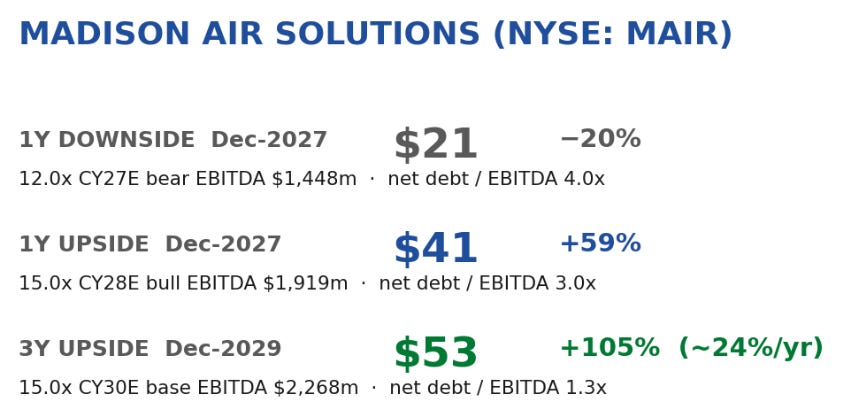
This is our first round of diligence, with more to come in the future as we go deeper on the product range and dynamics and refine estimates. For now, below the paywall we tell the high level story, the case for compounding… publishing in a timely manner here as the share price continues to approach levels we believe long-term investors will start to pick away to establish a floor. Math included, as always - matters more than the story (and don’t let people tell you that’s not the case).