


Introduction: Where This Is Going
The consensus on MLCCs is simple and half right. The bull case is that AI servers consume staggering quantities of high-end MLCCs, that Murata and Samsung Electro-Mechanics control that segment, and that the resulting shortage drives pricing power. This piece is about what comes next, and it has four parts that build on each other.
First, I am going to close the door on the most common pushback to the bull case: the claim that the broad MLCC industry can simply redirect automotive capacity into the AI server segment and relieve the shortage. This argument is wrong at the level of physics and manufacturing, and I will show you exactly why using the manufacturers’ own spec sheets.
Second, I will reiterate the greenfield economics, because understanding why new capacity does not arrive is the foundation of the entire thesis. The supply curve in MLCCs does not behave the way most investors assume.
Third, the new analytical contribution: the shift from AI training to AI inference is structurally CPU-intensive, server CPUs draw their MLCCs from the same shared mid-cap pool as automotive and industrial, and that pool is heading for deficit even under conservative assumptions. If the high-end AI segment is already ripping, this is the second act that pulls the commodity end of the market up with it.
Fourth, I will connect this to the names that get hurt: downstream manufacturers with heavy MLCC and memory exposure and weak pricing power, who have told the market the shortage is handled before their customers have agreed to pay for it.
PART 1: Auto MLCCs Cannot Become GPU MLCCs
The Pushback, and Why It Matters
Every time the MLCC bull case comes up, someone makes a version of this argument:
“There are six or more MLCC manufacturers. They all supply the automotive market, which has enormous volume and strict reliability requirements. Auto-grade MLCCs are qualified for harsh conditions, so they are good enough for AI servers. The capacity is more elastic than you think. The shortage will resolve.”
This matters enormously for the thesis. If automotive MLCC capacity can flex into the AI server segment, then the supply curve is elastic, pricing power is temporary, and the whole investment case has a short shelf life. If it cannot, then the bottleneck is structural and the pricing power is durable.
The argument is wrong. Not partially wrong, but wrong at the level of physics and manufacturing process. Here is the proof, working entirely from the manufacturers’ own published technical documentation.
Same Manufacturer, Two Products, Different Worlds
The cleanest single piece of evidence comes from Samsung Electro-Mechanics, which published two technical papers six weeks apart in early 2026, describing the MLCCs it builds for two different markets.
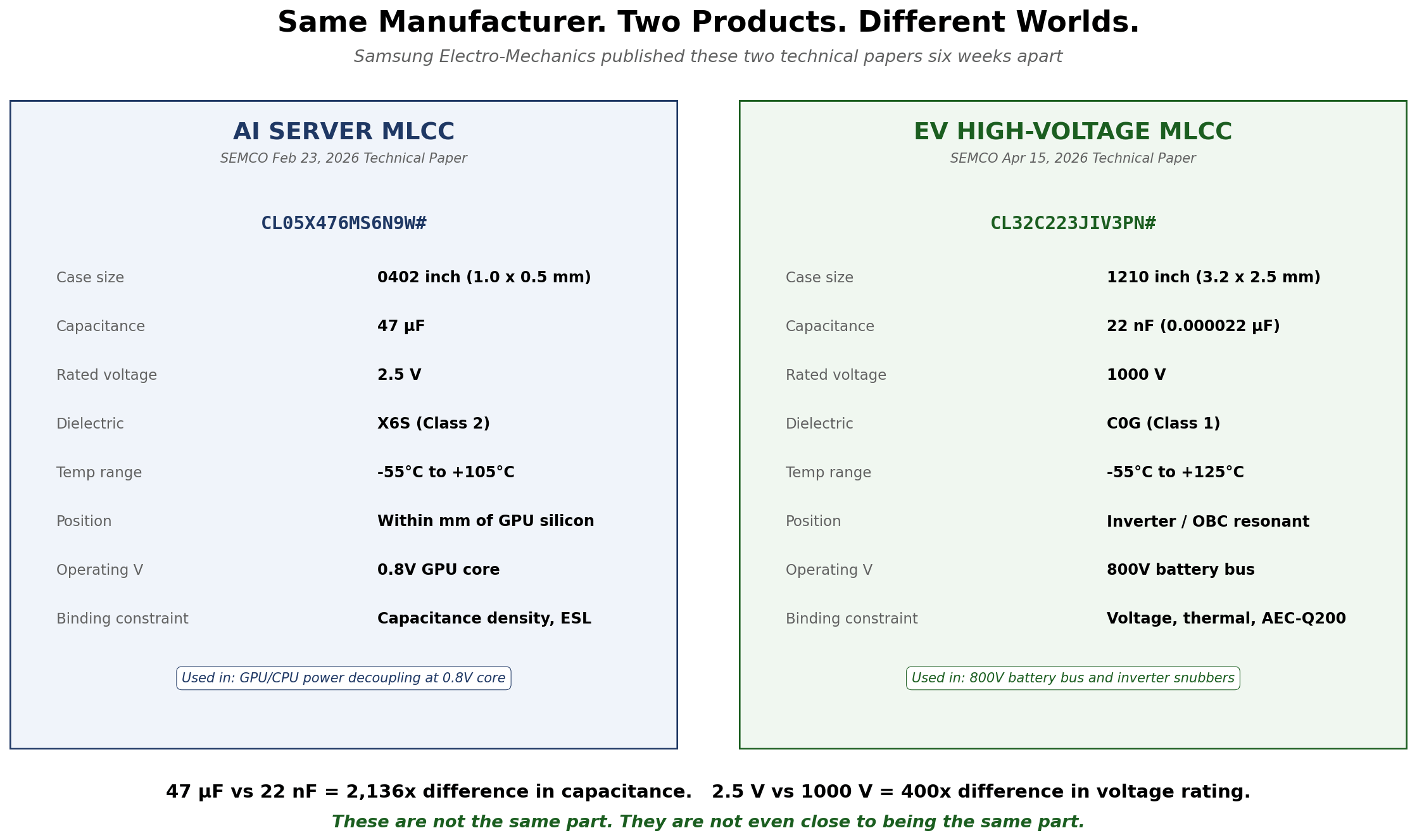
On February 23, 2026, SEMCO published its AI server MLCC strategy. The flagship part, CL05X476MS6N9W#, has these specifications:
Case size 0402 (1.0 x 0.5 mm)
Capacitance 47 microfarads
Rated voltage 2.5 volts
X6S Class 2 dielectric
Positioned within millimeters of GPU silicon, decoupling the 0.8V GPU core
On April 15, 2026, SEMCO published its electric vehicle powertrain MLCC paper. The part there, CL32C223JIV3PN#, has these specifications:
Case size 1210 (3.2 x 2.5 mm)
Capacitance 22 nanofarads
Rated voltage 1000 volts
C0G Class 1 dielectric
Positioned in the 800V battery bus and inverter snubber circuits
The difference between these two parts is not incremental. The capacitance differs by a factor of 2,136. The voltage rating differs by a factor of 400. The case footprint differs by 16x. The dielectric chemistry is fundamentally different. These are not variations on a theme. They are different products that happen to share a category name.
For the Non-Technical Reader: An Analogy
If the spec sheet language is unfamiliar, here is the intuition.
Think of MLCCs like containers for water. The AI server part is like a thin, wide, shallow tray designed to hold a large volume of water (high capacitance) at very low pressure (low voltage), and to release it instantly when needed. The EV part is like a narrow, thick-walled pipe designed to hold a small volume of water (low capacitance) at extremely high pressure (high voltage) without bursting.
You cannot use a shallow tray as a high-pressure pipe. It would burst. You cannot use a high-pressure pipe as a shallow tray. It holds almost nothing and is far too bulky. The two are engineered for opposite problems. The fact that both are “containers” tells you nothing about whether one can substitute for the other.
That is precisely the relationship between AI server MLCCs and EV MLCCs.
Physical Scale Makes It Concrete
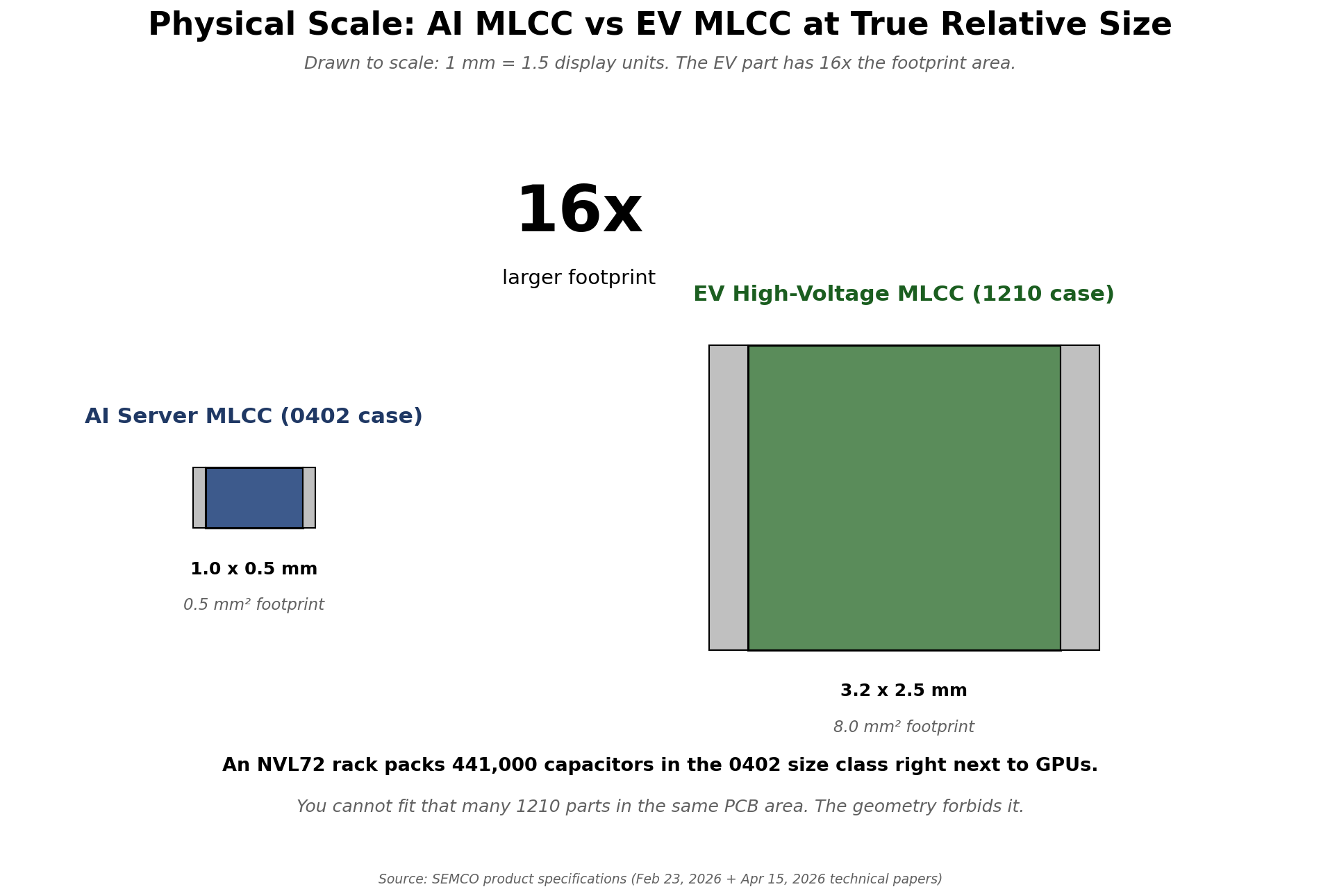
The AI server part is a 0402 case, one millimeter by half a millimeter. The EV part is a 1210 case, more than three times longer and five times wider, with sixteen times the board footprint.
This matters because of density. A single NVIDIA GB200 NVL72 rack contains roughly 440,000 MLCCs, the vast majority in the 0402 size class or smaller, packed tightly around the GPU silicon. You physically cannot fit that many 1210-size parts in the same board area. The geometry forbids it. The space simply does not exist on a GPU module for capacitors that are sixteen times larger.
So even setting aside the electrical specs, the substitution fails on physical packaging alone.
The “800V Is 800V” Confusion
The more sophisticated version of the substitution argument goes like this: “NVIDIA is moving to 800V power architecture. EVs run on 800V battery systems. Both convert high voltage down to roughly one volt. The MLCCs must be similar.”
This conflates the system-level voltage label with where the MLCC actually sits in the power chain.
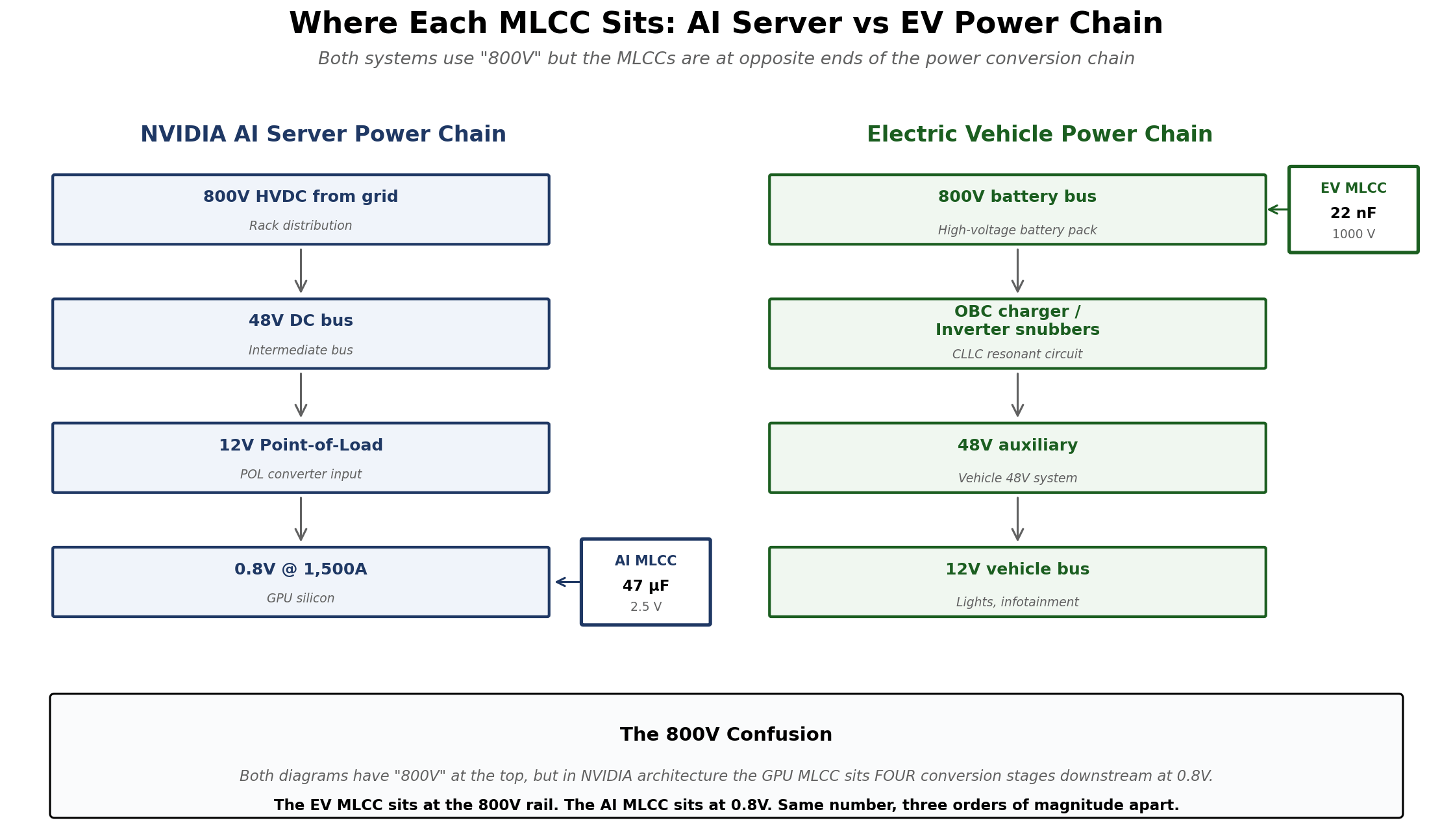
In NVIDIA’s architecture, 800V is the rack-level distribution voltage. The power is then stepped down through multiple conversion stages: 800V to 48V to 12V to 0.8V at the GPU core. The MLCCs that decouple the GPU sit at the 0.8V end of that chain. They are 2.5V-rated parts. The high-voltage parts in NVIDIA’s power supply units are a completely different component (a Class 1 C0G resonant capacitor, which I will return to).
In an EV, 800V is the battery bus voltage, and the high-voltage MLCC sits right there at 800-1000V in the inverter and on-board charger. The vehicle separately steps down to its own 48V and 12V buses with different parts.
So both systems have “800V” on the label, but in the AI server the GPU-adjacent MLCC is four conversion stages downstream at 0.8V, while in the EV the MLCC is at the 800V bus. Same number, three orders of magnitude apart at the actual component location. They cannot be the same part.
The Physics That Forbids One Part Doing Both Jobs
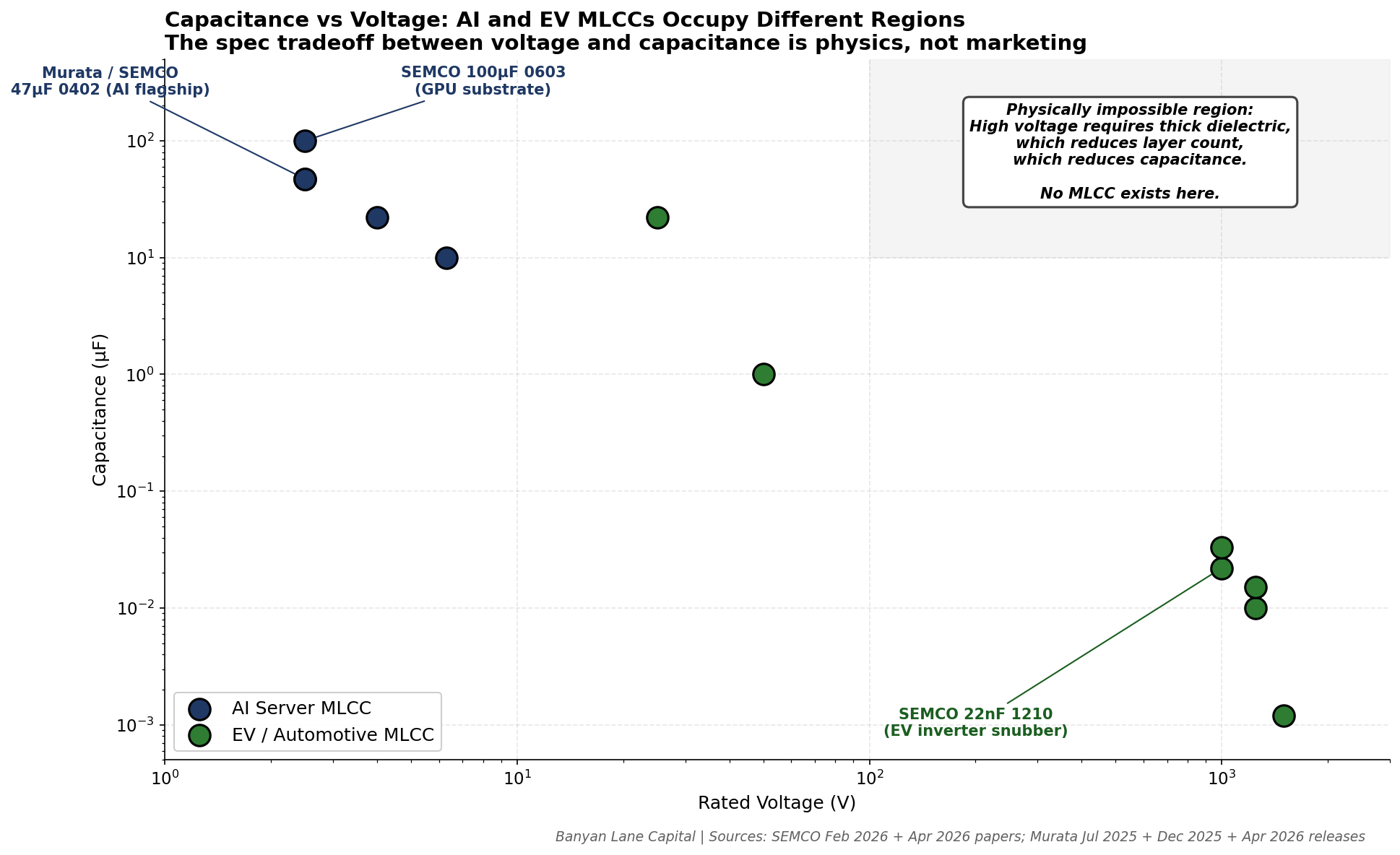
There is a fundamental engineering tradeoff in MLCC design between capacitance and voltage. An MLCC stores charge in many thin layers of ceramic stacked between electrodes. To handle high voltage, each ceramic layer must be thicker so it does not break down. Thicker layers mean fewer layers fit in a given package, which means less capacitance. On top of that, the high-voltage Class 1 dielectrics have far lower dielectric constants than the high-capacitance Class 2 dielectrics, for fundamental material reasons.
The result: you cannot build a single MLCC that is both high-capacitance and high-voltage. The chart above plots real products on capacitance versus voltage axes. The AI parts cluster in the upper-left (high capacitance, low voltage, small case). The EV parts cluster in the lower-right (low capacitance, high voltage, larger case). The upper-right region, high capacitance and high voltage together, is physically empty. No MLCC exists there because the materials do not permit it.
This is not a manufacturing limitation that engineering will overcome next year. It is the physics of dielectric materials.
A Single AI Server Uses Five Different MLCC Types
There is one more layer to this, and it actually concedes a small point to the substitution argument before taking it back.
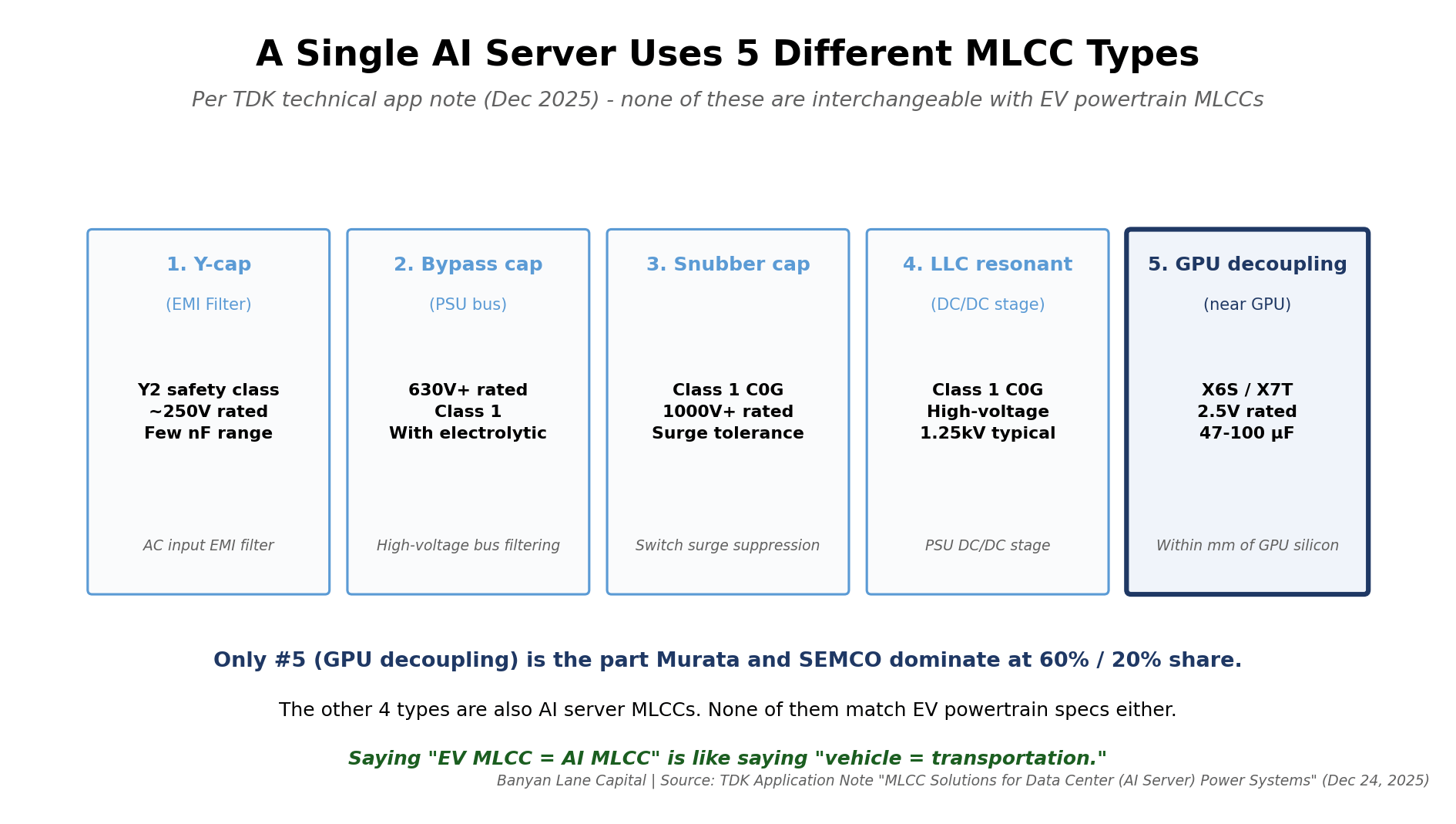
“AI server MLCC” is not one part. Per TDK’s December 2025 application note on data center power systems, a single AI server uses at least five distinct MLCC families: Y-caps for EMI filtering, bypass caps rated 630V and above, snubber caps with surge tolerance, LLC resonant caps in Class 1 C0G rated to 1.25kV, and the GPU decoupling caps in X6S/X7T at 2.5V.
Here is the honest concession. The high-voltage Class 1 parts used for snubbers and resonant circuits in AI server power supplies are actually closer to EV powertrain parts than the GPU decoupling caps are. There may be some genuine flexibility there. Murata’s December 2025 launch of a 15nF 1.25kV C0G part explicitly targets both EV chargers and high-end power supplies.
But that is not where the binding constraint sits. The shortage and the pricing power are concentrated in the GPU decoupling segment: the 47µF and 100µF, 2.5V, 0402 and 0603, X6S and X7T parts. That category has no EV equivalent, no automotive equivalent, and no commodity equivalent. It is built by Murata and SEMCO on dedicated lines with bespoke equipment, and nothing in the automotive supply base can substitute into it.
Part 1 Conclusion
The claim that automotive MLCC capacity can relieve the AI server shortage fails on four independent grounds: electrical specs differ by three orders of magnitude, physical packaging is sixteen times different in footprint, the components sit at opposite ends of the power conversion chain, and the capacitance-voltage physics forbids a single part from serving both roles. The manufacturers themselves publish these as entirely different products.
The bottleneck in high-end AI MLCC is structural. It does not resolve through capacity reallocation from autos. That is the foundation everything else rests on.
PART 2: What Greenfield Economics Actually Require
Why New Capacity Does Not Simply Arrive
If the high-end segment is so profitable and so constrained, why does new capacity not flood in? This is the question that determines whether pricing power is durable or fleeting, and the answer is in the capital and time economics of building MLCC capacity.
The hard numbers, from industry sources:
Building new MLCC production capacity takes 18 to 24 months from the moment capacity is committed to first output, per 773 Group and Mordor Intelligence. A full greenfield plant runs three to five years. The capital intensity is $750 million to $1.5 billion per advanced production line, per Mordor Intelligence. And per McKinsey’s capital projects research, the average large capital project of this type runs roughly 60% over schedule and more than 70% over budget.
This is not a fast-response supply curve. Unlike semiconductors, where process node advances drive rapid efficiency gains, MLCC manufacturing improvements are incremental and the equipment is specialized.
The ROIC Hurdle
Here I need to be explicit that the following is my own analytical framework, not a number published by Murata or any sell-side analyst. I am reasoning from Murata’s disclosed capital intensity and return targets to estimate what pricing is required to justify greenfield expansion. Treat it as a directional argument, not a precise figure.
Murata’s emergency capex announcement of ¥80 billion adds roughly 10 to 15% capacity at the high end. From the capacity added relative to the capital spent, I estimate brownfield capital intensity in the range of $200-300 million per billion units of annual AI-grade MLCC capacity. Greenfield is typically two to three times more capital-intensive, because you must build the building, the clean rooms, the utilities, and ramp yield from scratch. That puts greenfield in the range of $500-900 million per billion units of annual capacity.
To clear a 12% post-tax ROIC hurdle on a ten-year asset at those capital intensities, with current AI MLCC gross margins, my math suggests you need annual revenue per billion units of capacity in the range of $130-150 million, which implies an ASP roughly 3 to 5 times current levels.
The point is not the precise multiple. The point is the direction: at current ASPs, greenfield AI-grade MLCC capacity does not clear incumbent return hurdles. The first round of price hikes in March 2026 (15-35% from Murata) is not nearly enough to incentivize the wave of new capacity that would relieve the shortage. The market needs a far stronger and more sustained pricing signal before greenfield supply arrives, and even once the signal comes, the capacity is 18-24 months behind it.
Murata’s Own Capital Discipline Reinforces This
This is supported by Murata’s stated capital allocation framework. Murata’s Medium-Term Direction 2027 switched its primary return metric from pre-tax to post-tax ROIC and made capital efficiency a core KPI. The company’s FY2026 ROIC guidance is 12.3% against a weighted average cost of capital around 7%.
A company managing explicitly to post-tax ROIC, with a disciplined history of under-building in upcycles when peers over-built, does not flood the market with speculative capacity. It builds only when the pricing signal clears the hurdle, and it returns excess cash rather than chasing volume. That discipline is exactly what keeps the supply response slow and the pricing power durable.
Part 2 Conclusion
The supply curve in high-end MLCC is slow (18-24 months minimum), expensive ($750M-$1.5B per line), and gated by return hurdles that current ASPs do not clear. The incumbent with 60% share manages to post-tax ROIC and has every incentive to keep the market tight rather than flood it. New capacity is not coming fast enough to break the shortage in the thesis window. This is why the pricing power is structural rather than cyclical.
PART 3: The CPU Tightening Thesis
What Nobody Is Pricing
Everything to this point has been about the high-end, GPU-adjacent segment, which is a genuine duopoly. Now I want to make a different and, I believe, novel argument about the commodity and mid-tier end of the MLCC market, the segment that everyone currently dismisses as oversupplied.
The thesis in one sentence: the shift from AI training to AI inference is structurally CPU-intensive, server CPUs draw their MLCCs from the same shared mid-cap pool as automotive and industrial electronics, and that pool is heading for deficit even under conservative recovery assumptions for the consumer markets.
If I am right, the commodity end of the MLCC market, which the bears point to as proof there is no real shortage, tightens over the next several years for the first time since 2018. And unlike 2018, the driver this time is structural rather than cyclical.
Let me build this in four logical links, and verify each one.
Link 1: Inference Will Carry Much Higher CPU-to-GPU Ratio Than Training
This is confirmed by primary management commentary, not speculation.
On Intel’s Q1 2026 earnings call, CFO David Zinsner stated that training workloads run at 7 to 8 GPUs per CPU, while inference tightens to 3 to 4 GPUs per CPU. CEO Lip-Bu Tan added that the ratio has already moved from 1:8 to 1:4, and could reach 1:1 in agentic scenarios, or tilt even further toward CPUs. SemiAnalysis corroborates from the architecture side, noting Microsoft’s Fairwater datacenter runs a 1:6 CPU-to-GPU power ratio, and that future generations like Rubin may require an even higher ratio.
The mechanism is intuitive. Training is massively parallel matrix math, which is what GPUs excel at. Inference, especially agentic inference with tool-calling, orchestration, retrieval, and sequential decision-making, leans far more on general-purpose CPU compute. As the workload mix shifts toward inference, the CPU share of the system rises.
Link 2: Inference Is Becoming Dominant, and the CPU Runway Is Enormous
Inference is becoming the dominant share of AI compute. It accounted for roughly one-third of AI compute in 2023, half in 2025, and is projected at two-thirds in 2026, per Introl and Gartner data. Gartner sees inference at 65% or more of AI-optimized infrastructure spending by 2029.
The CPU demand implications are large. Arm estimates that traditional AI data centers require around 30 million CPU cores per gigawatt, but that demand could rise to 120 million cores per gigawatt in the agentic era, a fourfold increase. AMD, on May 6, 2026, raised its server CPU total addressable market outlook to $120 billion by 2030, at a 35%+ CAGR. IDC pegged the x86 server market at $283.9 billion in 2025, up 39.9%, with ARM-based servers growing 70% to reach 21.1% of shipments. Yole projects data center server semiconductor value reaching $500 billion by 2030. TrendForce notes that Google and Microsoft are specifically ramping general-purpose (CPU) server procurement to handle inference traffic from Copilot and Gemini.
The summary: if you are bullish on AI, you are bullish on CPUs. The inference and agentic future is more CPU-intensive than the training era was, and every major research house confirms the runway.
Link 3: Server CPU MLCCs Come From the Same Pool as Auto and Industrial
This is the crux, and it is stronger than mere substitutability. CPU MLCCs are not a separate category that happens to resemble auto MLCCs. They occupy the identical electrical envelope: mid-capacitance (1 to 100 microfarads), mid-voltage (4 to 100 volts), X5R/X6S/X7R dielectrics, case sizes 0402 to 1210.
The clearest proof is the DDR5 memory transition. Per Power Electronics News, DDR4 server memory used 10µF/6.3V MLCCs, while DDR5 requires 22µF/25V MLCCs in the 0805 case size. That 22µF/25V 0805 part is exactly the same specification class used in automotive body electronics, ECUs, and infotainment systems. Yageo’s high-capacitance MLCC series (1 to 220µF, 0201 to 2220 case sizes, 4 to 100V) is explicitly marketed for “Server, AI Server, Industrial, Computing” applications all in the same product family.
So when server CPU demand rises, it does not draw from some dedicated CPU MLCC supply. It pulls from the same production lines that make automotive body electronics capacitors and industrial capacitors. This is competition for shared capacity, which is more direct than substitution.
One important friction to name explicitly, because it actually strengthens the case. “Same electrical envelope” does not mean “same line, flipped overnight.” Automotive-grade MLCCs require AEC-Q200 certification: 1,000-hour high-temperature life testing, extreme thermal shock cycling, extended burn-in, and DC-bias ageing validation that IT-grade parts never undergo. A manufacturer cannot convert an IT-grade server line to an auto-grade line, or vice versa, without dedicated QA processes and a fresh qualification cycle that runs 18 to 24 months. This cuts both ways and both ways favor the thesis. When AI server CPU demand pulls on the IT-grade mid-cap pool, suppliers cannot instantly backfill from auto-grade capacity, and when they do reallocate, the qualification friction slows it to a crawl. The shared pool is therefore even stickier than the raw spec overlap suggests. The capacity is genuinely fungible at the materials and equipment level but genuinely sticky at the qualification level, which means demand shocks translate into shortages faster, not slower.
This distinction is what separates the CPU thesis from the GPU thesis. The GPU decoupling part is bespoke and duopoly-controlled. The CPU mid-cap part is commodity-to-mid-tier, made by everyone, and shared with the largest MLCC end market in the world: automotive. But “made by everyone” comes with a tiering caveat that matters enormously for the supply math, which I turn to next.
Link 4: Shared Pool Flips to Deficit
I built a supply and demand model for the shared mid-cap MLCC pool, breaking out the five demand segments that draw from it (server CPU, automotive, PC, phone, industrial) against the available mid-cap supply.
A critical modeling choice, flagged explicitly: I deliberately modeled only MODEST growth and recovery for the automotive, PC, and phone segments. All three are currently in cyclical down or soft patches. PCs and smartphones are in a demand trough, and automotive production is roughly flat with EV growth decelerating in the West. Rather than assume a sharp recovery, I assumed automotive grows at 7.2% CAGR (driven by EV content mix, not unit volume), PCs at 4.1%, and phones at 3.5% through 2030. These are conservative assumptions. If the consumer markets recover sharply, the pool tightens faster than I show. I would rather understate the case.
Here is the first output, the structural driver in isolation.
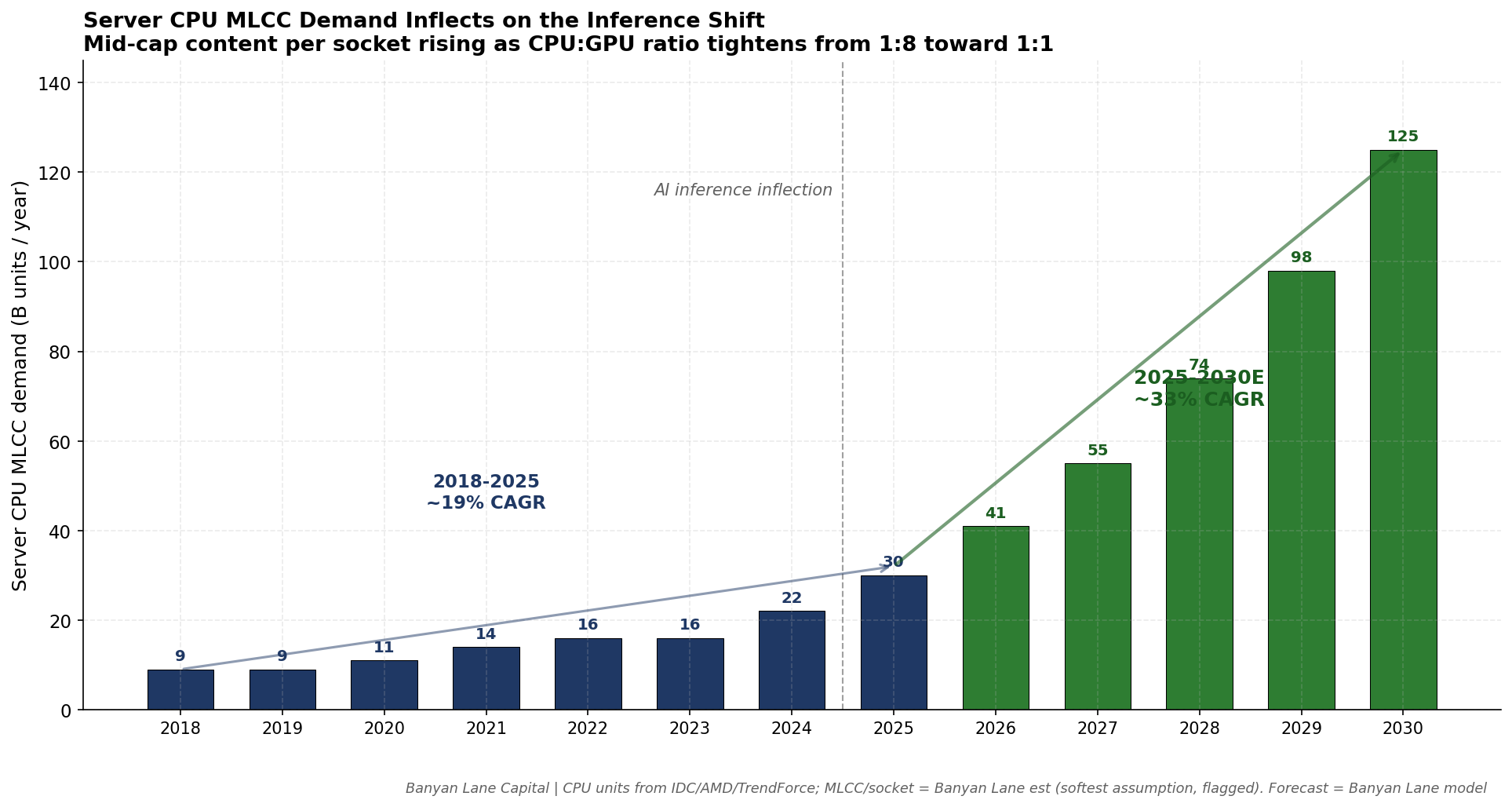
Server CPU MLCC demand inflects from roughly 19% CAGR over 2018-2025 to roughly 33% CAGR over 2025-2030E. It rises from about 30 billion units per year in 2025 to roughly 125 billion units per year by 2030. This inflection is driven by two compounding factors: more server CPU units (the inference shift) and more MLCC content per socket (DDR5, higher core counts, more power rails).
Now the shared pool, all five segments stacked against supply.
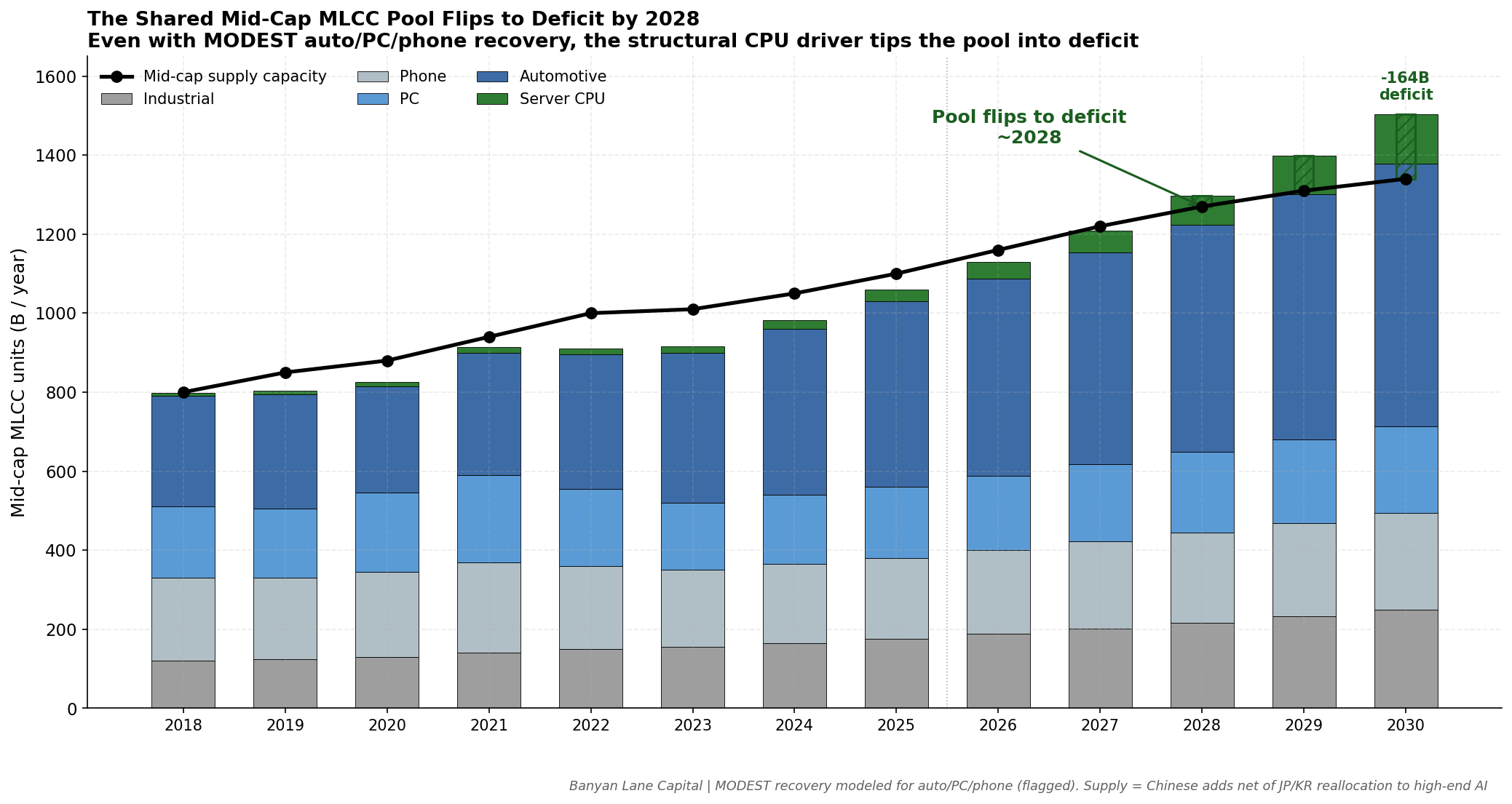
The shared mid-cap pool runs a comfortable surplus today, roughly +40 billion units in 2025. But under my conservative assumptions, the surplus shrinks every year and the pool flips into deficit around 2028, reaching a deficit of roughly 164 billion units by 2030, which is about 11% of demand. The deficit appears even though I modeled the consumer segments modestly, because the structural CPU driver and steady automotive and industrial growth outpace the slow supply additions.
Here is where the growth comes from, and what the supply response looks like.
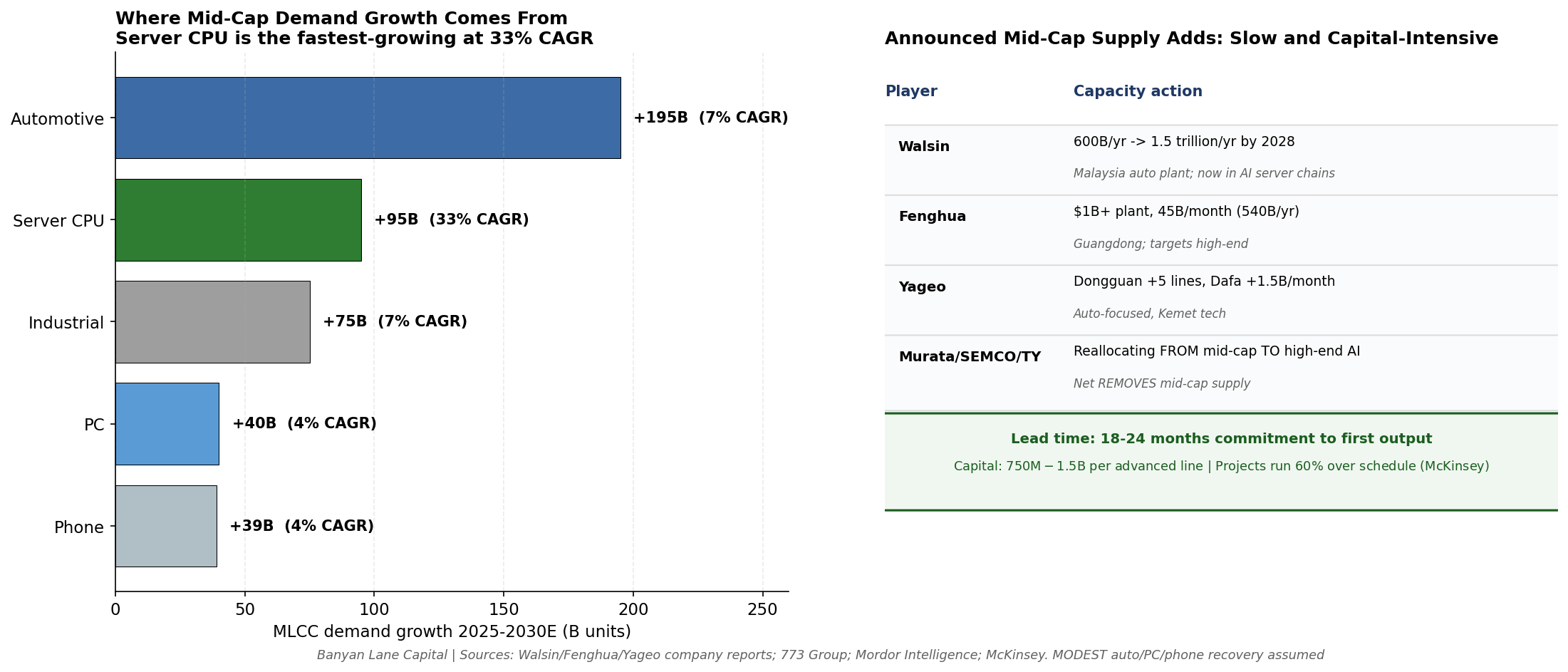
Of the roughly 444 billion units of incremental mid-cap demand from 2025 to 2030, automotive contributes the largest absolute share at +195 billion (44%), but server CPU is the fastest-growing segment at 33% CAGR, contributing +95 billion (21%). The key insight is that CPU is the new, structural, accelerating driver layered on top of an automotive base that was already going to grow. It is the marginal demand that tips the balance.
On the supply side, the announced capacity additions are real but slow, and a reader should immediately ask the obvious question: Walsin alone is scaling from 600 billion units per year toward 1.5 trillion by 2028, and Fenghua is adding a $1 billion-plus plant at 540 billion units per year. How does a 164 billion unit deficit survive a Chinese supply wave measured in the trillions?
The answer is the qualification and yield tiering, and it is the single most important nuance in the supply analysis. Raw Chinese MLCC volume is enormous, but it is concentrated in commodity smartphone and consumer parts where it does not compete for the sockets that matter here. Per Mordor Intelligence, Chinese entrants like Fenghua and Sunlord “move aggressively on price in commodity smartphones, underbidding Japanese peers by 15 to 25 percent, but remain excluded from automotive and data-center sockets that demand AEC-Q200 compliance and low-ESL metrics.” That is the crux. The deficit I am modeling is in the AEC-Q200 and server-qualified mid-cap tier, not in the raw commodity tonnage. Walsin’s 1.5 trillion units is a total-capacity figure spanning commodity to mid-tier; only a fraction is qualified for the auto and server sockets that define the shared pool, and Walsin and Yageo are pursuing automotive qualification largely through M and A (Yageo’s KEMET acquisition, Walsin’s facility build-outs) precisely because organic qualification is so slow.
Three things therefore blunt the Chinese supply wave against the specific deficit I am modeling. First, the qualification wall: a large share of announced Chinese capacity targets commodity sockets that do not relieve the AEC-Q200 mid-cap tier, and the parts that do qualify lag in the high-capacitance, low-ESL nodes that server and auto demand. Second, the Japanese and Korean leaders (Murata, SEMCO, Taiyo Yuden) are actively reallocating their own qualified mid-cap capacity OUT of the shared pool and INTO high-end AI, which removes qualified supply even as Chinese commodity volume grows. Third, as established in Part 2, any genuinely qualified new capacity takes 18 to 24 months to arrive and runs over schedule. The trillions of Chinese units are real, but they are mostly the wrong units in the wrong tier, and that is why the deficit math holds.
Why This Is Not 2018
The last MLCC cycle, in 2017-2018, was a broad cyclical tightening driven primarily by the smartphone supercycle (the iPhone X era), early EV adoption, and 5G preparation. The entire market tightened together because demand rose broadly across one connected pool. Then it corrected hard in 2019 when smartphone demand rolled over. The driver was cyclical, so the tightening was cyclical.
This time the structure is different and, for a sustained cycle, better. The high-end AI GPU segment is a separate, duopoly-controlled market ripping on its own. And the mid-cap CPU segment is now layering a second, structural demand driver onto the shared automotive and industrial pool. The CPU driver does not roll over like smartphones did, because it is tied to the secular shift toward inference and agentic AI compute, which is just beginning.
So the bull case is two independent demand surges, the bespoke GPU surge and the shared-pool CPU surge, hitting a supply base that is already reallocating away from commodity and cannot add capacity quickly. If both hold, you get broad MLCC price increases for the first time since 2018, but with a far more durable demand driver underneath.
The Major Assumptions, Stated Plainly
I want to be explicit about what could make this wrong, because the model depends on judgment calls.
The softest assumption is MLCC content per CPU socket. There is no published per-socket MLCC series. I built the ramp from the DDR5 transition, core-count growth, and power-rail trends. If content per socket rises more slowly than I assumed, the inflection pushes out past 2028.
The consumer recovery timing is the biggest cyclical swing factor. I modeled modest recovery for PC, phone, and auto. If those markets stay in trough longer, the pool stays looser longer. If they recover sharply, the pool tightens faster than shown. I chose the conservative path.
The Japanese and Korean reallocation rate is the biggest supply swing factor. How much of Murata’s roughly 1,100 billion units per year of total capacity they point at high-end versus mid-cap is a management decision I modeled as a smooth glide path. It could move either way.
EV penetration drives the slope of the automotive line. I assumed steady EV content-mix growth. A sharper EV slowdown would soften the automotive contribution.
Raw material inflation is absent from the unit model entirely, and it is a tailwind I left out. Nickel, palladium, barium titanate, silver, and copper have all seen double-digit price swings. Rising input costs raise the cost floor on even commodity MLCCs, which supports broad pricing independent of the supply and demand balance. Leaving this out makes the pricing case conservative.
The honest framing of the thesis is therefore not “the pool deterministically flips in 2028.” It is this: the shared mid-cap pool is tightening structurally even while three of its four demand drivers sit in cyclical troughs. The structural driver, AI CPU, is just beginning. When the troughs end and the structural driver compounds, the pool tightens hard. The timing depends on the cyclical recovery, but the direction is not really in question.
Part 3 Conclusion
The inference shift is real and CPU-intensive (confirmed). The CPU runway is enormous (confirmed by AMD, Arm, IDC, Yole, TrendForce). CPU MLCCs are drawn from the same pool as automotive and industrial (confirmed by spec overlap and the DDR5 transition). And the shared pool flips to deficit around 2028 even under conservative consumer assumptions (my model). This is the second act of the MLCC squeeze, and it extends the pricing thesis from the bespoke high end into the broad commodity market.
PART 4: The Shorts That Will Pay for It
Below we’ll discuss names that could suffer greatly from MLCC tightening along with memory shortages in the coming years. I have put this behind the paywall as it is not suitable for most investors. I previously spent 10 years at long/short hedge funds where I spent a substantial portion of my time looking for alpha shorts (as opposed to just hedges). These carry tremendous risk that is not suitable outside of most controlled, defined, institutional settings. I plan to continue to work this theme in the coming months/quarters, along with other thematic short themes given the large and shifting secular trends that are presenting lots of opportunities. Please see disclaimer at end of publication for additional information regarding risks.
