


In the weeks leading up to July 29, semis were breaking. Over $1 trillion of chip market cap evaporated in a week. Then FORM reported earnings and rose 26% the next day. FORM sells the checkpoint every advanced chip must pass, regarless of architecture. That is the pitch… FORM is the toll booth on chip complexity. The market still prices it like an equipment cyclical. It is a consumable tied to wafer volume, and the gap between those two descriptions is the trade. For those that have not encountered a consumable model before, they are often clean, powerful wasy to play a demand cycle and translate directly into volumes. FORM’s presence across leading edge technologies further de-risks the path forward.
Elevator pitch
Probe cards are consumables… they wear out and are rebuilt for every chip design, so revenue tracks wafer starts and design turnover, not capex sentiment
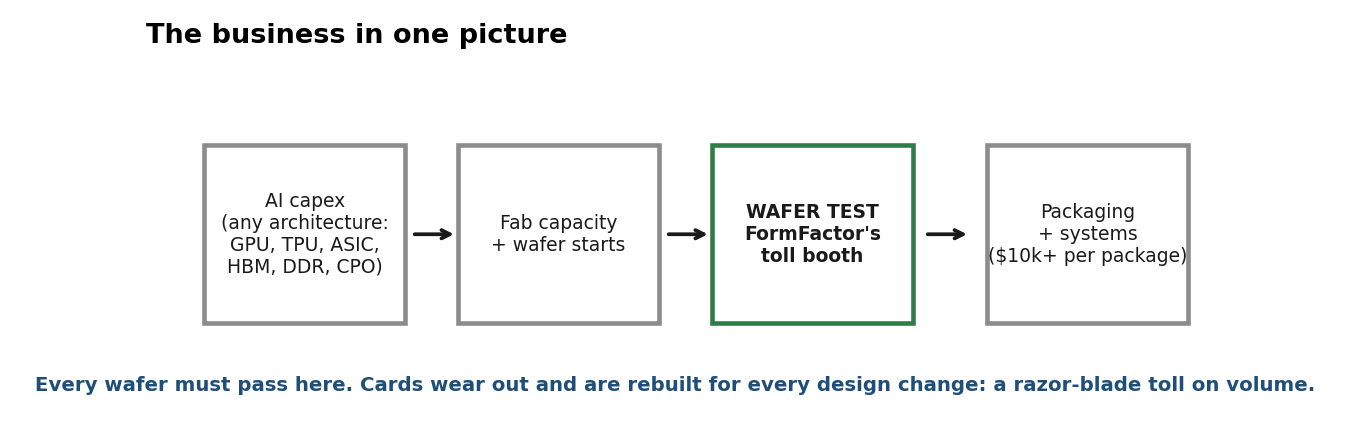
Every AI path pays the toll so they win with both GPUs or custom ASIC, HBM or DDR, pluggable or co-packaged optics… all of it runs wafers, and every wafer gets tested
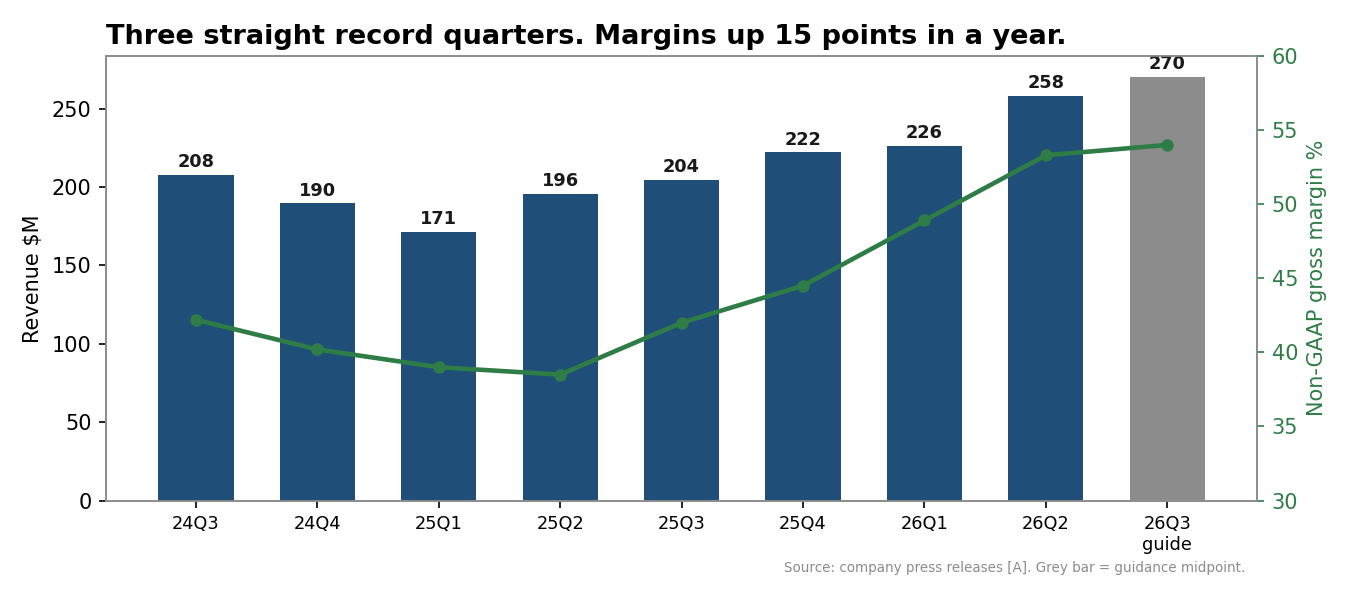
Q2 proved the model with revenue up 32% and GMs 1,500bps in four quarters and EPS tripling
A second engine is now lighting… co-packaged optics test revenue passes $20M this year… management sizes this market at $400M by 2030
The stock is up 4x from its April 2025 low on four straight record quarters, but still maintains powerful secular tailwinds that present good multi-year upside
Why this opportunity exists
The market files FORM under semicap equipment, so it trades on capex sentiment… revenue actually follows unit volume, which capex fear does not dent
Complexity is good… test intensity per wafer compounds with stacking, pin count, and now optics
The July selloff was a memory pricing scare and momentum washout… falling memory prices come from rising memory volume, and volume is FORM’s paymaster
The business in 60 seconds
FORM makes probe cards or boards holding thousands of microscopic springs that touch a chip while it is still on the wafer and check it electrically. A defective die caught here costs cents to discard. The same die caught after packaging destroys a $10,000-plus AI package. Cards wear out and are redesigned for every new chip, which makes this a razor-blade business. FORM holds the number one share in advanced probe cards, roughly twice the next competitor [VLSIresearch]. It also sells the probing systems used to characterize chips, which is where the optics story lives.
Free section ends here.
