


Vision 20/20 Plus is a public commitment to the trajectory our original post mapped, without crediting any of the satellite optionality. The thesis is on track. The next few quarters are about product launches landing in market.
Three months ago I laid out the case for BeWhere as a quiet compounder approaching its most catalyst-dense window in company history. Q1 2026 landed this morning and changes the analytical job in one specific way. Management put public numbers on the multi-year plan for the first time, and those numbers line up with the published base case almost exactly.
The headline numbers
Q1 revenue C$4.7M, up 12% year over year, a record first quarter. Q1 Adjusted EBITDA C$653K, up 96%, also a record first quarter. Q1 gross margin 45.5%, the highest in company history, a 750 basis point jump year over year and a 1,000 basis point jump versus Q4. Adjusted EBITDA margin 14% versus 8% in the prior year, a 600 basis point expansion. ARR C$9.7M, up 16% year over year and up from C$8.9M exiting Q4. Twenty-sixth consecutive quarter of positive Adjusted EBITDA.
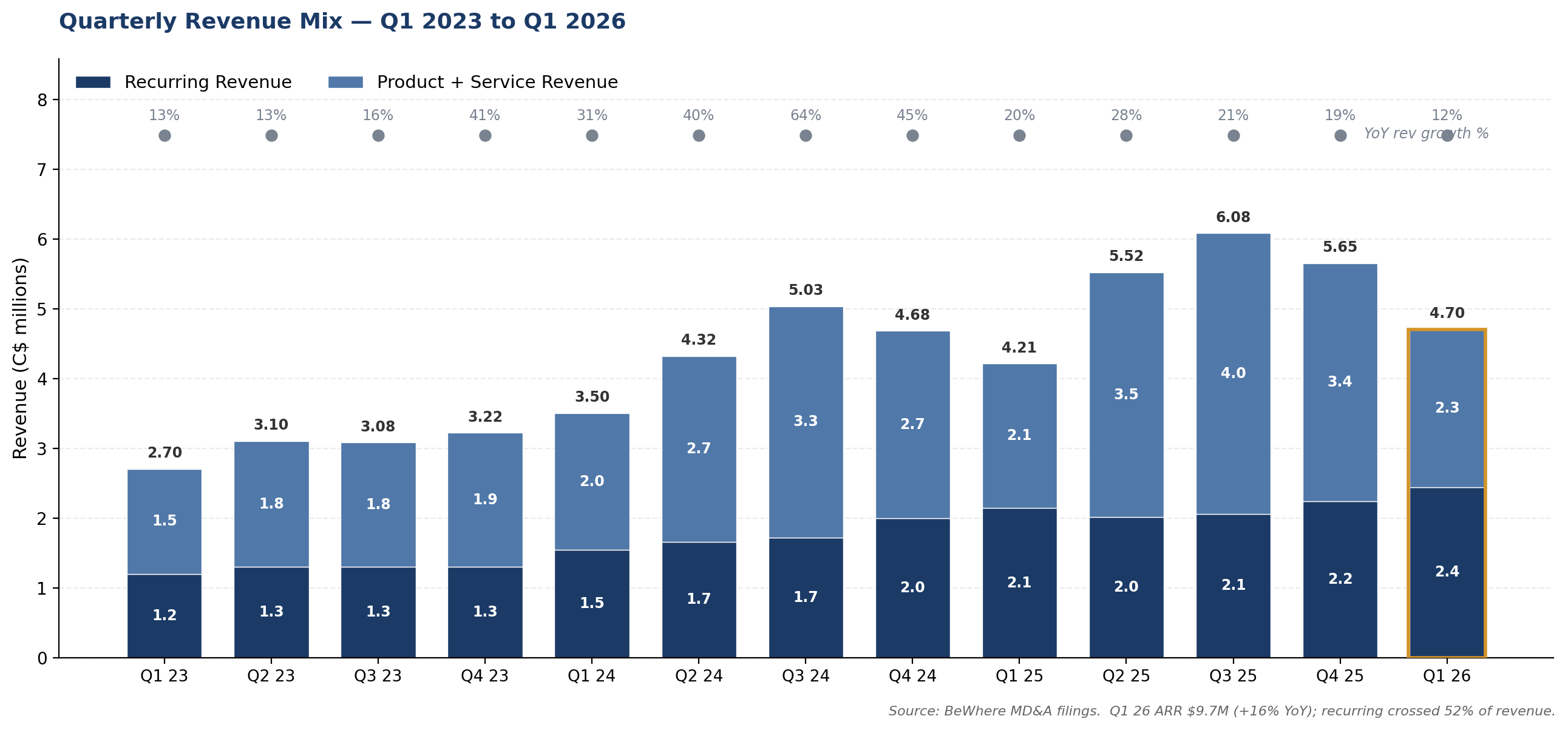
The unusual feature of this print is that revenue growth was the slowest in eight quarters while gross profit dollars hit an all-time high. However, this should not be surprising given the product launch-driven nature of growth cycles that has occurred multiple times (see here for original post detailing this dynamic). Operating leverage finally showed up in the financials as a printed number rather than a forecast.
The new disclosure: Vision 20/20 Plus
For the first time, management published a multi-year financial target. Three-year objectives exiting 2028:
ARR above C$20M, versus C$9.7M today
Adjusted EBITDA margin 20% run-rate, versus 14% in Q1
Path driven by organic growth (new products, new geographies, new verticals) plus strategic acquisitions
The original post explicitly modeled a base case of approximately 25% revenue CAGR through 2028 with meaningful margin expansion as recurring revenue mix grew, and 40%-plus EBITDA CAGR through 2028. That base case sat in the post without crediting AST SpaceMobile, Vodafone, or European expansion. Vision 20/20 Plus reads the same way. The satellite and carrier optionality is not in the targets.
How Vision 20/20 Plus compares to the published view
Working through the math, recurring goes from C$9.7M to above C$20M by end of 2028, which implies roughly a 28% recurring CAGR. The original base case implied recurring growth in the 25 to 30% range as DaaS and the product cycle layered in.
Adjusted EBITDA scales from a Q1/26 annualized run-rate near C$2.6M to 20% of a much larger revenue base. If total revenue reaches roughly C$35 to C$40M by 2028 (a reasonable derivation given recurring above C$20M and the historical mix), Adjusted EBITDA at 20% margin is C$7-8M. From the FY2025 print of C$2.25M, that math implies roughly 45 to 55% EBITDA CAGR over three years.
In plain language, management just publicly committed to a financial plan that exceeds the published base case on EBITDA growth and broadly matches it on revenue trajectory. None of this requires the satellite story to work.
What Q1 actually demonstrated
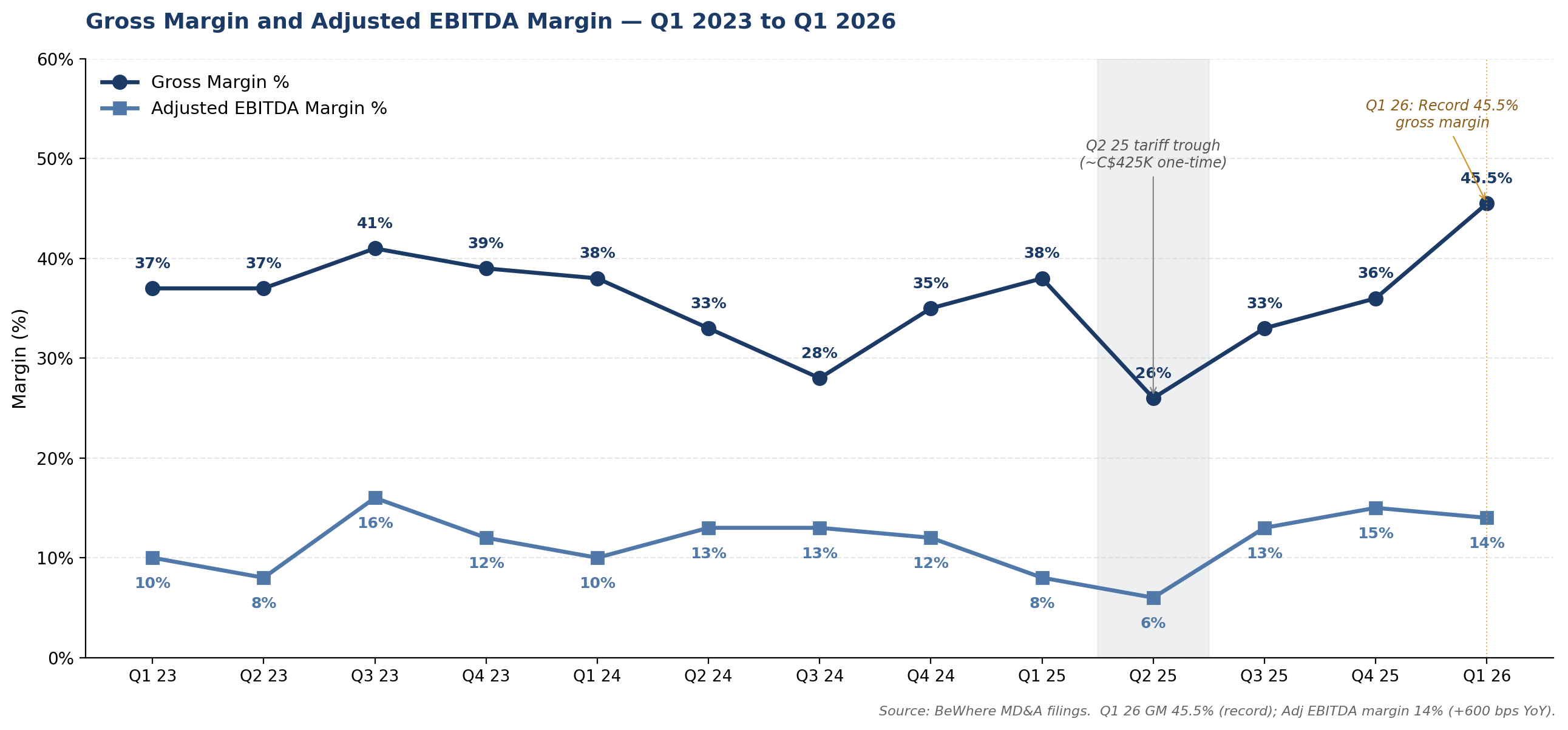
A few KPI movements worth flagging against the original thesis.
Operating leverage is now tangible, yet again. Revenue up 12%, gross profit up 34%, EBITDA up 96%. The thesis required this mechanic. Q1 was the cleanest demonstration of it, including in a quarter where unit shipments were essentially flat year over year. The gross margin jump to 45.5% means the supply chain pivot (CUSMA compliance, Albania manufacturing, plus a second international contract manufacturer onboarded in Q4) is delivering more than tariff neutralization. It is restructuring the unit economics.
The DaaS book continues to scale. Long-term trade receivable grew from C$1.13M at year-end to C$1.45M in one quarter, up 29%. The February raise was sized specifically to support this expansion. The working capital math is starting to look correct.
Moore Installs flipped accretive. Contributed C$439K of revenue and a C$60K net profit in Q1 versus a C$39K net loss in the year-ago stub period. The dilutive-acquisition concern from the FY25 update reversed in one quarter.
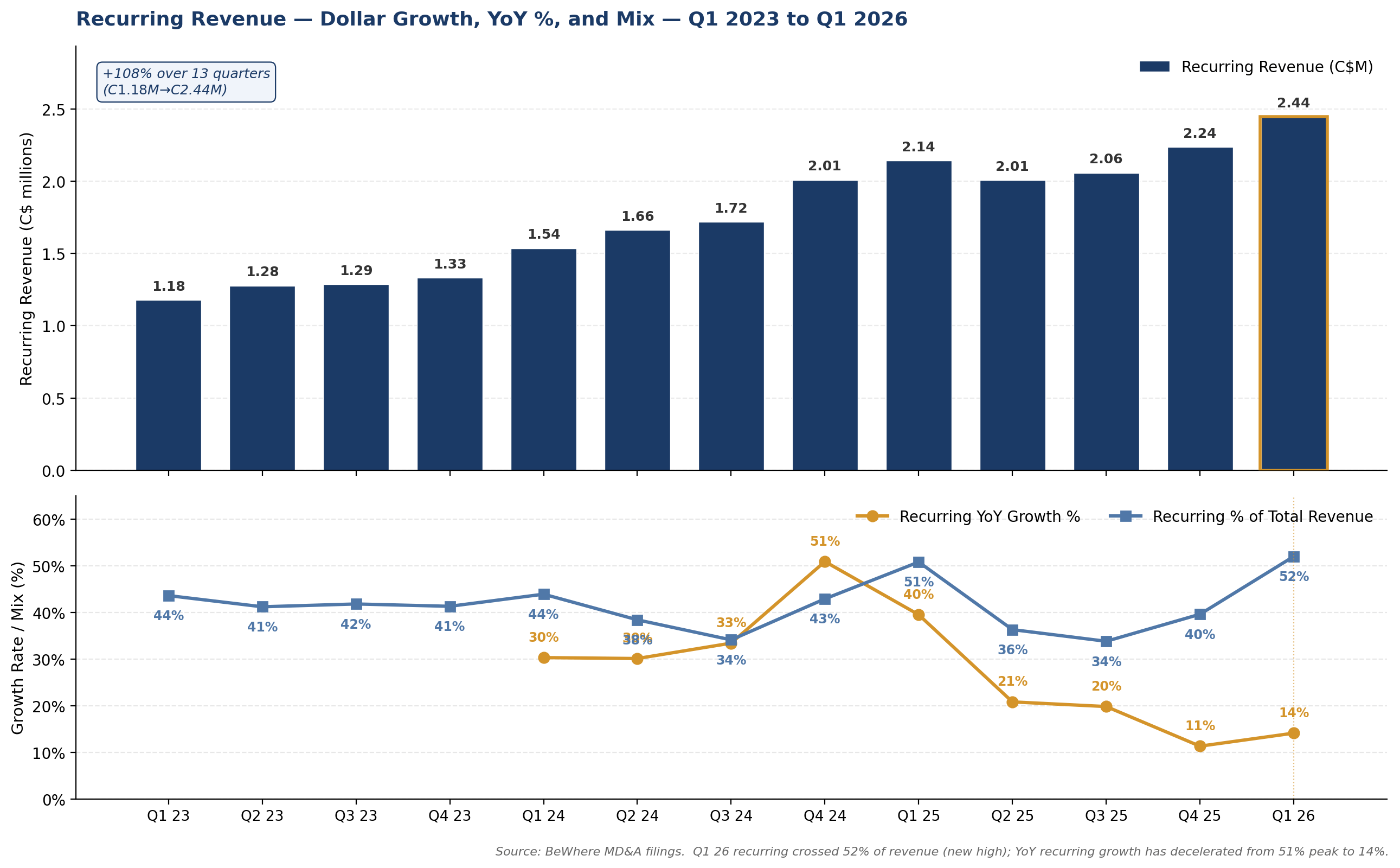
Recurring crossed 52% of revenue. New high. The original thesis mapped the rotation from hardware-led to recurring-led. Q1 was the first quarter where recurring is a majority of the revenue mix.
What worsened and what to watch for
Two items moved the wrong direction.
First, revenue growth decelerated to 12% from 19% in Q4 and 21% in Q3. Hardware revenue declined 3% year over year for the first time I can recall, with management language of “relatively flat device shipments year over year.” The benign reading is that customers held back ahead of the BeBatt launch on February 9 (mid-quarter) and the B5-BeSol+ refresh coming in Q2. If Q2 hardware shipments reaccelerate, this is a non-event. If Q2 hardware is still flat or down, the BeBatt cycle is pushing demand out rather than pulling it forward, and the deceleration story becomes harder to dismiss.
Second, recurring revenue growth itself has decelerated from a 51% peak in Q4/24 to 11% in Q4/25 to 14% in Q1/26. The mix is at a new high, dollar growth is record, but the YoY recurring growth curve has compressed. To hit Vision 20/20 Plus organically, recurring needs to compound at roughly 28%. The trailing run-rate is closer to 14%. The math closes only if the BeBatt and B5 cycle pulls device-to-recurring attach materially higher, or carrier and satellite channels add a step-function in 2027-28, or M&A contributes meaningfully. Management explicitly invoked all three. The acquisition lever in particular is now a public part of the plan, which is new.
Where the stock can go
BeWhere has been in the C$0.80 to C$0.90 range. Fully diluted share count post the February raise is approximately 100M, putting the equity at roughly C$85M and enterprise value near C$76M after netting C$9.2M of cash and a small government loan. Against trailing revenue of C$21.5M, that is about 3.5x trailing sales, versus an IoT/SaaS peer average closer to 8x.
The Vision 20/20 Plus targets translate fairly cleanly into a multi-year price framework. By the end of 2028, if management delivers what they just committed to publicly, the company should be running at C$35 to C$40M of revenue with Adjusted EBITDA in the C$7-8M range. Three scenarios are worth laying out.
In a conservative case where the company trades at 5x forward sales (still a discount to peers despite a higher recurring mix and better EBITDA profile), market cap exits 2028 near C$175 to C$200M, or roughly C$1.75 to C$2.00 per share. That is a double from the current C$0.85.
In a base case at 6x to 7x forward sales (compressing the peer discount but not closing it entirely), market cap is C$210 to C$280M, or C$2.10 to C$2.80 per share. That is 2.5x to 3.3x from here.
In a re-rated case where the recurring mix above 60%, the 20% EBITDA margin, and the disclosed three-year plan justify trading closer to the IoT/SaaS peer average of 8x sales, market cap reaches C$280 to C$320M, or C$2.80 to C$3.20 per share, roughly 3.5x to 4x from here.
The 2028 EBITDA exit at C$7 to C$8M cross-checks the framework. At a 20x EBITDA multiple (modest for a company at this growth rate and recurring mix), market cap is C$140 to C$160M. At 25x, C$175 to C$200M. At 30x, C$210 to C$240M. The two methodologies bracket each other in a consistent range of C$1.40 to C$3.20 per share over a three-year horizon, on management’s own publicly committed numbers.
The satellite scenario sits above all of this. The original post laid out a path where European and Middle Eastern expansion via Vodafone / AST SpaceMobile / Satellite Connect commercialization could push revenue toward C$100 to C$150M by 2029-30 with 25 to 35% EBITDA margins. At 8 to 10x forward revenue, that implies an enterprise value in the C$800M to C$1.5B range, or 10x to 20x upside from today. That scenario remains contingent on AST execution and is still optionality rather than a forecast, but the value of that optionality is the same as it was three months ago. Nothing in Q1 changed it for better or worse. The GSMA Foundry whitepaper still names BeWhere as one of two companies rolling out integrated solutions, and the Vodafone board seat still sits where it sat.
Why the thesis is on track
The compounding base is doing exactly what the thesis required. Gross margin re-rated to 45%. EBITDA margin expanded 600 basis points. Recurring crossed 50% of revenue. The DaaS book is recognized on the P&L upfront and funded on the balance sheet via the February raise. Management committed publicly to a three-year financial plan that broadly matches the published base case and exceeds it on EBITDA growth.
What remains is execution on the product cycle. BeBatt launched February 9. B5-BeSol+ is scheduled for Q2, B5-BeWired+ for Q3. Every prior step-function in BeWhere’s revenue trajectory traces back to a product cycle landing in market, and the 2025-26 cycle is the first to combine a new low-cost form factor with a full platform refresh and the embedded satellite-readiness via firmware update. If the BeMini ramp from 2023-24 is the template, the visible financial impact of the current cycle should be most pronounced in the second half of 2026 into 2027. That is when ARR growth re-accelerates from the current 14 to 16% range back toward the 25 to 30% trajectory required by Vision 20/20 Plus.
In short, the operating story has done its work. The valuation story now waits for product cycle revenue to land and for the recurring re-acceleration to begin showing in the prints. Q2 is the first read on that.
What I would ask management
Three questions matter most… 1) What does the Q2 unit shipment cadence look like, and how is BeBatt sell-through tracking against the BeMini ramp pattern from 2023? 2) Of the C$10M-plus ARR uplift implied by Vision 20/20 Plus, what is the organic versus M&A split management is underwriting? 3) And Canadian revenue declined 11% in Q1 after declining for the full year 2025, so what is driving the Canadian market softness given Bell Canada relationships at the board level?
DISCLOSURE
Position: At the time of publication, the author owns BeWhere.
Trading Policy: The author will not materially alter this position within 48 hours of publication. After this period, the author may buy, sell, or otherwise adjust the position without further notice. Changes to the author’s view or position will be reflected in subsequent publications when material.
Conflicts: The author has received no compensation from the issuer or any party with a financial interest in this security.
Forward-Looking Statements: This report contains the author’s opinions, estimates, and projections, including price targets derived from financial models. These are forward-looking statements subject to substantial uncertainty. If these assumptions prove incorrect, the actual value may differ materially, including scenarios of significant loss or total impairment. The price target represents the author’s estimate of fair value under the stated assumptions, not a prediction of where the stock will trade.
This report is provided for informational purposes only and does not constitute investment advice. See the full Terms & Disclosures for additional important information.