


What Does BeWhere do?
BeWhere Holdings is a 22-person company based in Mississauga, Ontario, founded in 2014, with a market cap of ~C$90M. They design and sell low-power 5G-enabled sensors and software to track the real-time location and condition of non-powered, mobile assets (trailers, containers, equipment). Manufacturing is handled by third parties making the business very asset light. BeWhere’s asset tracking devices are small, rugged, battery-powered devices that stick onto trailers, generators, cable reels, and just about any other unpowered asset a company needs to keep tabs on. The devices report location, temperature, motion, tilt, and light exposure over low-power 5G cellular networks (LTE-M / NB-IoT) for years on a single battery charge. They have deployed ~500,000 from 2018 to 2025, with ~100,000 of those coming in 2025 alone, reaching over 10,000 companies.
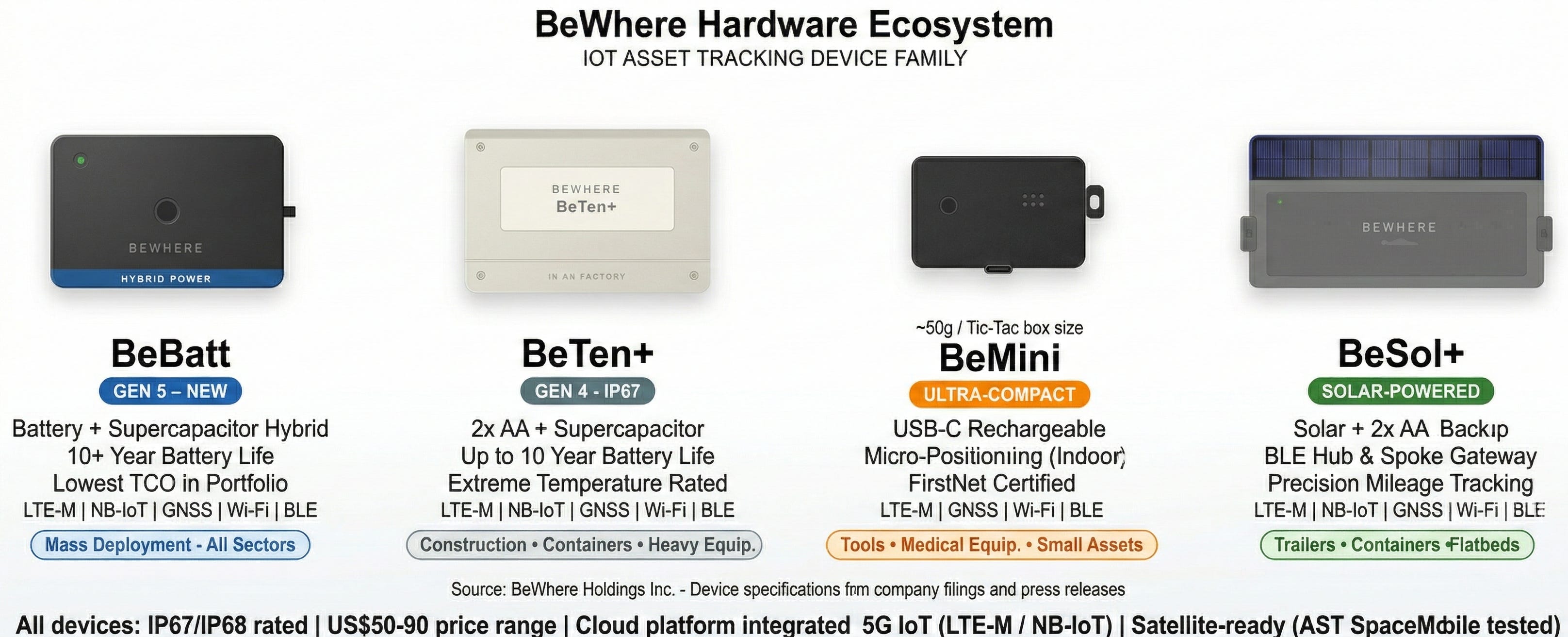
BeWhere’s devices are eyes for the millions of “dumb” assets sitting in construction yards, on flatbed trucks, and at rail depots across North America. BeWhere sells through massive distribution partners like AT&T, Bell Canada, T-Mobile, Geotab, Ford Pro, and Tenna – impressive for such a small company facing rigorous security and performance requirements that take years from some of the world’s largest companies. Several large relationships are maintained direct. The customer buys the device (sub-US$100) and pays a recurring monthly software fee (US$1–5/month) for data access. They count CostCo, UPS, Lyft, Lowe’s, Toyota, Boeing, and Ford as customers. Their strategy is straightforward – engineer the lowest cost devices possible with the most advanced forms of connectivity that customers want, don’t price gouge, and slowly mop up market share. They offer modest software capabilities vs. peers yet are still chosen by some of the largest corporations.
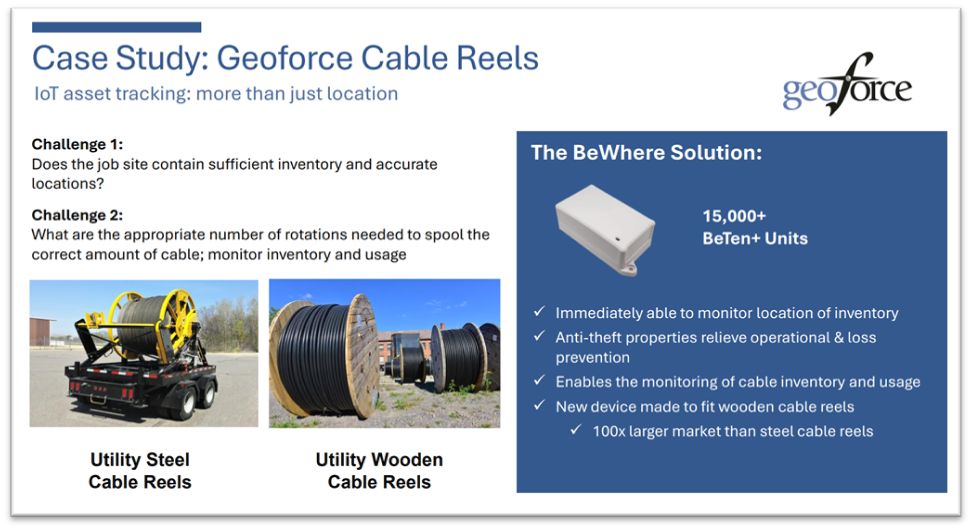
These markets are highly fragmented – both those providing service and customers. Growing regulatory and compliance requirements, threats of theft, and general efficiency provide powerful secular tailwinds which have and will continue to persist for years. The low-cost nature of their devices has actually expanded the market overtime beyond large transportation-related assets such trailers, containers and large equipment, to first responder kits, portable toilets, and rideshare bikes.
The management team has done this before. CEO Owen Moore and SVP Brian Boychuk co-founded Grey Island Systems International, a publicly traded telematics company that helped Moore grow from zero to C$24M in revenue before selling it in 2009 for C$40M. They know how to build, scale, and exit an asset-tracking business. Insiders also own 22% of the company, including 10% by CEO and 9% by COO.
The numbers are unusual for a micro-cap. 24 consecutive quarters of positive Adjusted EBITDA, ~30% revenue CAGR since 2018, C$21M in LTM revenue growing 28% YoY, C$9M in ARR growing 21% YoY, and ~$9M in cash with minimal debt. Insider ownership stands at 22% with no warrants outstanding. Recurring revenue now covers just under 100% of all cash operating expenses. This is not a science project burning capital, rather they’ve compounded profitably with new product launches every 2-3 years which have reliably grown their customer count (and into Fortune 500), increased customer penetration, and expanded the market itself.
The stock trades at ~3.0x 2026e sales versus an IoT/SaaS peer average of approximately 8.0x, and ~20x 2026e EBITDA (on 50%+ EBITDA CAGR through 2028).
Why Care Now? Eight Catalysts Converging
BeWhere has been quietly compounding for years. Most investors never look at a sub-C$100M market cap stock on the TSX Venture Exchange. But we’re approaching the most catalyst-dense 12–18 months in the company’s history. Here’s what’s stacking up.
1. Product Launch Cycle Is Repeating
BeWhere has a remarkably consistent product release pattern… each new generation of hardware, device sales accelerate sharply. This has happened three times now, and a fourth cycle is underway.
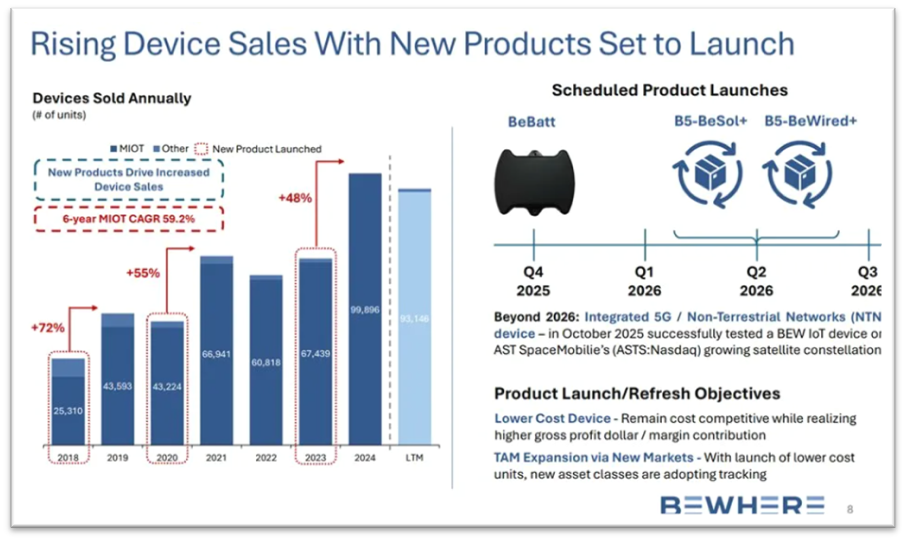
The cadence is clear… Each refresh engineers cost out of the BOM while adding functionality — lower price, better margin, new use cases. The result is a 59% six-year M-IoT device CAGR.
BeWhere is rolling out three new products in sequence. BeBatt launched in February 2026 as a fifth-generation tracker with 10+ year battery life at the company’s lowest price point ever (~US$30–35 BOM cost versus ~US$45–50 for the unit it replaces, but with higher absolute dollar margin). There is an opportunity for this device to incrementally expand the market because of its low cost. The B5-BeSol+ (solar-powered) arrives Q2 2026 and B5-BeWired+ (external power) in Q3 2026. All three are built on LTE Cat 1 Bis architecture. This is the same chipset that enables future satellite connectivity via AST SpaceMobile (ASTS).
BeBatt was purpose-built for cable reels, pallets, and other lower-value assets that were previously too cheap to justify tracking. At sub-US$50 device cost and monthly fees approaching US$1, BeWhere is expanding the addressable market into asset classes that legacy US$200+ trackers can’t touch economically.
This cycle could be even bigger than prior ones because the installed base of enterprise customers is substantially larger today than during previous launches.
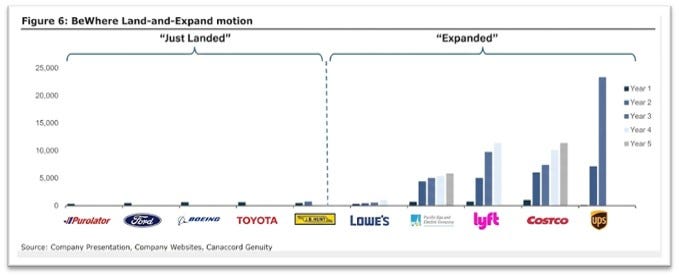
The “Just Landed” cohort on the left half above represents early-stage relationships with enormous upside. Once a client like UPS or Costco completes their initial RFP process and gets BeWhere approved by IT security, other departments can piggyback on that procurement with minimal friction. Costco went from a small pilot to 10,000+ units. UPS is deploying 20,000+ seasonally. FirstNet deployed 11,000+ over the course of 2025 and have a partnership with AST SpaceMobile for direct-to-device satellite coverage once their constellation is operational (likely late 2026/early 2027), which could lead to much broader adoption across their 7.8m users. Each new product refresh gives their partner sales teams a reason to go back to these accounts with something new. Management estimates they have penetrated just 17% of their land-and-expand opportunity depicted above for just 57,000 devices with material upside over time – moving this to 50% penetration would add another ~125,000 devices or 25% growth on their installed based today.
2. The Device-as-a-Service Shift Changes Everything
For most of its history, BeWhere operated a classic “razor and blade” model – sell the hardware upfront (~US$70), collect a monthly software fee (~US$3/month). This worked but created lumpy quarterly revenue and required customers to find CapEx budget.
Starting in early 2025, BeWhere began offering a rental model. Under the new DaaS (Device-as-a-Service) structure, customers pay zero upfront and instead pay a higher monthly fee (roughly US$5–7/month) that bundles hardware and software. The economics are compelling on both sides (estimated figures):
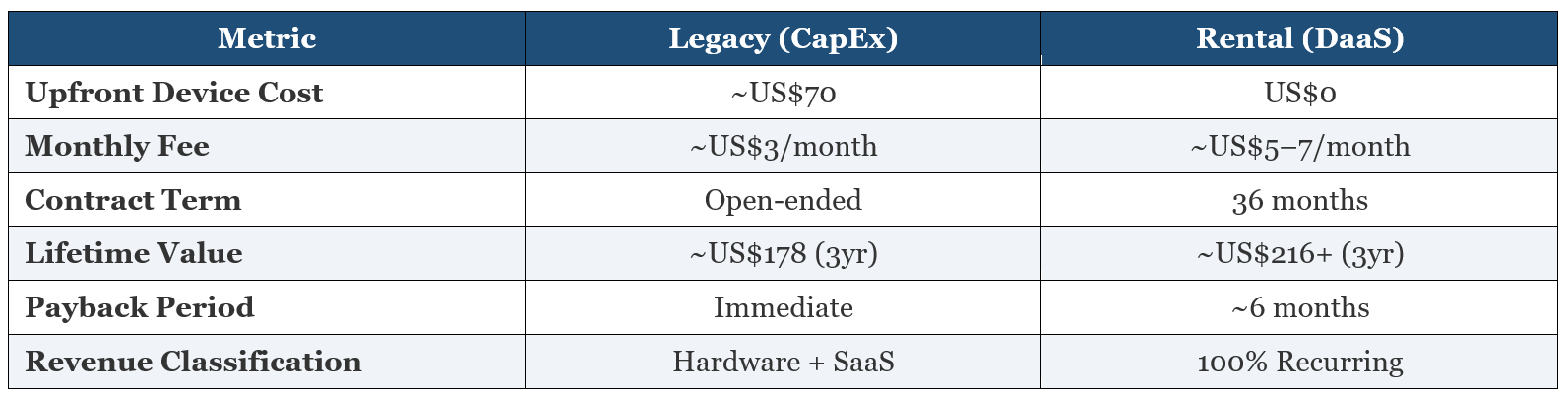
CEO Owen Moore on the rental economics cites a six month payback on a three-year contract. The model has been capped at 8,000 units per quarter to manage balance sheet impact, but within two to three quarters it generates free cash flow on its own that can be reinvested to increase the cap. This funding has been addressed following their equity issuance in early February 2026 for C$5M at C$0.70 to expand their rental business and expand into Europe (more on this later). The lifetime value nearly doubles over a six-to-eight-year term.
This matters for three reasons. First, the market rewards recurring revenue for its predictability and higher blended margins. Second, it removes the biggest friction point in enterprise sales as customers with no CapEx budget can now sign off on an OpEx line item. Third, and most importantly for the stock, SaaS/recurring revenue businesses trade at dramatically higher multiples than hardware businesses. As the recurring revenue mix climbs from 40% toward 60%+, the stock should re-rate accordingly.
3. Margin Inflection
BeWhere has a series of positive gross margin drivers hitting in 2026…
· Organic growth in mix of Recurring Revenue deployments, from 40% of mix today
· Rollout of new “rental”/DaaS model
· Lapping 2025 tariff impact of 3-4pts
· Lower BOMs for new devices could add 1pt
Assuming that Recurring Fees Revenue GMs are 40% and revenue mix grows to 55% of total, GMs could exceed 40% by 2028 from depressed 33% in 2025. Add to this 50bps of annual Cash OpEx margin declines (which fell from ~30% to ~22% in 2022 to 2025 as revenue doubled, or put another way Cash OpEx grows ~80% in a few years), and EBITDA margins would find themselves growing from 12% to 20% by 2028. To illustrate the power of this prospective improvement in margins, a ~25% revenue CAGR to 2028 would result in an EBITDA CAGR of 50%+.
4. Satellite Connectivity — Zero CapEx, Massive TAM Expansion
This is where the story gets genuinely exciting. Terrestrial cellular networks cover only about 15% of the Earth’s land surface. Historically, tracking an asset in a “dead zone” required a specialized satellite terminal costing US$500–1,500 with monthly satellite data plans running US$50+. The result is roughly 85% of global cargo goes untracked once it leaves a cell-covered area.
In October 2025, BeWhere made history: they successfully connected a standard, off-the-shelf BeWhere LTE tracker directly to AST SpaceMobile’s BlueBird LEO satellite. The signal traveled from the device in New Brunswick, Canada, to space, and routed seamlessly through Bell Canada’s terrestrial network. BeWhere is the first asset-tracking company to achieve this with an unmodified cellular IoT device.
The breakthrough was not needing to build a “satellite tracker.” A simple over-the-air firmware update to their existing devices will enable satellite connectivity. Zero incremental hardware cost. Zero new SKUs. Same sub-US$50 device, but now capable of tracking assets anywhere on the planet.
AST SpaceMobile is targeting deployment of its 45-satellite initial constellation by year-end 2026, which would enable commercial-scale coverage. BeWhere is positioned to be among the first IoT device makers to go live on this network, courtesy of its carrier relationships and the integrated technology already proven in testing.
The new addressable markets this unlocks are enormous: maritime container shipping, remote mining and forestry operations, offshore energy platforms, agricultural equipment tracking, and cross-border logistics through territories with no cellular coverage. These are multi-billion dollar markets that were previously unreachable at BeWhere’s price points. This solution should also come with higher pricing and margins.
5. The European Opportunity and Vodafone Connection
BeWhere today generates zero revenue from Europe. That’s about to change, and the breadcrumb trail is hard to ignore.
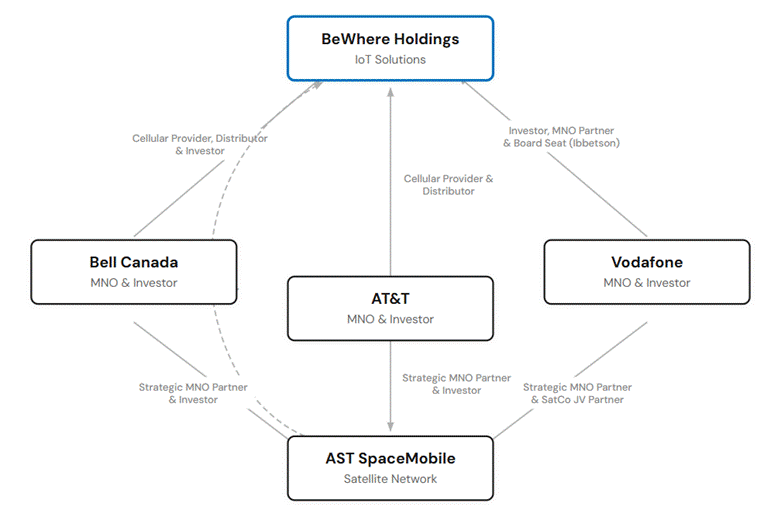
Follow the board seats. Luke Ibbetson sits on both BeWhere and AST SpaceMobile (as Vodafone’s designee) boards, and he runs Vodafone’s Group R&D including 5G, 6G, and NB-IoT strategy. Peter Wilcox, a BeWhere director appointed in January 2025, is the Director of Enterprise Solutions at Bell Canada. These aren’t advisory roles, rather they’re strategic positions linking the IoT device maker to two of the world’s largest cellular networks and the satellite company connecting them.
Vodafone operates one of the world’s largest IoT platforms with 215+ million connected devices globally. They’re an anchor investor in AST SpaceMobile (14.5m shares owned), share a JV called SatCo, and will be among the first carriers to launch D2D satellite service in Europe. BeWhere co-authored the GSMA Foundry whitepaper on integrated 5G and satellite asset tracking, literally helping write the industry blueprint that major carriers are building toward.
The company opened European operations in 2025 and completed a C$5M brokered equity offering in February 2026 with stated proceeds earmarked in part for European expansion and the equipment rental business. They also onboarded a second contract manufacturer in Albania during Q4 2025, providing a production base with favorable tariff treatment for European distribution.
This mosaic includes a shared board member running Vodafone’s IoT strategy, co-authorship of the GSMA industry whitepaper, a proven D2D satellite test on an AST network that Vodafone has invested heavily in, the opening of European ops, a new Albanian manufacturing base, and a fresh equity raise to fund expansion. A formal Vodafone distribution agreement hasn’t been announced yet. However, there’s strong reason to believe this could be the case, and if so, Vodafone would bring the lowest cost solution to the European market which could significantly grow their own share, while simultaneously expanding the market as BeWhere did in North America.
6. Potential Move to the TSX Main Board
BeWhere currently trades on the TSX Venture Exchange, Canada’s junior market. History of profitability appears to be the primary gating metric, but with 24 consecutive quarters of positive EBITDA and a trajectory toward full-year GAAP profitability, 2027 looks like a realistic timeline for this move.
An uplisting could expand institutional investor and sell-side research interest (many funds have policies preventing TSX-V purchases), improved trading liquidity, inclusion in additional indices, better access to capital markets, and a general credibility upgrade in commercial negotiations. Historically, junior companies that graduate from TSX-V to TSX experience multiple expansion as liquidity and institutional participation increase.
7. Entering the Seasonally Strongest Period
BeWhere’s Q4 and Q1 quarters are typically their strongest, driven by seasonal logistics demand (holiday shipping, year-end fleet procurement cycles) and the fact that a portion of recurring revenue from one major client (UPS) is seasonal, benefiting Q4 and Q1. Q3 2025 was already a record quarter at C$6.1M in revenue (grew 21% YoY driven by stable mid 50s growth in Product/Hardware Revenue and stable mid 30s growth in Recurring Revenue). Management has flagged it as the second-highest unit volume quarter in company history, offering strong visibility into Q4 and Q1 recurring revenue growth.
8. Potential Takeout
CEO Owen Moore’s first business, Grey Island Systems International, was acquired for ~C$35M in an all-stock deal in October 2009 by competitor WebTech Wireless. He served as CFO and then President, helping the business scale to C$24M of revenue. This early vehicle telematics business was part of the large wave of consolidation at the time. While BeWhere lacks the heavy software layer today that likely contributes greatly to peers’ revenue multiples in high-single digits vs. their ~3.0x LTM, rapidly growing revenue plus margin expansion plus no debt at a below-average multiple is a strategic acquirer’s dream. If management can execute on the DaaS transition and new product launches while continuing the successful enterprise land-and-expand strategy and growing the market itself, it would not be surprising to see them acquired for a healthy multiple in the coming years.
The AI Question: Enabler, Physical AI, Not Disrupted
In every stock pitch today, you inevitably get the question, “but what about AI?” For BeWhere, the answer reveals something important about their competitive positioning.
BeWhere Collects the Data AI Needs
AI models are only as good as their input data. BeWhere’s devices generate a continuous stream of location, motion, temperature, and environmental data from hundreds of thousands of assets globally. This is precisely the real-world physical data that supply chain AI, predictive maintenance algorithms, and logistics optimization engines need to function.
CEO Owen Moore has stated publicly that BeWhere doesn’t position itself as an AI company. It positions itself as an AI enabler. The data they provide to clients like Costco, UPS, and J.B. Hunt feeds directly into those companies’ own machine learning algorithms for asset utilization, predictive maintenance, and route optimization.
API-First Approach
This is where BeWhere’s strategic positioning differs fundamentally from competitors like Samsara. Samsara has built a comprehensive “Connected Operations Cloud” – a full software platform with AI-powered dashcams, routing, compliance, and analytics. It’s a powerful lock-in strategy, but it also means customers are buying into a single vendor’s software vision.
BeWhere took the opposite approach. Their API-first architecture translates raw device data into clean JSON feeds that inject natively into whatever ERP, fleet management, or analytics system the customer already uses. BeWhere becomes an invisible data layer. This means:
• Customers aren’t locked into software and can swap analytics layers without friction
• As individual AI/software layers become easier to replicate (and they will), physical hardware generating the data retains its value
• Large enterprises that build their own AI-powered operations platforms internally still need someone to provide low cost, most reliable hardware (that’s BeWhere)
• Enabling shift from CapEx to OpEx for customers further insulates BeWhere by reducing the customer’s switching friction and increasing contract duration
Competitive Positioning Matrix (see Appendix for more details)
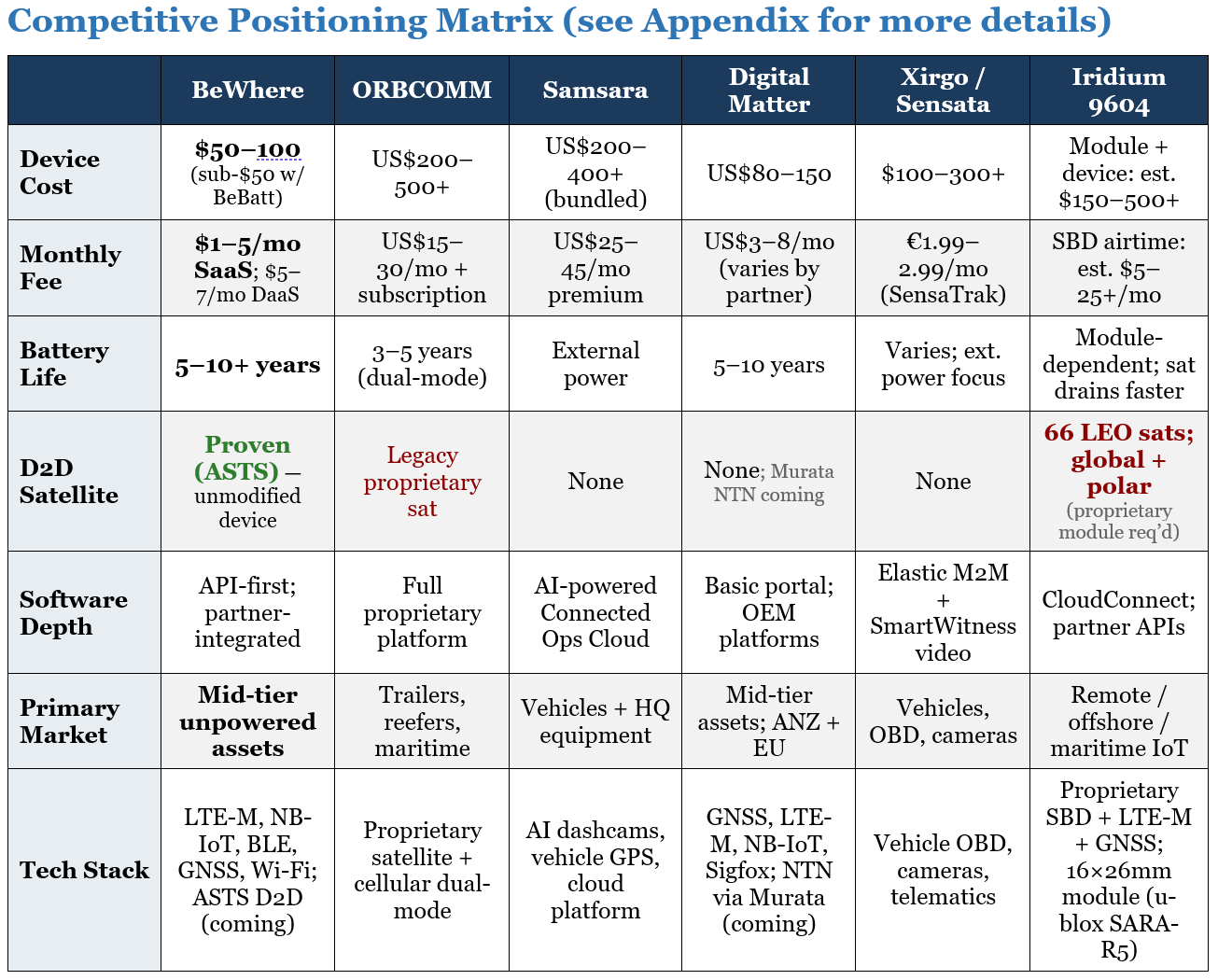
Source: Company filings, product specifications, management commentary, analyst reports, press releases. Iridium 9604 announced Feb 24, 2026. All costs USD unless noted. BeWhere DaaS pricing reflects all-inclusive device + connectivity + software bundle.
BeWhere occupies a “middle ground” that’s difficult to attack from either direction. High-end players like Samsara and ORBCOMM can’t profitably serve sub-US$100 asset tracking. Low-end consumer tags (AirTag, Tile) are passive and useless in industrial environments. BeWhere’s API-first approach means they’re complementary to, not competitive with, emerging AI analytics platforms, positioning them as the go-to data collection layer regardless of which software wins.
BeWhere occupies the low-cost, high-volume segment where the unit economics enable tracking of assets previously too cheap to justify. Iridium and ORBCOMM compete at the opposite end with high-cost, satellite-first solutions for assets in locations where cellular coverage doesn’t exist. The convergence point is the emerging NTN/D2D satellite layer. BeWhere’s AST SpaceMobile approach offers satellite as a free firmware overlay on cheap cellular devices, while Iridium’s approach requires dedicated (and expensive) satellite hardware. If AST’s D2D network reaches commercial scale, BeWhere can deliver equivalent global coverage at a fraction of Iridium’s cost structure.
4. Financials and Valuation
The base case assumes successful launches leading to a step up of just 20,000 annual unit sales in 2026 with additional contribution from the new DaaS model and European expansion. Out years assume no new launches, but nice organic growth from DaaS and Europe (a market likely as large as their own North America core today).
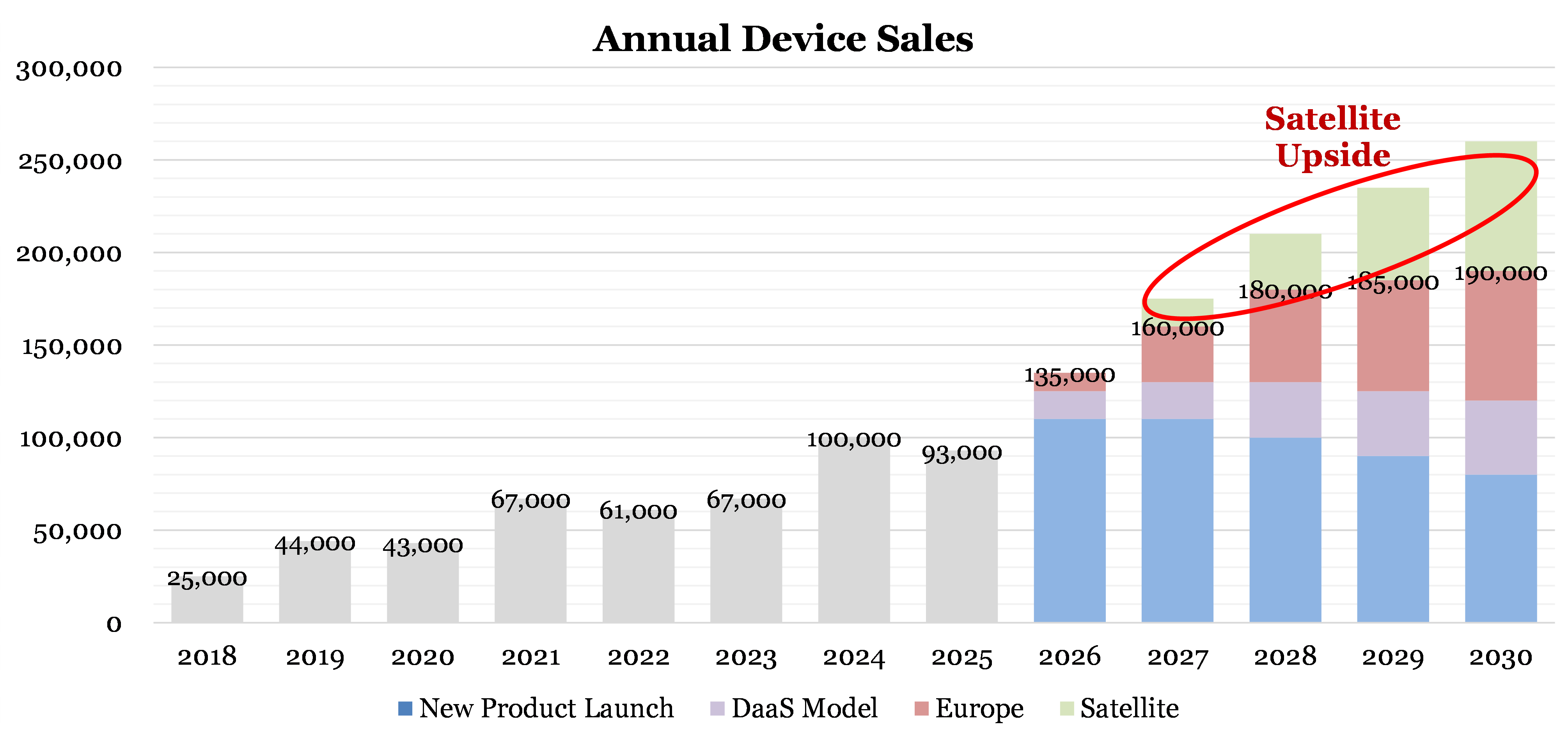
This cadence yields a 25% revenue CAGR to 2028 and significant margin expansion.

Using the Satellite Device upside depicted above, 2029 could see significant upside to EBITDA. This scenario would yield a 55%+ EBITDA CAGR from 2025 to 2029. This would not be possible without an asset light model and scaled distribution partners.

Finally, BeWhere’s current share price of C$.90 represents a compelling entry point as a result of the numerous initiatives set to drive meaningful growth in 2026. The early February offering was met with significant demand, closing the next day at C$0.86 and recently touching C$1.00. It would appear management told a compelling story of expansion.

APPENDIX
Appendix Contents
Competitive Landscape — Extended Analysis
Go-to-Market Strategy — The Channel Model
Manufacturing Model & Supply Chain
Product Portfolio — Detailed Hardware Specifications
Customer Base & Case Studies
AST SpaceMobile Partnership — Technical Deep Dive
Vodafone IoT Ecosystem — Extended Analysis
Risks
GSMA Whitepaper & Industry Framework
Recent News & Press Releases
Management Team & Board of Directors
Competitive Landscape
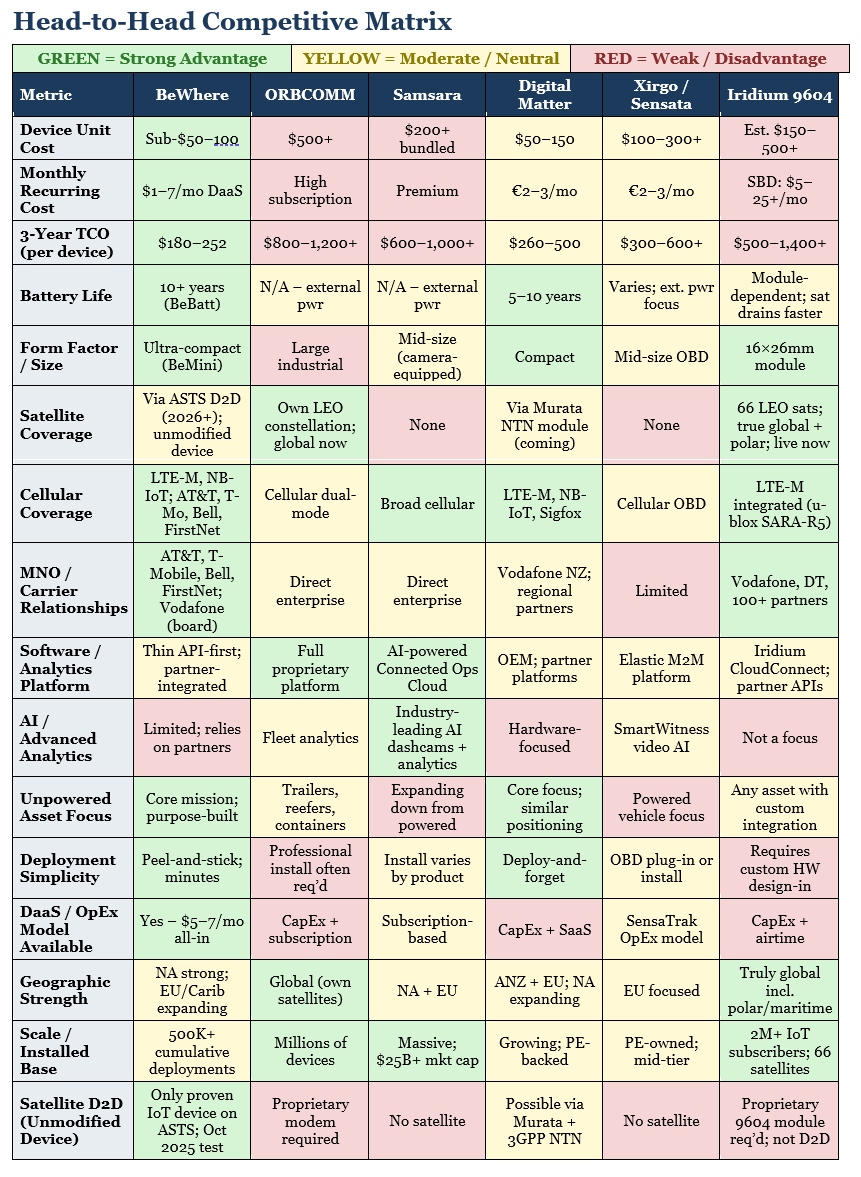
Source: Company filings, product specifications, management commentary, analyst reports, web research. Iridium 9604 data from Feb 24, 2026 press release. Assessment as of Feb 2026. Ratings are author estimates and reflect competitive positioning in the unpowered/low-power IoT asset tracking segment specifically.
Samsara (IOT-NYSE)
San Francisco-based. The IoT industry bellwether. Revenue ~US$1B+. Offers a full “Connected Operations Cloud” platform including AI dashcams, vehicle telematics, equipment tracking, and connected worker solutions. Commands a 10–20% price premium driven by software value proposition. Employs 3,500+ professionals. Not a direct head-to-head competitor in the mid-tier asset tracking segment but is expanding downmarket into trailers and smaller assets. The key difference: Samsara’s monthly subscription runs US$25–45/device versus BeWhere’s US$1–5. Different markets, different economics.
Digital Matter (Private, Australia/South Africa)
The closest direct competitor. Specialist in low-power, battery-powered GPS/IoT hardware. Strong in Europe, Australia, and New Zealand but limited North American presence. Received PE investment from Five V Capital in January 2025. Founded 2001. Key overlap: similar price points, similar device types, similar target markets. Key difference: Digital Matter lacks BeWhere’s carrier relationships and D2D satellite capability.
Geotab (Private, Oakville ON)
Global fleet management telematics leader with millions of connected vehicles. Acts as both BeWhere’s partner and competitor. As a partner, Geotab sells BeWhere devices through its marketplace to track non-powered assets alongside Geotab-tracked vehicles. As a competitor, Geotab is expanding into higher-value asset tracking (trailers, generators). The relationship is net positive for BeWhere today but worth monitoring.
ORBCOMM (Private, acquired by PE)
The incumbent in trailer tracking with revenues historically exceeding US$1B. Relies on older, higher-cost proprietary satellite hardware. CalAmp/ORBCOMM devices typically cost US$200–500+ and require external power. BeWhere undercuts them by 70%+ on price with 5x battery life. Their counter-strategy is to spread FUD about BeWhere’s small size, but this is mitigated by BeWhere selling through AT&T and Bell rather than as an unknown startup.
Apple AirTag / Tile / RFID
Consumer-grade trackers and passive tags. AirTags cost US$25 but are passive — they rely on iPhones walking past them to relay location. Useless in industrial settings (construction yards, rail depots, remote logging camps). RFID costs pennies per tag but requires a human with a US$1,500 scanner to physically walk the yard. BeWhere devices are autonomous, cell-connected, and report continuously without human intervention.
Go-to-Market Strategy
If there is one thing to understand about BeWhere, it’s their B2B2B channel partner model. They rarely sell direct-to-consumer. Rather than spending tens of millions building an enterprise sales force, BeWhere acts as the “Intel Inside” for massive distributors, giving their 22-person team an army of thousands of proxy salespeople.
Channel 1: Telematics Giants
BeWhere integrates natively with Geotab (world’s largest commercial fleet tracker with millions of connected vehicles) and Ford Pro Telematics. When a logistics firm buys Geotab for their trucks, they inevitably ask about tracking trailers too. Geotab sells them a BeWhere device from the Geotab Marketplace. Ford Pro completed its soft launch of BeWhere device integration in February 2026.
Channel 2: Telecom Carriers (MNOs)
AT&T, Bell Canada, T-Mobile, and others sell white-labeled BeWhere hardware to their enterprise clients. Carriers want to grow IoT data subscriptions and BeWhere provides fully certified hardware they can resell. The FirstNet relationship (8,000 units for public safety applications) is a prime example.
Channel 3: Regional and Specialty Partners
GISCAD (Caribbean/Latin America, 29 territories), Tenna (construction), GPS Insight, Titan GPS, and others provide geographic and vertical-specific reach. These partners handle the sales cycle; BeWhere fulfills orders and collects the recurring revenue.
The beauty of this model: BeWhere’s Sales & Marketing expense stays extremely low relative to revenue because the channel partners bear the majority of customer acquisition cost. It’s how 22 people generate C$20+ million in revenue.
Manufacturing Model & Supply Chain
BeWhere operates a fabless manufacturing model. All PCB design, engineering, R&D, and proprietary firmware development is done in-house in Mississauga, Ontario. Physical assembly is outsourced to contract manufacturers (CMs). While it is not abundantly clear they have an IP moat, their access to market / distribution is impressive for such a small company and is a testament to their build and pricing strategy. This acts as a sort of moat at best, and strategic in-roads to many enterprise conversations at worst.
As of Q4 2025, BeWhere operates a dual-CM strategy. The primary CM is in China and has been the company’s manufacturing partner for years. BeWhere represents approximately 10% of this CM’s business. A second CM was onboarded in Albania in Q4 2025. The Albania facility was chosen specifically for its favorable tariff position — a maximum effective tariff rate of ~10% into the U.S. or EU, providing a hedge against CUSMA renegotiations.
The tariff situation in 2025 was a meaningful test for the business. In Q2 2025, U.S. tariffs cost BeWhere C$425,000 in a single quarter, temporarily wiping out quarterly profit. Management responded aggressively: by Q3 2025, they achieved full CUSMA compliance (0% effective tariff rate), bringing product from China into Canada for firmware loading before shipping to the U.S. They also acquired Moore Installs, a U.S.-based installation and logistics company, for US$600K in January 2025 to improve supply chain capabilities.
Devices undergo “potting” during manufacture — the internal circuitry is injected with epoxy resin, creating a solid waterproof brick. This is what enables the IP67 rating and multi-year outdoor deployment durability.
Product Portfolio
BeMini
A compact, rugged tracker with GPS, cellular (LTE-M/NB-IoT), and BLE connectivity. Features include temperature/humidity sensors, motion detection, and geofencing alerts. Priced around US$50–100 per unit. Ideal for container and cargo tracking. The BeMini was the subject of the 8,000-unit FirstNet order in August 2025.
BeTen+
An industrial-grade beacon with extended battery life (10 years on 2 AA batteries at 1x/day reporting) and future satellite fallback capability. Used in mining, oil & gas, and heavy equipment monitoring. The “10” in the name stands for 10 years of battery life.
BeSol / BeSol+
A solar-powered variant for outdoor applications. The solar panel and energy harvesting system enables an industry-leading 5-minute reporting rate purely from solar charging. Ideal for agricultural machinery, outdoor equipment, and long-haul trailer tracking. The B5-BeSol+ refresh is scheduled for Q2 2026.
BeWired / BeWired+
A rugged, waterproof outdoor-mounted beacon for tracking assets with an external power source. Applications include trailers, dry vans, construction equipment, and chassis. Sensors cover light exposure, temperature, air pressure, humidity, and acceleration. The B5-BeWired+ refresh is scheduled for Q3 2026.
BeBatt (NEW — February 2026)
The first fifth-generation device. Purpose-built for cable reels, pallets, and lower-value assets. Features hybrid power (replaceable lithium battery + supercapacitor) for 10+ year operational life. Universal location intelligence switching between GNSS for outdoor and WiFi/BLE for indoor environments. Real-time alerts for motion, tilt, and light-based tamper detection. Critically, BeBatt was engineered at approximately 30% lower BOM cost than the BeTen+ it partially replaces, while delivering higher absolute dollar margins.
All devices comply with IP67 (water/dust resistance) and selected models carry ATEX certification for hazardous environments. The full product line operates on LTE Cat 1 Bis architecture, which is the same chipset enabling future D2D satellite connectivity through AST SpaceMobile.
Customer Base & Case Studies
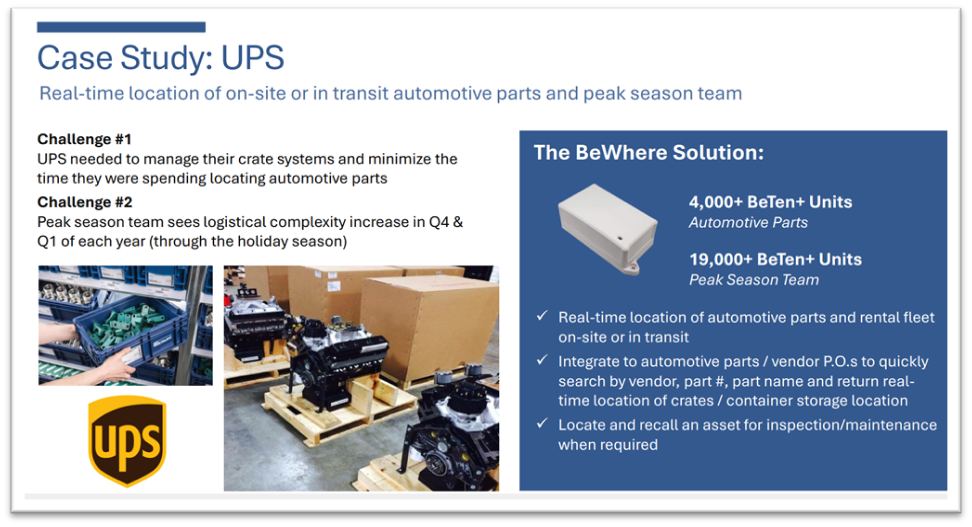
UPS
Deployed 20,000+ BeWhere units seasonally (Q4/Q1) to track equipment during peak shipping periods. The recurring revenue from this account is seasonal, benefiting Q4 and Q1 quarters. UPS also has a separate business relationship with Moore Installs (acquired by BeWhere in January 2025).
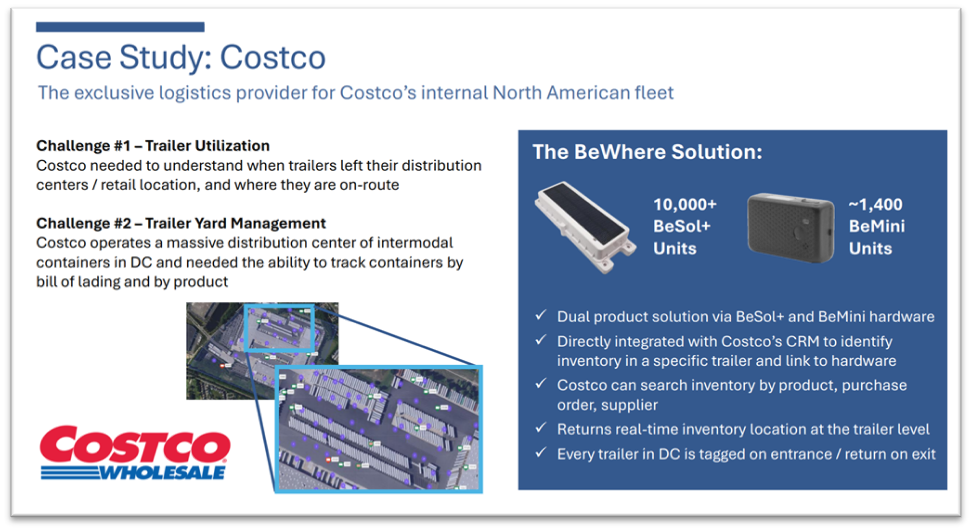
Costco
Tracking 10,000+ container fleets to manage inventory flow from yard to warehouse. A classic land-and-expand story that grew from a small initial pilot.
Lyft
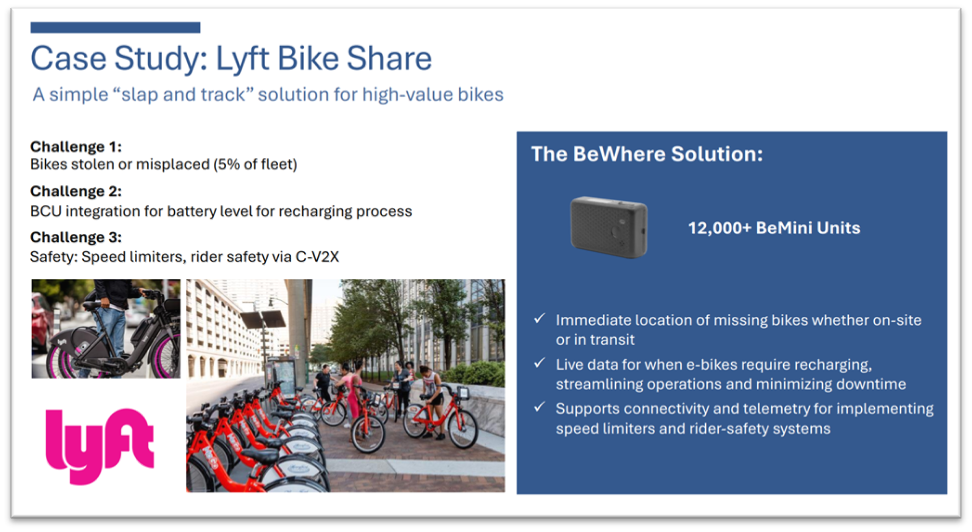
Tracking over 12,000 e-bikes in their ride-share program. This represents a creative non-traditional use case that demonstrates the versatility of BeWhere’s low-cost tracking platform.
FirstNet / AT&T Public Safety
An 8,000-unit order in August 2025 for BeMini trackers across 100+ first responder agencies including Boston Fire and Florida Emergency Management. FirstNet provides prioritized cellular connectivity for first responders during disasters. BeWhere has already deployed 3,000+ FirstNet units to agencies like Denver Water, Alabama DOT, and North Carolina DOT.
Examinetics (Healthcare Case Study)
BeWhere partnered with Examinetics to transform occupational health with low-power 5G asset tracking, monitoring mobile health screening equipment across hundreds of deployment sites. This demonstrates the expansion beyond traditional logistics into healthcare and compliance verticals.
Ford Pro
Completed commercial soft launch in February 2026. Ford Pro customers can now access BeWhere’s BeTen+, BeSol+, and BeWired+ devices directly through Ford Pro Telematics software, enabling fleet managers to track both their Ford vehicles and their non-powered assets on a single platform.
AST SpaceMobile
AST SpaceMobile (NASDAQ: ASTS) is building the first space-based cellular broadband network accessible directly by standard, unmodified devices. They’re not building satellite phones — they’re building cell towers in space that communicate with standard LTE/5G chipsets using 3GPP telecom standards.
Technology & Deployment Status
AST validated its technology with the BlueWalker 3 prototype in 2022. As of early 2026, they have launched six commercial BlueBird satellites, with BlueBird 6 being the largest commercial phased array ever deployed in LEO (launched December 2025). The company plans to deploy a 45–60 satellite constellation through 2026, which represents the minimum required for commercial-scale coverage.
The BeWhere Integration
BeWhere’s October 2025 test in New Brunswick, Canada demonstrated that a standard, unmodified BeWhere LTE IoT tracker could connect to a BlueBird satellite and route data through Bell Canada’s terrestrial network. This is significant because BeWhere’s existing devices use the same LTE Cat 1 Bis cellular module that AST’s satellites target. No hardware modification is needed — only a firmware update that manages the handover between cellular and satellite connectivity.
Economic Implications
Traditional satellite tracking requires US$500–1,500 devices with US$50+/month data plans. BeWhere’s D2D satellite approach uses the same sub-US$50 device, meaning the incremental hardware cost for satellite capability is zero. The only incremental cost is the satellite data plan, which will be billed through the carrier (AT&T, Bell, Vodafone) at rates that management expects to be dramatically lower than legacy satellite providers. This could unlock tracking for maritime containers, remote mining equipment, offshore energy platforms, and agricultural assets in areas with zero cellular coverage.
MNO Partnership Structure
AST operates on a B2B2C model — they partner with MNOs (AT&T, Verizon, Bell, Vodafone, stc group, and 50+ others globally) who provide spectrum access in exchange for a 50/50 revenue share. Both AT&T and Bell are equity investors in AST. Vodafone is a strategic investor with Luke Ibbetson serving on the AST board. This means BeWhere’s existing carrier distribution partners are the same carriers launching AST’s D2D service — creating a natural channel for satellite-enabled BeWhere devices.
Vodafone Opportunity
Vodafone’s IoT Platform — Scale and the Device Gap
Vodafone connects over 215 million IoT devices across 180+ countries through 760+ network partnerships. In 2024, it signed a 10-year strategic partnership with Microsoft to “hyperscale” the platform, with Microsoft investing in a planned spinoff of the IoT unit as a standalone business. Yet the hardware ecosystem remains fragmented. Its “Integrated Terminals” partners (BEC Technologies, Cradlepoint, Digi, Teltonika) orient toward high-throughput gateways and routers, not low-cost battery-powered trackers. Vodafone’s in-house “Asset Solar” tracker sits near BeWhere’s price points, but with notably less functionality and durability. Its Multi-Asset Tracking solution aggregates devices from various manufacturers spanning 2G, NB-IoT, and Cat-M1.
Vodafone’s Three-Pronged Satellite Strategy
Vodafone pursues three complementary satellite partnerships, each addressing a different layer of the stack:
AST SpaceMobile / SatCo (D2D Broadband) The deepest relationship. In March 2025, Vodafone and AST created SatCo, a jointly-owned European satellite service provider that will exclusively distribute AST’s D2D services to European MNOs — 21 EU member states have expressed interest. Vodafone holds ~5% equity in AST with a commercial agreement through 2034. Commercial service targets 2026.
Iridium NTN Direct (NB-IoT via LEO) Announced November 2025, delivering 3GPP standards-based NB-IoT over Iridium’s 66-satellite constellation for global pole-to-pole coverage in remote industrial applications. Commercial launch targets 2026.
Skylo Technologies (NTN NB-IoT via GEO) Partnered January 2026, trialing hybrid cellular-satellite connectivity where devices switch between terrestrial and NTN via a single Vodafone SIM across 36 countries.
Vodafone is preparing its entire IoT ecosystem for connectivity beyond terrestrial coverage limits.
The Luke Ibbetson Bridge
Luke Ibbetson, Vodafone’s Head of Group R&D since 2013, simultaneously serves on BeWhere’s board and AST SpaceMobile’s board (as Vodafone’s designee). His portfolio spans 6G, non-terrestrial networks, quantum technology, and advanced AI/ML; he chairs the NGMN Alliance’s Strategy Committee. This is not a passive advisory role, rather it creates an information and decision bridge between Vodafone’s R&D strategy, AST’s satellite architecture, and BeWhere’s device engineering. Additional board members Peter Wilcox and Nauby Jacob (both Bell Canada executives) reinforce an intentional carrier-ecosystem integration strategy.
The GSMA Foundry whitepaper, “Smart Logistics: Designing Integrated 5G and Satellite Solutions for Global Asset Tracking” (February 2025), amplifies this connection. BeWhere co-authored what functions as an industry blueprint for carrier deployment of integrated terrestrial-satellite tracking, projecting 2–3 billion devices addressable for satellite integration by 2030 with a $10 billion annual revenue uplift. BeWhere and Telit Cinterion are the only two companies named as rolling out integrated solutions in 2025.
A Toehold, Not a Partnership Announcement
No formal commercial agreement exists between Vodafone and BeWhere. Board-level relationships provide strategic access but do not bypass Vodafone’s procurement processes across 15 operating companies. Vodafone’s satellite IoT buildout, particularly through SatCo, opens an entirely new category of European asset tracking demand, and BeWhere’s cost structure, satellite-readiness, and carrier relationships position it to capture an early toehold. The playbook mirrors North American market entry – secure initial deployments through carrier channels, prove value at modest scale, and let economics drive organic expansion.
Why the Price Point Matters
BeWhere’s BeBatt (launched February 2026) delivers 10+ year battery life at what management describes as the company’s “most competitive price point to date.” The historical pricing model of sub-$100 wholesale hardware and $2–5/month SaaS fees (or $0 upfront under DaaS at $5–7/month) justifies tracking assets valued in the hundreds or low thousands of dollars. The GSMA whitepaper projects satellite integration will unlock entirely new categories: remote agricultural equipment, construction assets, portable generators, rural medical equipment, and renewable energy infrastructure. These are exactly the asset classes where ROI requires sub-$100 hardware. Even a modest deployment through a single Vodafone operating company (10,000–20,000 units) would represent meaningful revenue for a ~C$20M company and a reference customer opening the door to 20+ European markets.
Satellite IoT Market Context
Berg Insight reports the global satellite IoT subscriber base reached 5.8 million in 2024, forecasting a 41.1% CAGR to 32.5 million by 2029 with revenue growing from €334M to ~€1.58B and monthly ARPU declining to ~€4.05, aligning with BeWhere’s recurring revenue model. IoT Analytics estimates combined revenue growing at 26% CAGR to surpass $4.7B by 2030. Incumbent operators (Iridium, ORBCOMM, Globalstar) rely on proprietary terminals costing $200–$1,500+ with $20–50+/month data plans. The value proposition of 3GPP-compliant D2D satellite connectivity is eliminating that proprietary terminal barrier entirely. BeWhere’s October 2025 satellite test connecting a standard off-the-shelf LTE tracker to an AST BlueBird satellite routed through Bell’s terrestrial network provides proof-of-concept.
Risks
Customer Concentration
BeWhere’s top clients (UPS, Costco, Lyft) represent meaningful revenue concentration, likely over 50% based on several charts in their presentations, one of which may be as much as 15-20% of revenue. Mitigation: the company has approximately 10,000 customers across the platform and the land-and-expand model means new enterprise relationships are continuously being added. The DaaS rental model also increases switching costs via longer contract terms.
Tariffs and Trade Policy
The Q2 2025 tariff impact demonstrated real vulnerability. Mitigation: CUSMA compliance achieved in Q3 2025 (0% effective rate). Albania CM onboarded in Q4 2025 as a 10% tariff backstop. Stress test: even if the Q3 2025 C$425K tariff hit occurred every quarter, the company has C$9M in cash and C$7M in working capital to survive 2+ years without external capital.
AST SpaceMobile Execution Risk
The satellite opportunity is highly contingent on ASTS deploying its constellation on schedule. Delays, technical failures, or funding gaps at ASTS would push out BeWhere’s satellite revenue timeline. Mitigation: the satellite opportunity is pure optionality — the base business is compounding nicely without it. Multiple re-pricing of ASTS risk is not BeWhere’s problem.
Key Person Risk
22 employees means every person matters. Owen Moore’s departure would be particularly impactful. Mitigation: the Grey Island team (Moore, Boychuk, Panczuk) has worked together for decades, reducing flight risk. The board is deep with strategic expertise (Ibbetson, Wilcox, Jacob).
Competition from Samsara Down-market
Samsara is publicly expanding into lower-value asset tracking — BeWhere’s core market. Mitigation: Samsara’s cost structure (3,500 employees, US$25–45/month SaaS fees) makes it structurally difficult to compete at BeWhere’s price points and would significantly dilute their P&L to the demise of shareholders. Samsara will capture the higher-value end of asset tracking, and BeWhere owns the cost-sensitive middle and low end.
Liquidity and TSX-V Listing
The stock trades on the TSX Venture Exchange with limited daily volume, making it difficult for larger investors to build positions. This is a real friction point for institutional capital. Mitigation: a TSX main board graduation (possibly 2027) and continued revenue growth toward the C$50M threshold would organically resolve this over time.
Dilution
The February 2026 equity offering grew share count by 8%. Future raises to fund the DaaS rental model, European expansion, or acquisitions would further dilute shareholders. Mitigation: management has historically been disciplined with capital — no warrants outstanding, active NCIB buyback program, and the DaaS model generates free cash flow within 2–3 quarters of deployment.
GSMA Whitepaper & Industry Framework
In February 2025, BeWhere co-published through the GSMA Foundry the whitepaper titled “Smart Logistics: Designing Integrated 5G and Satellite Solutions for Global Asset Tracking.” This was a collaboration between BeWhere, Bell Canada, and GSMA to define the technical and commercial framework for next-generation asset tracking that seamlessly transitions between terrestrial 5G and satellite networks.
The whitepaper lays out the architecture for devices that intelligently switch between cellular and satellite connectivity based on available coverage, representing a paradigm shift in supply chain visibility. BeWhere’s involvement as a co-author of this industry blueprint is significant — it positions them as a thought leader and potential preferred implementation partner for carriers building toward this vision.
Recent Developments
February 12, 2026 — Ford Pro Integration
BeWhere completed the commercial soft launch of its collaboration with Ford Pro, integrating BeWhere’s device suite into Ford Pro Telematics Software. Ford Pro customers can now access BeTen+, BeSol+, and BeWired+ devices directly through the Ford Pro ecosystem.
February 9, 2026 — BeBatt Launch
BeWhere unveiled BeBatt, the first fifth-generation IoT asset tracker delivering 10+ years battery life at the company’s most competitive price point. Available today.
February 5, 2026 — Equity Offering
BeWhere completed a C$4.0M brokered LIFE offering of 8.5M common shares at C$0.70 per share. Proceeds earmarked for equipment rental business expansion, European expansion, and general working capital.
October 28, 2025 — AST SpaceMobile D2D Test
Successfully connected an unmodified BeWhere IoT tracker to AST SpaceMobile’s BlueBird satellite via Bell Canada’s network. First asset-tracking company to achieve D2D satellite transmission with an off-the-shelf cellular device.
August 28, 2025 — FirstNet Order
Received order for 8,000 FirstNet-connected BeMini trackers operating on AT&T’s network for 100+ first responder agencies.
March 10, 2025 — GISCAD Partnership
Announced partnership with GISCAD Group (Trinidad & Tobago) covering 29 territories in the Caribbean and Latin America for BeWhere’s LTE Cat 1 Bis devices.
Management Team & Board of Directors
Executive Leadership
Owen Moore — CEO & Co-Founder
Moore was President and Co-Founder of Grey Island Systems International, a publicly traded Canadian/U.S. manufacturer of real-time internet-based vehicle monitoring and predictive arrival systems. He grew Grey Island from startup to C$24M in revenue in less than ten years before selling in October 2009. Grey Island was a multi-year recipient of the Deloitte Technology Fast 50 and Profit 100 honors. Moore holds ~10% of BeWhere’s outstanding shares.
Chris Panczuk — COO & Co-Founder
Panczuk spent 15+ years in GPS and telematics, most recently as VP of Enterprise Sales at BSM Wireless. He has been in the industry since 1998.
Rajiv Khanna — CFO
Khanna has 33+ years of senior finance experience across telematics, manufacturing, and consumer packaged goods.
Brian Boychuk — SVP, Sales & Marketing
Boychuk was co-founder of Grey Island Systems, serving as VP Sales & Marketing and then EVP Business Development at Grey Island.
Alban Hoxha — CTO
Hoxha has two decades of experience spanning data center management, firmware development, hardware manufacturing, M-IoT, telematics, and M2M compliance.
Board of Directors
Paul Christie — Chairman
Former Toronto city councilor and TTC chair. Director at Grey Island Systems. Has been BeWhere Chairman since 2016.
Joanne De Laurentiis — Director
Former CEO of IFIC, Credit Union Central of Canada, Interac, and Mondex Canada. Currently chairs the Financial Services Regulatory Authority of Ontario (FSRA).
Nauby Jacob — Director
SVP of Consumer Products and Platforms at Bell Media. Former Director at EnStream and TELUS. Expertise in telecommunications product strategy and mobile network operations.
Luke Ibbetson — Director
Head of Group R&D at Vodafone since 2013, responsible for 5G, 6G, and NB-IoT strategy. Serves simultaneously on the board of AST SpaceMobile as Vodafone’s designee. Chairs the Strategy Committee for the NGMN Alliance. This is arguably the single most strategically significant board appointment at BeWhere.
Peter Wilcox — Director
Director of Enterprise Solutions at Bell Canada with two decades of experience leading product teams in 5G, Private Mobile Networks, and IoT solutions. Ivey Business School, Western University.
DISCLOSURE
Position: At the time of publication, the author owns BeWhere.
Trading Policy: The author will not materially alter this position within 48 hours of publication. After this period, the author may buy, sell, or otherwise adjust the position without further notice. Changes to the author’s view or position will be reflected in subsequent publications when material.
Conflicts: The author has received no compensation from the issuer or any party with a financial interest in this security.
Forward-Looking Statements: This report contains the author’s opinions, estimates, and projections, including price targets derived from financial models. These are forward-looking statements subject to substantial uncertainty. If these assumptions prove incorrect, the actual value may differ materially, including scenarios of significant loss or total impairment. The price target represents the author’s estimate of fair value under the stated assumptions, not a prediction of where the stock will trade.
This report is provided for informational purposes only and does not constitute investment advice. See the full Terms & Disclosures for additional important information.
Great write up!