


Google is dead one week, and back the next. Now it sits on the 200dma and the market is, rightfully so, debating durability of Search in a consumer agent world. This is the right question, and I plan to write on this in the future, but it also discounts the idea that Google might have their consumer agent in the future… as though they’re lacking the pieces to do so…
This last piece is what I want to work through next, but on the enterprise side. Gemini’s progress has been disappointing, but material personnel changes and founder input returning seems to be turning things if we are to judge by recent rumors on the upcoming release of Gemini 4 as a hit in the making.
What some in the market misses today on AI in general is that the leading edge models are good, and while not AGI, if productized can drive huge changes in daily life. That’s literally what we’re seeing with Muse today. Google will be forced to the productization path next or risk having key advantages and legacy profit pools perish while Cloud continues its positive earnings upgrade cycle.
Why do I say this… well Google already has all the parts internally and just needs to piece them together to form an incredibly compelling enterprise offer for larger corporates all the way down to the long tail of SMEs…
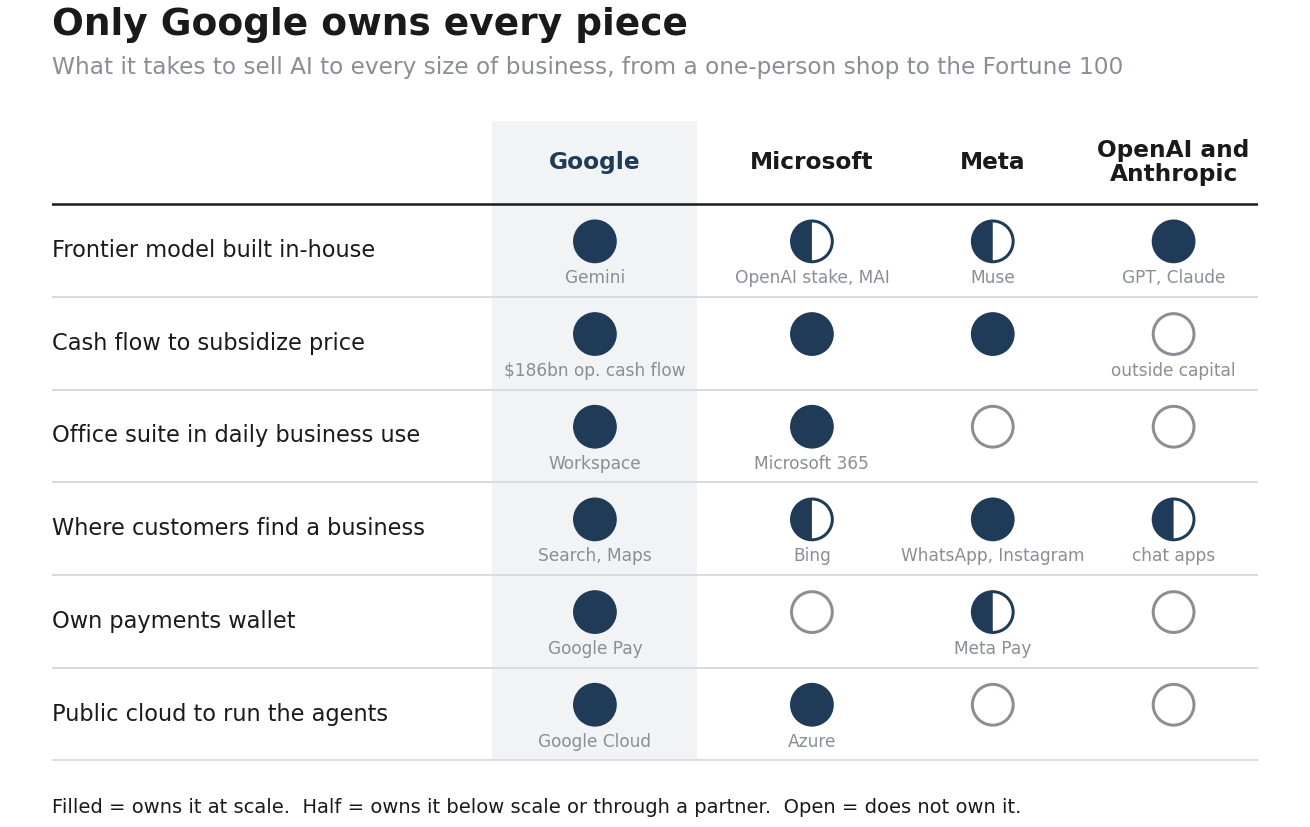
No doubt it will take some time to realize this a vision like this, and in the meantime they have to contend with worries on Search, CapEx, and short term cash burn. Search revenue still grew 17% in 2Q26, and AI Mode passed 1bn monthly users. The question that sets Alphabet’s value over the next decade is who sells AI to the tens of millions of businesses that have barely started buying it. Our answer is Google, and it takes only a little imagination to see why.
Data + distribution
In a recent appearance, Gavin Baker of Atreides Management argued that only three model companies will hold enterprise value in five years. “The three companies that have unique data are Meta, Google, and xAI.”
I would take it a step further… unique data keeps Google in the race. What Google owns beyond the model decides how much of the race it wins. This requires them to have a model on or near the frontier. On the July 22 call, Sundar Pichai said Google has started “our most ambitious pretraining run yet” and is “very committed and very confident of being at the frontier.” Once the model is close enough, the model is no longer the whole product. The pieces around it start to matter more, and Google holds more of them than anyone.
Here’s a quick rundown of some of those pieces / traits…
Cash and cash flow to subsidize offerings - already effectively happening today vs. upsell charge for CoPilot
Trusted brand with inbox and the calendar… first of 500 AI companies in Cybernews’ Aug 2026 trust ranking, with OpenAI 22nd and Anthropic 70th
No baggage, no polarizing founder, no decade of social-media scandal to live down, while OpenAI ranked 68th in the 2026 Axios Harris Poll 100 and Meta and X trailed the rest of Big Tech
Suite with Gemini built in, Gmail, Docs, Sheets and Meet, carrying mail for 3.6mm business domains
Search and Maps plus a Gemini app at 950mm monthly users
Rails via Google Pay to collect and Google Cloud to run the agents, with Cloud up 82% in 2Q26 on a $514bn backlog
Each rival can match one or two of these. None can assemble the rest quickly.
The desktop moat is shrinking
For 30 years Microsoft’s edge was the desktop app - near monopoly one might say. Office set the standard because it was a necessity of white collar / knowledge work. When an agent builds the model and drafts the memo, the app underneath matters less than the model and the data it can reach. A spreadsheet an agent built in Sheets is as good as one it built in Excel.
That moves the buying decision toward the people doing the work. IT leaders have long preferred Microsoft for control and compliance. Users tend to prefer Google, and ease of use is the strength G2 reviewers cite most for Workspace.
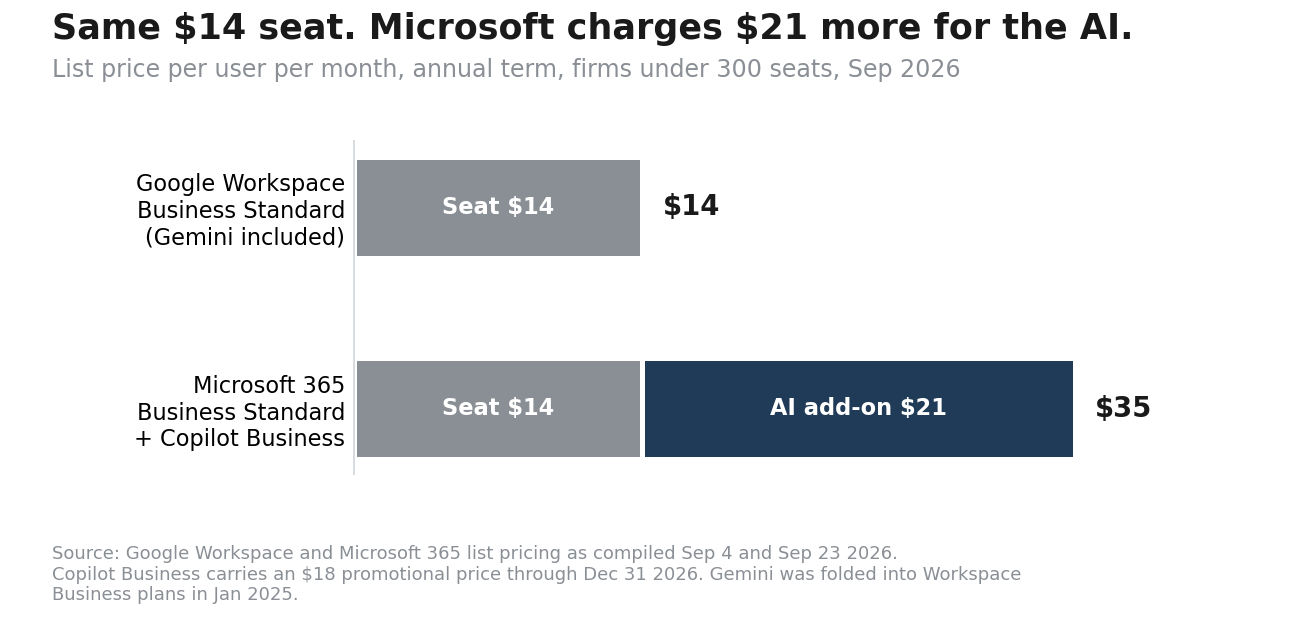
Price points the same way. Gemini comes inside a $14 Workspace seat. Microsoft charges $21 on top of its own $14 seat for Copilot.
A little imagination
Picture a 12-person accounting firm or a six-truck plumbing company in 2029. Today they barely use AI. The Census Bureau found AI use at firms with 250+ staff reached ~37% by May 2026, while firms under 20 staff were flat and the smallest stayed below 20%.
When those firms go as deep as the average tech company is today, they will not hire an AI team. They will need handholding, and a product built into tools they already open every morning. For most of them that is Google. They run mail on Gmail and find customers through Google Search and Maps.
The vendor already sitting in those places can sell the agent that answers the phone and books the job, then charge for it. Philipp Schindler said on the July 22 call that Google’s new agentic tools for small businesses had reached hundreds of thousands of new customers this year. Why would there not be a far larger software suite that sits on top of that over time? Some of it will be built for specific trades and sold into small and mid-sized firms through channels Google already owns. As the cost of building declines, so does their ability to meet more verticalized needs over time.
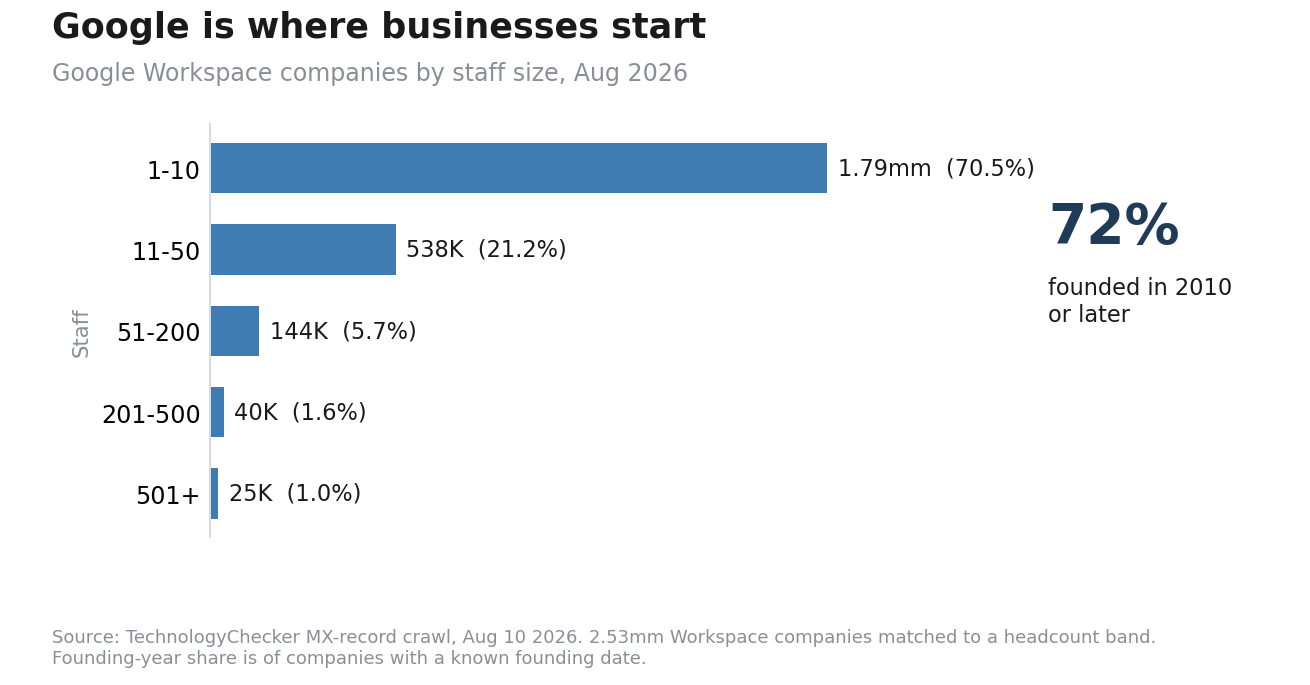
Google is also where many of these firms begin. Of the Workspace companies matched to a headcount, 70.5% have 10 or fewer staff.
Small checks, nearly half the workforce
Each contract would be small, but they are by far the best positioned to implement AI into the long tail of 36m American small businesses employing 62m people, 46% of the private workforce and the largest single block of American labor, per the SBA. Every $10 a month of AI spend per small-business worker is ~$7.5bn a year of revenue. At $30 it is ~$22bn, close to a full quarter of Google Cloud revenue today. And why wouldn’t this also be the case across Europe?
Even better, nearly 90% of the Fortune 100 use Gemini Enterprise, per the 2Q26 call. Simply put, they have the ability to sell one AI stack to a one-person shop and to the Fortune 100. Microsoft is strongest higher up the axis. Meta holds the storefront. WhatsApp counts 200mm+ small-business users.
Google is the only company with a piece at every point on the axis. The market still sees a search company with a capex bill.
What has to go right
Gemini 4 must be a strong launch with a more sustained pace of releases… the latter should be increasingly possible once back on the frontier as both Anthropic and OpenAI are using their latest models to train the next
Workspace keeping the firms it signs as they grow, Microsoft still wins ~2 mail-provider switches for every 1 it gives back (TechnologyChecker, Aug 2026), and ideally they start to stem the tide in the NTM
It would be great to see a Google’s small-business agent tools vs. Meta’s Business Agent at 1mm+ businesses
Putting it altogether
It doesn’t take much imagination to understand what the existing component pieces of the business can produce in say 3 to 5 years, but the market clearly is not doing so today. There is not player better positioned to meet the needs of SMEs to enterprises, and I dare say even push into other adjacent spaces further like payments and operations software systems. Reading the tea leaves, it feels like there are A LOT of changes happening internally all at once. Results will take time but their position is irreplaceable. But just giving the market a taste of a vision like that above should ultimately support valuation and provide comfort that the large CapEx bill will have positive ROI.
DISCLOSURE
Position: At the time of publication, the author does hold a position in GOOGL.
Trading Policy: The author will not materially alter this position within 48 hours of publication. After this period, the author may buy, sell, or otherwise adjust the position without further notice. Changes to the author’s view or position will be reflected in subsequent publications when material.
Conflicts: The author has received no compensation from the issuer or any party with a financial interest in this security.
Forward-Looking Statements: This report contains the author’s opinions, estimates, and projections, including price targets derived from financial models. These are forward-looking statements subject to substantial uncertainty. If these assumptions prove incorrect, the actual value may differ materially, including scenarios of significant loss or total impairment. The price target represents the author’s estimate of fair value under the stated assumptions, not a prediction of where the stock will trade.
This report is provided for informational purposes only and does not constitute investment advice. See the full Terms & Disclosures for additional important information.