


There is a company listed on Nasdaq First North in Stockholm, with a market capitalization of roughly $30 million, that sits on one of the most critical layers of modern defense infrastructure. Not the engine that renders the synthetic world. Not the AI that pilots the aircraft. But the software that designs the exercise, grades the performance against NATO doctrine, measures unit readiness, captures lessons learned, and determines whether a brigade is certified to deploy.
That company is 4C Group AB (4C.ST). Its software is called Exonaut.
Here is the pitch: Exonaut is mission-critical defense software employed by NATO headquarters, the British Army, the Australian Defence Force, and now, after a decade of patient US market entry, the US Army’s 1st Cavalry Division and 2nd Infantry Division. The Resilience segment has been restructured, with SEK 40 million in annualized costs removed. The order backlog is SEK 332 million and growing, roughly equal to the entire market capitalization. The stock has been severely punished by IFRS 15 revenue recognition lumpiness, a dilutive capital raise, and passive fund rebalancing. The downside from here, if the company muddles through for a year, is roughly 25 to 30%. The upside, if management executes on the backlog in front of them, is 3 to 4x in one to two years and potentially 5 to 8x in three.
The Return Potential: How We Get to 3-4x and 5-8x
Before diving into the business, it is worth being explicit about the assumptions behind those upside figures, because they require scrutiny rather than faith.
The entry point today is approximately SEK 8.70 per share. Enterprise value is roughly SEK 450 million given approximately SEK 120 million in net debt. That implies roughly 1.3x EV/Sales on FY2025 revenue of SEK 352 million.
Base case (3 to 4x, 2027 to 2028): Revenue reaches SEK 500 to 550 million, driven by approximately 50% of the SEK 332 million confirmed backlog converting in 2026, continued 20% organic growth in the defense segment as NATO framework agreements generate call-offs, and the SEK 40 million annualized cost savings lifting the EBIT margin to 15 to 20%. At 3x EV/Sales, where the stock traded in 2022 into 2023 when growth was strong and margins 10%+, enterprise value reaches SEK 1.5 to 1.65 billion. At SEK 1.5 billion EV with net debt paid down toward SEK 60 to 80 million, equity value is roughly SEK 1.42 to 1.59 billion on approximately 38 million shares, implying SEK 37 to 42 per share. That is 4x from today. The multiple is not aggressive: the peer group of Nordic defense software companies trades at an average of approximately 28x EV/EBIT. A company generating 15 to 20% EBIT margins on SEK 500 million in revenue, with sub-2% churn and 80% software gross margins, reaching 3x revenue requires a sustained discount to those peers.
What this base case does not require: any US Army contracts beyond the four DoD organizations already signed. Any material Resilience recovery. Any blue-sky AI monetization from the Hadean partnership. The base case is purely: execute on the backlog in front of you.
Bull case (5 to 8x, 2028 to 2029): Revenue reaches SEK 650 to 800 million. This requires meaningful US pipeline conversion. Of the 130 potential Army and National Guard commands identified as addressable, 4C has signed 6. Getting to 20 to 30 signed commands at an average annual contract value of SEK 10 to 15 million would add SEK 140 to 225 million in high-margin US ARR alone. It also assumes the Resilience segment contributes positively rather than draining resources, as the Swedish PTS framework agreement (up to SEK 100 million) and similar civilian resilience contracts convert. At EBIT margins of 20 to 22% on SEK 700 million in revenue, and a 4 to 5x EV/Sales multiple reflecting the re-rating that comes when a small Nordic software company becomes a recognized name in NATO’s procurement ecosystem, enterprise value reaches SEK 2.8 to 3.9 billion. Per-share value: SEK 70 to 100+.
What the bull case does require: the US DoD procurement environment staying intact. At least partial conversion of the 130-command US pipeline. Continued NATO rearmament driving European call-offs. And management delivering on the 2026 cash-flow-positive commitment, which is the threshold event that removes the financing risk overhang from the stock entirely.
What kills it: Another dilutive capital raise, persistent cash flow negativity through 2026, or the US pipeline stalling again under a new government shutdown cycle. These are real risks, addressed in the red team section at the end of this piece.
The asymmetry is the point. The bear case, as modeled, implies roughly SEK 6 to 8 per share. The base case implies SEK 37 to 42.
Why Military Readiness Is a Software Problem Now
Before diving into the company, you need to understand why this matters to the Pentagon, to NATO, and to every allied defense ministry writing checks right now.
The Western military model depends on a concept called “Force Generation,” the process of training, evaluating, and certifying military units before they can be deployed. This is distinct from “Force Employment,” which is the act of commanding forces in combat. Palantir, Anduril, and others operate in Force Employment, the sharp end of the spear. But none of those systems matter if the units wielding them are not ready.
Readiness is not a vague concept. It is a measurable, certifiable status. Before a NATO brigade deploys to the Eastern flank, before a US Army division rotates through a combat training center, before a UK battlegroup is declared operational, each must pass a Mission Rehearsal Exercise (MRX). These are massive, multi-domain events lasting days or weeks, involving thousands of personnel across land, air, sea, cyber, and space domains. They are graded against specific doctrinal standards. The evaluation determines whether the commanding general signs the certification or sends the unit back for more training.
This process has historically been managed with a combination of institutional knowledge, manual record-keeping, and ad hoc tools. A training exercise involving 5,000 soldiers across three countries generates thousands of data points: movement orders, fire missions, logistics flows, communications patterns, decision timelines. Traditionally, teams of evaluators tracked this on whiteboards and spreadsheets, wrote narrative assessments, and filed reports that were rarely digitized or compared across exercises.
The problem is that modern warfare does not allow for this anymore.
There is also a macro timing dimension that most investors miss. Defense spending follows a specific sequence, what 4C’s CEO Jonas Jonsson calls the “three-wave cycle.” First, countries replenish ammunition and basic gear. Second, they buy major platforms: tanks, ships, planes. Third, they invest in capability, the training, evaluation, and readiness infrastructure that turns hardware into fighting power. 4C’s software is a third-wave product. This explains why the company’s revenue remained flat from 2022 to 2024 despite the war in Ukraine and the largest European defense spending increase in a generation. The ammunition and platform waves came first. The capability wave, where training software contracts are signed, is only now reaching procurement stages in 2026 and 2027.
Operational tempo has accelerated. The time between “alert” and “deploy” has compressed. NATO is now running simultaneous exercises across multiple fronts. The US Army needs to rotate divisions through certification faster. Allies need interoperable training standards so that a Danish battalion can plug into a British brigade and both can be graded against the same doctrinal framework. Live ammunition is being diverted to active conflicts, pushing more training into synthetic environments where the evaluation layer becomes even more critical.
This is where Exonaut enters. It is the only NATO-accredited software platform that manages the full lifecycle of military readiness, from planning the exercise, to executing it, to grading the performance, to certifying the unit, to capturing the lessons for next time. And it has been doing this for over twenty years.
What Exonaut Actually Does, and Why It Can’t Be Ripped Out
Exonaut is not a point solution. It is a modular platform with six defense modules, each addressing a different phase of the readiness cycle.
Planning and Programming aligns long-term operational objectives with training requirements and resource allocation across an entire force structure. At the NATO level, this module coordinates training plans across dozens of member nations with different force structures, calendars, and capability requirements.
Collective Training and Exercise Management is the operational core. It manages the full lifecycle of an exercise, from the initial planning document to the Main Events List to the real-time scenario injection. This is the module that the evaluators, the White Cell operators, and the training audience all work within simultaneously during the exercise itself.
Training Measurement and Evaluation is where performance gets scored. Individual and collective performance is measured against doctrinal benchmarks. The module generates the readiness grades that determine whether a unit passes. This is the module with the deepest switching costs: the grading templates, the readiness baselines, and the historical performance data are all stored inside the platform. Switching means starting from scratch with no historical context.
Special Forces Selection manages the highly structured, legally and operationally sensitive evaluation pipeline for special operations candidates. The data sensitivity and compliance requirements here make migration almost inconceivable.
Wargame and Simulation Management is the integration layer connecting Exonaut to the simulation ecosystem: MASA SWORD, MAK VR Forces, BAE Systems’ OneArc, and others. This is where the AI integration with Hadean sits, described in detail in a later section.
Lessons Management is where after-action reviews are digitized, stored, and systematically incorporated back into future exercise designs. This module creates the institutional memory flywheel: every exercise makes the next exercise better. The data accumulated across twenty years of NATO exercises is effectively irreplaceable.
The architecture creates a moat that compounds over time. To understand why Exonaut is not ripped out, consider what a defense ministry would lose in a migration: twenty years of readiness baseline data, the exercise templates calibrated to their specific force structure, the doctrinal grading criteria built and validated through operational experience, and the tribal knowledge of 4C’s military-background staff embedded in their evaluation teams.
A precise word of clarification on the “they own the doctrine” framing, because precision matters here. 4C does not own NATO doctrine. No company does. NATO’s doctrine is developed by Allied Command Transformation and codified in publicly available publications. What 4C has done is operationalize that doctrine into structured, digital evaluation frameworks, and accumulate twenty years of exercise data, readiness baselines, and assessment templates that no competitor can replicate without starting from scratch. The moat is cumulative, built on data, accreditation, and operational trust, not conceptual.
Inside the Walls: Proof Points from Twenty Years of Deployment
The customer roster is the single most important fact about 4C Group. It is not a startup trying to sell into defense. It is already embedded in the evaluation infrastructure of the world’s most capable militaries.
NATO headquarters. Exonaut is the platform used by Supreme Allied Commander Europe (SACEUR) and Allied Command Transformation for managing NATO-level exercises. The NATO TALOS program, a multi-year contract for Exonaut development and maintenance covering trials, experimentation, and capability evaluation, was extended in early 2026 through 2029 at USD 2.4 million. This is the platform-of-record designation at the top of the NATO pyramid.
United Kingdom. The British Army uses Exonaut across 22 separate contracts, covering multiple formations and headquarters. The UK MoD’s JCAST (Joint Command and Staff Training) program is delivered through 4C. The British Army’s Land Training School awarded Exonaut the LTS Quality Mark accreditation, the formal certification that the platform meets the British Army’s training standards. The UK relationship exemplifies the land-and-expand model: what started as a single headquarters engagement has grown to cover most of the British Army’s collective training apparatus.
Norway. The Norwegian Armed Forces are one of 4C’s longest-standing customers, with Exonaut embedded across the joint force structure. Norway’s elevated readiness posture on NATO’s northern flank, directly facing Russia, has made this relationship a strategic reference point for other Nordic and Baltic nations.
Australia. The Australian Defence Force adopted Exonaut as its readiness management platform. The AUKUS alliance context is relevant here: the operational and training interoperability requirements that come with AUKUS create a strong pull toward shared evaluation frameworks with US and UK forces, both of which also use Exonaut.
United States. The US beachhead deserves its own section, covered next. But the headline is that after a decade of patient market entry, 4C now has signed contracts with four US DoD organizations, including the 1st Cavalry Division, the 2nd Infantry Division, and two additional commands. US ARR exceeds SEK 30 million.
Emerging markets. Three additional NATO countries completed successful Exonaut tests in 2025. Demand is growing in countries including Spain, the Netherlands, and Austria as they align with NATO readiness standards. A new European public defense entity signed a 3-year contract worth SEK 14.1 million base with potential SEK 26 million over five years. A second EU defense entity signed a 5-year agreement worth up to SEK 26 million.
This is the critical point that the market capitalization obscures: 4C is already inside the walls. The software is already running the exercises. The data is already accumulating. The question is not whether militaries will adopt Exonaut. They already have. The question is how fast the footprint expands within each customer, and whether the financial statements catch up to the operational reality.
The Order Book: Reading the Backlog With Eyes Open
One of the most important features of 4C’s business model is the distinction between framework agreements and the reported order book.
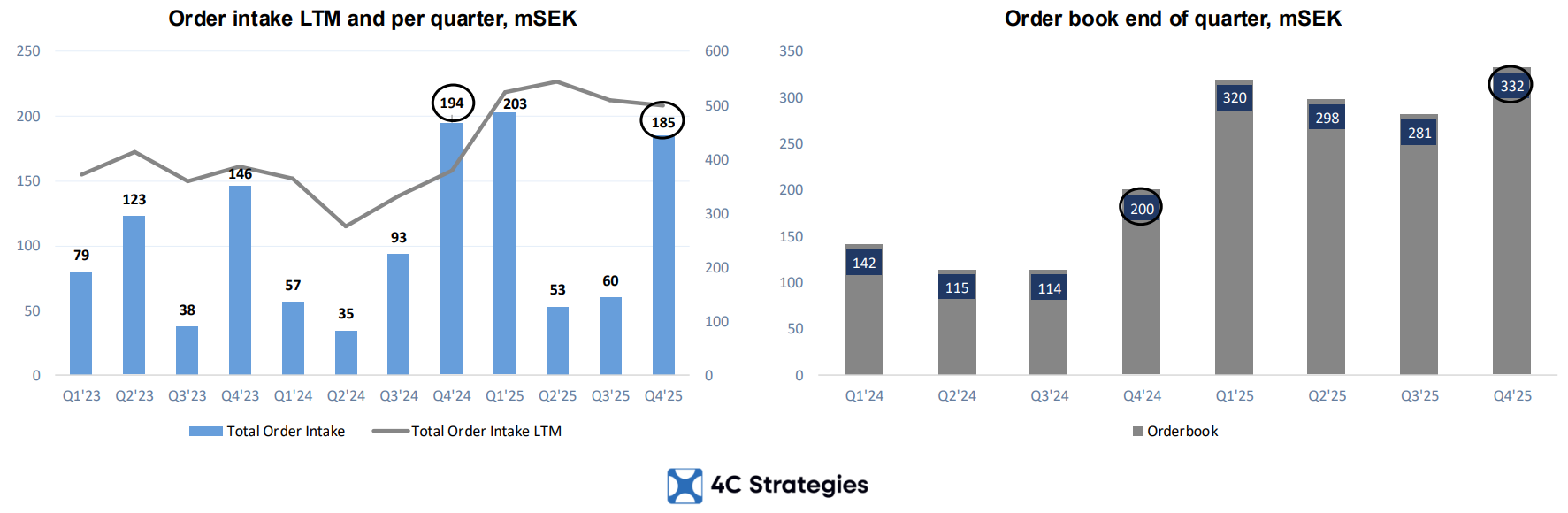
The reported order book at year-end 2025 was SEK 332 million, up 50% year-over-year. That number already looks impressive relative to the company’s SEK 352 million in annual revenue. Framework agreements totaling an additional SEK 578 million sit outside the reported backlog.
In defense procurement, a framework agreement is essentially a hunting license. The customer, typically a defense ministry, has agreed that 4C is an approved vendor for a defined scope of work over a multi-year period. The framework specifies maximum values and terms. But no money changes hands until the customer issues a “call-off order,” an actual purchase order against the framework. Frameworks do not appear in the reported backlog until call-offs are issued.
An important caveat that bulls tend to gloss over: framework agreements guarantee exactly zero dollars in revenue. Governments routinely sign large framework agreements to pre-vet vendors, only to let them expire after issuing a fraction of the maximum amount in actual call-off orders. The SEK 578 million figure represents a ceiling, not a forecast. Treating uncommitted framework maximums as guaranteed future revenue is a classic trap in defense sector investing.
That said, the reported order book alone, SEK 332 million, trades at approximately 1x the market capitalization. This is the more conservative way to frame the setup: confirmed, contracted backlog that roughly equals the equity value, in an environment where NATO rearmament is accelerating and the company’s customer relationships are deepening.
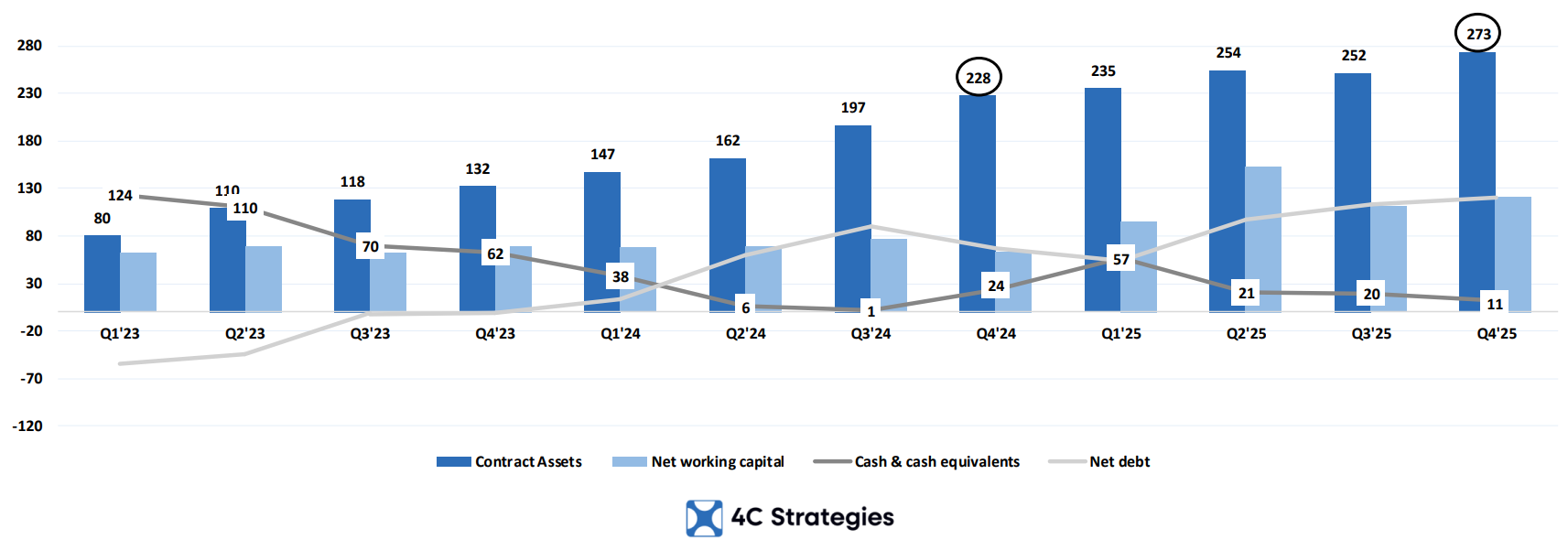
Approximately 50% of that SEK 332 million backlog is expected to convert to recognized revenue in 2026. The revenue recognition lag is the central accounting artifact that has caused the market to misprice this company. Order intake grew 32% in FY2025 to SEK 501 million. Revenue grew only 3%, to SEK 352 million. That divergence is not a sign of business deterioration. It is the direct result of IFRS 15 milestone-based revenue recognition applied to defense procurement contracts, where revenue is recognized at specific contract milestones rather than ratably. The earned but unbilled revenue sits on the balance sheet as “contract assets,” growing the asset base while suppressing reported revenue. The economic activity is real. The accounting timing is an artifact of how governments structure their contracts.
The US Beachhead: A Decade of Patience
The US market deserves its own section because it is both the largest opportunity and the most misunderstood element of the investment case.
The timeline tells the story of methodical, decade-long market entry.
2016 to 2018: Established Washington DC and Orlando offices. Obtained facility security clearances enabling 4C to handle classified information and pursue classified defense contracts. Began building relationships with the US Army training community at Fort Leavenworth and the Combined Arms Center.
2019 to 2021: Won subcontract through CESI on the US Army’s $192 million Synthetic Training Environment (STE) program. Gained initial operational credibility within the DoD procurement ecosystem.
Late 2023: Hired Brigadier General (Ret.) Guy Jones as President, North America Defense. Jones brought direct relationships within the Army training establishment and the credibility of a senior retired officer running evaluations for institutions where his former colleagues remain in command.
2024 to 2025: Continuing Resolutions blocked “New Starts,” freezing new software contracts regardless of commander demand. The October 2025 government shutdown froze deal conversions during the quarter where 4C expected its largest bookings. The dam broke in late 2025, contributing to the 50% backlog explosion. By then, the market had largely stopped paying attention.
2026: US Facility Clearance has been upgraded, enabling Prime contractor status on classified programs. Previously, 4C had to work through prime contractors as a sub. Prime status removes the intermediary, improves margin, and gives 4C direct relationships at the contracting level.
The US pipeline today: 130 potential Army and National Guard commands identified as addressable. 6 have signed. US ARR already exceeds SEK 30 million across four DoD organizations.
The theoretical US TAM is approximately $150 to $200 million annually, based on approximately 100 relevant commands at an average annual contract value of $1.5 million. A precise caveat on that number: if TRADOC (US Army Training and Doctrine Command) were to pursue a centralized enterprise license agreement, the bottom-up math could compress significantly. The realistic near-term transformative target is not $150 million. It is $20 to $40 million in US ARR, which would represent roughly 4x the current US ARR base and a step-change in the revenue mix. Even that more conservative target would dramatically change 4C’s growth profile and valuation.
The frustration, and the reason the stock has been punished, is that US federal budget mechanics have repeatedly throttled conversion. But the contracts were never at risk. The work continued. The invoices queued. The bureaucracy eventually processed them.
The AI Integration: What 4C Built, and What Its Partners Built
In late 2023, 4C signed a memorandum of understanding with Hadean, a UK-based spatial computing company backed by Epic Games. By April 2024, the partnership had produced a live product.
Here is what the integrated system does: generative AI automates the “White Cell,” the group of human operators who traditionally populate military exercises with realistic civilian activity, social media chatter, and adversary behavior. Hadean’s PopulAI engine generates the AI-driven civilian traffic patterns, social media panic, and virtual riots. Hadean’s physics engine calculates the real-world consequences of military decisions. Exonaut manages the exercise timeline (the Main Events List and Main Incidents List), the scenario injection, and the auto-grading of unit performance against NATO doctrine.
Credit where it is due: the generative AI and spatial computing engine driving this capability is Hadean’s technology. The 3D simulation is provided by MAK VR Forces. In the December 2025 UK SJFHQ exercise, the overall delivery was managed by MASS as prime contractor. 4C’s role in this federated architecture is specific and important, but it is not the entirety of the stack. Exonaut is the platform that ties the components together for exercise design and doctrinal evaluation. It is the administrative and evaluative layer, not the AI engine itself.
The product delivered to the UK MoD is called JCAST, Joint Command and Staff Training. The result: approximately 70% less human manpower required to run a full-scale command exercise. A note of analytical rigor: the 70% figure comes from a specific command-post pilot study for the JCAST UK MoD contract, not army-wide deployments. But the mechanism for savings is validated and meaningful. The traditional White Cell, a large team of human operators who manually simulate civilian traffic, adversary social media, and non-combatant behavior, represents the single largest labor bottleneck in military exercise design. The digitization of this function through generative AI eliminates that bottleneck.
The economic implications extend beyond cost savings for militaries. For 4C, an AI-integrated exercise product commands premium pricing relative to legacy database and consultancy offerings. The market is currently pricing 4C as the latter. The Hadean partnership is optionality priced at zero.
The Competitive Landscape Is Not What You Think
The instinctive objection is competition. Palantir, Anduril, and others dominate defense tech coverage. Surely they will eat 4C’s lunch.
The reality is more nuanced.
Palantir is not a competitor. It is structurally symbiotic. Palantir is Force Employment: it operates in the live operational environment, providing command and control for real-world missions. 4C is Force Generation: it certifies that units are ready before they enter the fight. These are different customers, different budget lines, different procurement offices, and different NATO command structures (Allied Command Operations versus Allied Command Transformation). The readiness scores that Exonaut produces could feed directly into Palantir’s operational picture. Where relevant, 4C has noted that Exonaut cooperates and shares data with platforms like Palantir. Competitive threat: zero.
Systematic/SitaWare is the most direct competitive threat, and requires the most careful analysis. SitaWare is the dominant C4ISR solution for several NATO land forces. Systematic has introduced “SitaWare Aspire,” a digital training platform that integrates directly with its C2 suite, allowing units to train within the same interface they use for combat operations. The “train as you fight” integration is a genuinely powerful value proposition. This threat should not be understated.
For many military planners, a built-in training tool native to their operational software may be preferable to integrating a separate third-party evaluation platform. The defensive case for 4C rests on an architectural distinction: Exonaut is vendor-agnostic evaluation, whereas Aspire is system-specific instruction. Exonaut does not teach soldiers how to use SitaWare. It evaluates whether a brigade met NATO’s doctrinal standards during an exercise, regardless of which C2 system the brigade was using. The ability to grade a formation using SitaWare C2 and MASA simulation simultaneously, within a single evaluation framework, is a capability Systematic cannot replicate without abandoning its own product ecosystem. And in multinational NATO exercises where different nations bring different C2 systems, a vendor-agnostic evaluator is structurally necessary.
However, as Systematic adds more evaluation modules, the modularity moat will be increasingly tested. This is the competitive dynamic that bears closest watching: not whether Palantir eats 4C’s lunch, but whether the C2 incumbents grow backward into Force Generation faster than 4C grows forward into deeper NATO standardization.
MASA/SWORD is a French AI simulation engine that has partnered with 4C, using Exonaut as the administrative and evaluation interface on top of SWORD’s scenario generation. Partner, not competitor.
BAE Systems, CAE, MAK are 3D simulation engine providers. Exonaut bolts on top of all of them for NATO-accredited evaluation and grading. Complementary, not competitive.
Generic AI and big tech. Exonaut’s NATO Secret accreditation, combined with its air-gapped deployment capability and operational track record, creates barriers that generic AI cannot bypass. You cannot deploy cloud-based AI in a NATO Secret environment. You cannot prompt-engineer the doctrinal evaluation criteria for a multinational brigade exercise. The security accreditation alone takes years. The domain knowledge takes decades.
The biggest competitor? Excel spreadsheets and whiteboards. The majority of military training management globally is still done manually. This is not a sign of competitive pressure on 4C. It is a sign of how early the market is and how much greenfield opportunity remains.
Cash Flow and Capital Structure
The balance sheet is where the bear case finds its most legitimate ammunition, and it deserves an honest assessment.
Operating cash flow was negative SEK 47 million in FY2025. Cash fell from SEK 24.2 million to SEK 11.5 million. Net debt stands at approximately SEK 120 million. The company raised SEK 55 million in a directed share issue in March 2025 at SEK 17.50 per share, a price that now represents roughly a 50% premium to where the stock trades today. The dilutive nature of that raise, issued to institutional investors at prices that retail holders could not access and that have since been eroded by market weakness, is a legitimate grievance.
The core dynamic driving the cash burn is the contract asset build. Exonaut contracts are typically structured with milestone-based payment schedules aligned to government budget cycles and procurement procedures. 4C delivers the work, the revenue is earned economically, but the invoice cannot be submitted until the government counterpart signs the acceptance certificate. The government counterpart is a procurement officer who may be managing dozens of contracts across multiple fiscal years. Delays are structural, not exceptional.
The market is not wrong to be cautious here. The bank facility provides a bridge, not a fortress. If contract asset conversion delays persist into 2027, the liquidity position will require attention.
The evolving picture is more encouraging. Management has committed explicitly to cash-flow-positive operations in 2026. The SEK 40 million in annualized cost savings from the Q3 2025 Resilience restructuring are fully effective from Q1 2026. Approximately half of the SEK 332 million backlog is expected to convert to invoiced revenue in 2026. If both of those dynamics materialize, the working capital cycle begins to self-fund. The 2026 cash flow trajectory is the single most important monitoring variable for this investment.
The Resilience segment restructuring is worth understanding as a separate chapter. In Q3 2025, the CEO announced the elimination of roughly 30 positions, primarily in Resilience segment sales, marketing, and low-margin municipal consultancy delivery. The stock dropped 27% in a single day. The market read it as a sign of distress. The more accurate reading is that management chose to stop subsidizing a loss-making segment rather than continue reporting misleadingly blended margins. The SEK 8 to 9 million one-time restructuring charge produces SEK 40 million in annualized savings, a roughly 5-to-1 payback in under three months. The Resilience business that remains after the restructuring focuses on higher-margin software deployments for telecom resilience (the SEK 48 to 100 million PTS framework agreement), financial sector business continuity, and power grid operators, a better quality portfolio.
Shareholders and Management
The ownership structure is an underappreciated part of the thesis.
Andreas Hedskog, the founder and chairman, holds approximately 10 to 11% through Hedskog Equity. He has not sold. Martin Gren, co-founder of Axis Communications, the company that created the global IP camera market and sold it to a SEK 50 billion business, holds approximately 8 to 9% through Grenspecialisten. His continued stake, without any reduction during the sell-off, signals a specific hypothesis: that 4C is on the same trajectory from Nordic niche solution to global software standard that Axis followed. Klas Lindström holds approximately 8%.
Institutional shareholders include AP4 (the 4th Swedish National Pension Fund), TIN Fonder (Carl Armfelt and Erik Sprinchorn, a Nordic SaaS-focused fund with a track record of identifying software transitions early), Carnegie Fonder, Chelverton Asset Management (a UK small-cap specialist), Swedbank Robur, and Schroders.
Recent insider buying is notable because of the depressed price context. CEO Jonas Jonsson purchased shares in open market transactions in early March 2026. Board member Anders Fransson bought 50,000 shares at SEK 8.42 on March 10, 2026, bringing his holdings to 272,314 shares. These are not token gestures. When the CEO and a board member are buying in the open market at prices representing a 50% discount to the last institutional round, the directional signal is clear.
The selling pressure has come primarily from passive funds executing mechanical rebalancing, not fundamental selling. The March 2025 directed issue amplified retail frustration over dilution. For a company with SEK 250 million in ARR and 80% software gross margins, the fundamental unit economics remain intact despite the balance sheet noise.
On management, a notable board development: Magnus Hansson was proposed as a new board member in February 2026. Hansson is CFO of Karnov Group and was previously at Lime Technologies, both Nordic SaaS companies that navigated the transition from services-heavy to software-first revenue models. This is a specific, operational skill set, not a figurehead appointment.
The Financials
FY2025 results, which have not yet triggered the re-rating, tell the underlying story more clearly than the headline numbers suggest.
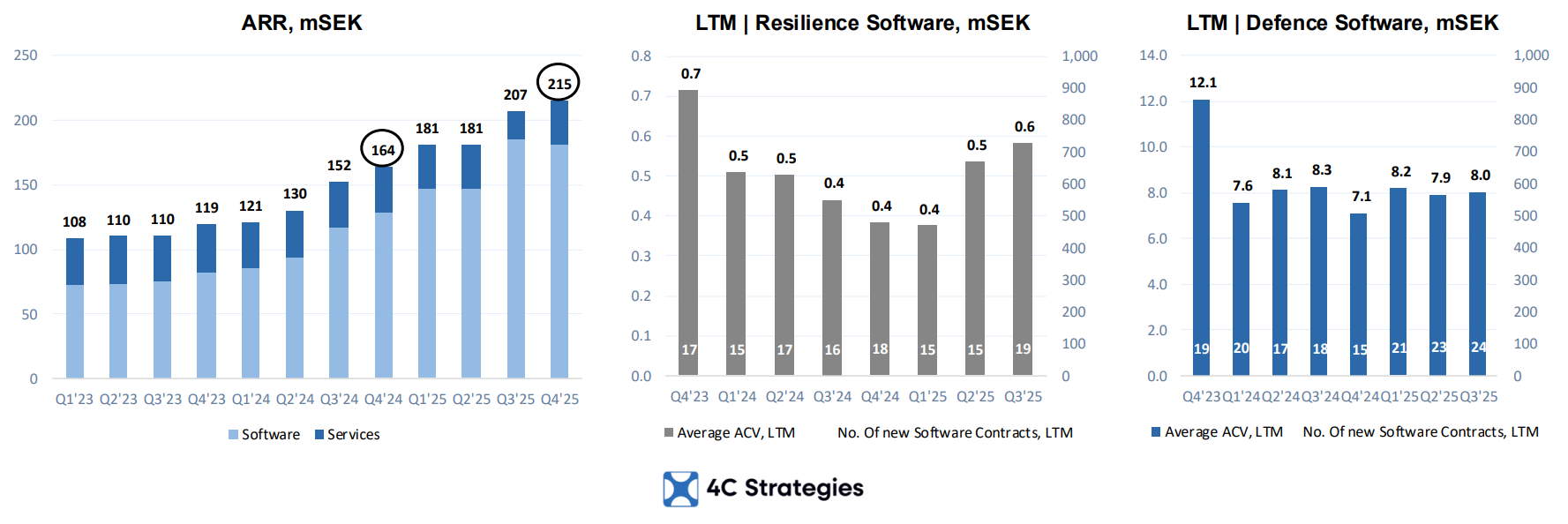
Net sales were SEK 352 million, up 3% nominally and 7% on an FX-adjusted organic basis. Order intake was SEK 501 million, up 32% year-over-year. The order book ended the year at SEK 332 million, up 50%. ARR reached SEK 250 million, up approximately 53% year-over-year. Software ARR specifically was SEK 181 million, and the software mix reached 74% in Q4 2025.
The EBIT story requires a careful read. The full-year blended adjusted EBIT margin was 2%, on SEK 8.6 million of adjusted EBIT. That number reflects a year during which the Resilience restructuring charge hit in Q3, US government shutdowns deferred deal conversions, and cost savings had not yet fully taken effect. The Q4 2025 adjusted EBIT margin was 21%, on a standalone basis. These two figures measure different things and should not be conflated: the 2% is the full-year blended result including the restructuring impact; the 21% is the Q4 run-rate on normalized volumes with software mix at 74%.
MetricFY2023FY2024FY2025Net SalesSEK 332MSEK 343MSEK 352MOrder IntakeSEK 358MSEK 380MSEK 501MOrder Book~SEK 180M~SEK 221MSEK 332MARR~SEK 115M~SEK 163MSEK 250MAdj. EBITNegativeNegativeSEK 8.6MAdj. EBIT MarginNegative-2%2% FY / 21% Q4
The headline story is the divergence between intake and revenue. Order intake grew 32% to SEK 501 million while reported revenue grew just 3%. This gap is entirely explained by IFRS 15 milestone-based recognition and the contract asset buildup described above. Q4 2025 provides a preview of what normalized quarters look like: 21% EBIT margins on SEK 185 million of order intake, with software representing 74% of revenue.
The Valuation
The core valuation question: if order intake is growing 32%, the order book is growing 50%, ARR is growing 53%, churn is below 2%, NATO is expanding the platform’s role, and the US Army is adopting it, why does the stock trade at 1.3x revenue when defense tech peers trade at 28x EBIT? The answer: post-IPO losses, a dilutive share issue at SEK 17.50 (now trading at approximately 8.70), a US government shutdown that froze deal flow, and the Q3 2025 Resilience restructuring that crushed sentiment. Those are solvable problems.
The scenario math is laid out in the earlier section. To restate it succinctly with the full table:
ScenarioFY27-28E RevenueEV/Rev MultipleImplied EVImplied Per ShareMuddle ThroughSEK 375M2xSEK 750M~SEK 14 to 17Base CaseSEK 450-500M3-5xSEK 1.35-2.1B~SEK 30 to 45Bull CaseSEK 550-650M4-6xSEK 2.2-3.9B~SEK 45 to 70+Blue SkySEK 800M+6-8xSEK 4.8B+SEK 100+
The muddle-through scenario is worth dwelling on. If revenue only reaches SEK 375 million on mid-single-digit growth, EBIT margin expands to just 8% as cost savings take hold but revenue disappoints, and the stock is assigned 2x EV/Sales, the implied equity value is roughly SEK 14 to 17 per share. That is 60 to 100% upside from the current price in a scenario that essentially assumes the business barely grows. That asymmetry is what makes this a compelling setup even for skeptics.
The base case does not require heroic US pipeline assumptions. It requires executing on the backlog already on hand. The bull case requires meaningful US Army adoption, even 10 to 15 commands beyond today’s 6. The blue sky scenario requires the US TAM to begin materializing at scale and the market to re-rate 4C as the defense readiness platform it is becoming, rather than the Nordic consultancy it used to be.
At roughly 1.3x EV/Sales, the current valuation prices in none of it.
The Case Against
Intellectual honesty requires a serious red team.
Cash and financing risk. Operating cash flow was negative SEK 47 million in FY2025. If the 2026 cash-flow-positive commitment fails, or if the government shutdown cycle repeats and defers cash collection again, the company may need to raise capital. Given the share price relative to the March 2025 issue price, any new raise would be highly dilutive. This is the bear case’s most powerful argument and should be taken seriously.
IFRS 15 lumpiness is not the whole story. The accounting artifact explanation is genuine and well-supported. But the contract asset balance is also growing, which means cash conversion has been slower than the bull narrative implies. The 2026 conversion thesis is testable, and Q1 and Q2 results will be the first evidence of whether it is materializing.
US political volatility. The largest growth market is hostage to federal budget cycles and government shutdown risk. The 2025 shutdown cost the company a quarter of conversions. This risk is structural, not exceptional.
Systematic/SitaWare. The “train as you fight” value proposition is real and the competitive encroachment from C2 incumbents is a genuine long-term risk. It has not materialized at scale yet, but “not yet” is not “never.”
Recruitment bottleneck. Scaling delivery requires personnel with military experience, software proficiency, and high-level security clearances, a genuinely scarce talent pool. This probably constrains growth rate more than the bull case assumes. 15 to 20% organic growth is more realistic than 25%+, which still works at current valuations but produces a lower terminal value.
Small-cap illiquidity. The stock is thinly traded, amplifying price swings in both directions. For institutional investors, the position-sizing constraints are real.
The genuine upside scenario requires all of the following to work in parallel: cash flow turns positive in 2026, the US pipeline converts at a meaningful rate, the Systematic threat remains contained, and no further dilutive capital raise is needed. Each of those is individually plausible. All four simultaneously is a tighter ask.
Conclusion
4C does not own NATO doctrine. No company does. But it has built the only accredited platform that operationalizes that doctrine into structured, digital evaluation frameworks, and it has twenty years of exercise data, readiness baselines, and assessment templates that no competitor can replicate without starting from scratch.
4C is not building a simulation engine. It is not building an autonomy platform. It is not competing with Palantir. It is building the evaluation layer that sits above all of them, the layer that determines whether the pilot is ready, whether the brigade is certified, whether the division can deploy. It integrates with every simulation engine. It grades performance against every doctrinal standard. It captures every lesson learned. And it has been doing this, quietly, for twenty years, accumulating the institutional memory of NATO’s collective training apparatus inside a single software platform.
2026 is the year the thesis either proves or breaks. The cash flow commitment is testable by Q2. The backlog conversion is visible in the order book. The US pipeline trajectory will be evident in new contract announcements. The restructuring payoff is already flowing through the cost base.
The market has assigned that layer a value of $30 million.
Something is wrong with the market’s math.
DISCLOSURE
Position: At the time of publication, the author owns 4C Group.
Trading Policy: The author will not materially alter this position within 48 hours of publication. After this period, the author may buy, sell, or otherwise adjust the position without further notice. Changes to the author’s view or position will be reflected in subsequent publications when material.
Conflicts: The author has received no compensation from the issuer or any party with a financial interest in this security.
Forward-Looking Statements: This report contains the author’s opinions, estimates, and projections, including price targets derived from financial models. These are forward-looking statements subject to substantial uncertainty. If these assumptions prove incorrect, the actual value may differ materially, including scenarios of significant loss or total impairment. The price target represents the author’s estimate of fair value under the stated assumptions, not a prediction of where the stock will trade.
This report is provided for informational purposes only and does not constitute investment advice. See the full Terms & Disclosures for additional important information.